
The number hiding in plain sight that changes everything about your child’s daycare experience
When parents start looking for daycare or preschool, the conversation usually goes straight to location, price, and curriculum. Those are all reasonable starting points. But there’s one metric that quietly shapes everything else about a child’s daily experience — and most parents either skip right past it or don’t fully understand what it means in practice.
That metric is the teacher-to-child ratio.
It sounds like an administrative detail. Something you’d find buried in a licensing document or mentioned briefly during a tour. But the more time you spend thinking about what actually happens inside a childcare classroom every day, the more you realize the ratio isn’t a footnote. It’s the foundation. And understanding it before you enroll your child anywhere could genuinely change the decision you make.
What the Teacher-to-Child Ratio Actually Means
At its most basic, the teacher-to-child ratio tells you how many children a single educator is responsible for at any given time. A ratio of 1:12 means one teacher for twelve children. A ratio of 1:8 means one teacher for eight.
Simple enough on paper. But let’s translate that into what a real Tuesday afternoon looks like inside each of those classrooms.
In a 1:12 room, one teacher is simultaneously tracking the location and safety of twelve toddlers. She’s managing at least three ongoing conflicts. She’s answering questions from multiple children at once. She’s keeping the activity moving while making sure no one is getting hurt, left out, or quietly disappearing into a corner. She’s doing all of this at the same time, every hour, all day.
She’s surviving. She’s not teaching.
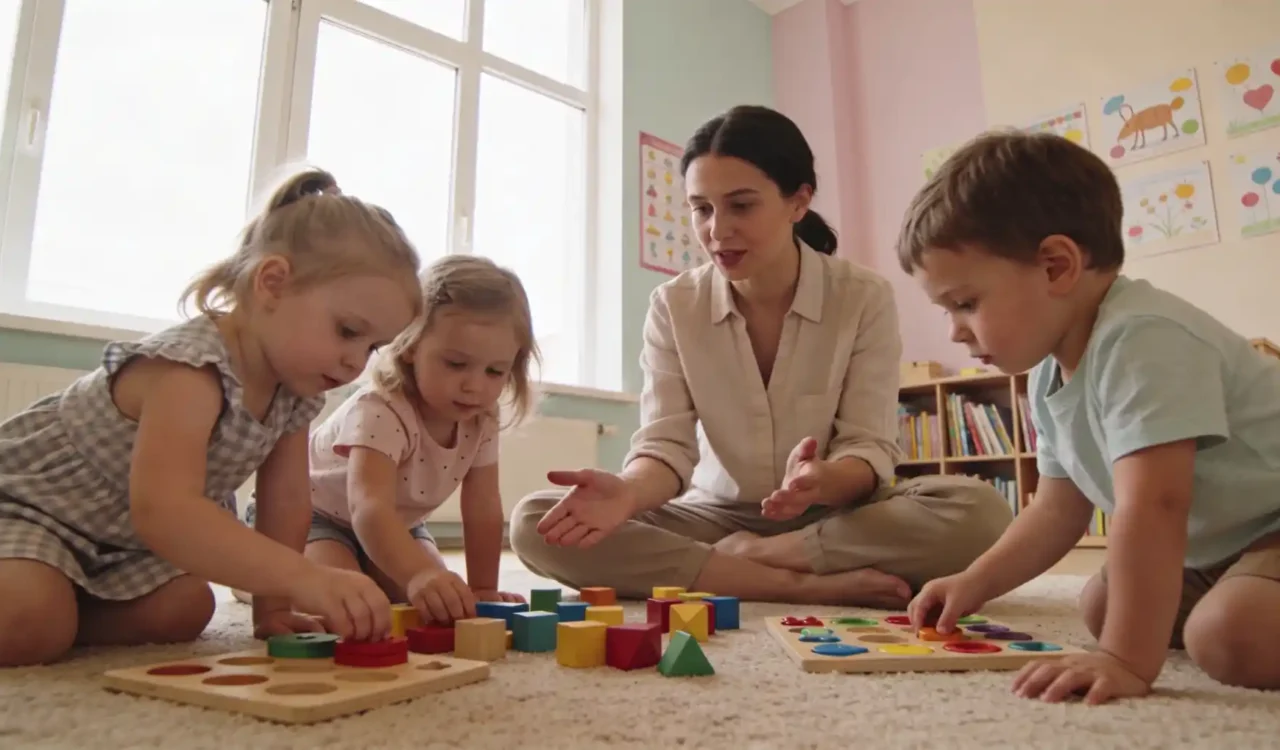
Drop the number to eight children and the entire texture of that classroom changes. The teacher isn’t in constant triage mode. She has enough bandwidth to actually sit with a child, follow their thinking, respond to what they’re saying, and catch the moments that matter — the small frustration before it becomes a meltdown, the quiet question that reveals a child is struggling, the breakthrough that deserves a real response rather than a distracted nod.
That difference — four children — is not a rounding error. Inside a real classroom, it’s the difference between being managed and being known.
The State Minimum Is a Floor, Not a Standard of Quality
California’s licensed ratio for preschool-age children is 1 teacher for every 12 kids. That number exists to prevent things from going badly wrong. It is not a quality benchmark. It is a legal minimum — the lowest permissible standard, not the recommended one.
Most centers in Orange County operate at or near that minimum. Some do it because budget requires it. Some do it because parents don’t know to ask otherwise. And because the websites and brochures rarely lead with ratio information, the metric stays invisible to most families until they’re already enrolled.
The research on this is consistent and clear. Studies from the National Institute of Child Health and Human Development have found that children in lower-ratio environments show measurably stronger language development, better social skills, and higher cognitive performance by kindergarten. The mechanism isn’t complicated: children learn through interaction with responsive adults. When one adult is stretched across twelve children, that responsiveness becomes structurally impossible.
A center that voluntarily maintains a lower ratio — below what the state requires — is absorbing real cost to do so. More staff, smaller group sizes, higher operating expenses. When a center makes that choice anyway, it’s telling you something important about its values. And those values tend to show up everywhere else in how the program is run.
How the Ratio Affects Your Child’s Day (More Than You’d Expect)
Beyond the obvious safety benefit — more eyes on fewer children — the teacher-to-child ratio shapes your child’s experience in ways that are surprisingly specific.
Language Development
The single greatest predictor of early language growth is the number of back-and-forth conversational exchanges a child has with an adult each day. Not passive listening. Not group instruction. Actual dialogue — where the child says something, the adult responds meaningfully, and the child responds again.
In a 1:12 classroom, those exchanges are rare. There simply isn’t time. In a 1:8 classroom, they become a natural part of the daily rhythm. And over weeks and months, that daily rhythm compounds into a significant developmental gap.
Emotional Regulation
Children between two and five are learning how to manage big feelings in real time. That process requires a trusted adult who can notice when a child is starting to dysregulate — before the meltdown, not after — and respond in a way that guides rather than just corrects.
A teacher managing twelve children cannot consistently do that. A teacher with eight can. Over time, children who receive that kind of responsive guidance develop stronger self-regulation skills than those who are simply managed through their emotions.
Individual Attention and Confidence
Every child has a different way of learning, a different pace, a different set of things they find exciting or challenging. In a large group, instruction gets aimed at the middle. The kids who are ahead get bored. The kids who need more time fall behind without anyone noticing.
A lower ratio makes genuine individual attention in preschool structurally possible. Not as an occasional bonus, but as a daily reality. Children who feel seen and responded to individually develop confidence in ways that group management simply cannot replicate.
What I Noticed When I Started Paying Attention to Ratios on Tours
I didn’t fully understand the ratio until I started touring centers with it front of mind. Once I did, the difference became impossible to ignore.
Centers operating at 1:12 had a particular energy. Busy. Loud in a reactive way. Teachers who were clearly doing their best but who were visibly stretched. Kids competing for attention in ways that were completely understandable given the math.
Then I toured Super Bees Academy in Costa Mesa. The ratio there is 1:8, maintained consistently — not just on paper, but in practice. The classroom I walked into felt different before I even had context for why. Calmer. More focused. The teacher wasn’t circling the room on patrol. She was actually sitting with a small group, building something, having a real conversation.
When I asked about it afterward, the director explained that maintaining 1:8 costs more and limits how many children they can enroll. They do it anyway because they believe it’s the right structure for actual learning. That answer — straightforward, unprompted, slightly at odds with their own financial interest — was more convincing than any brochure.
What to Ask Before You Enroll Anywhere
Once you understand the ratio, the follow-up questions become obvious. Here’s the list I’d recommend bringing to every tour in Orange County:
- What is your current teacher-to-child ratio, by age group? Ratios can vary by classroom. Infant rooms typically require lower ratios than preschool rooms. Ask specifically about the room your child would be in.
- Is that ratio maintained on days when a teacher is absent? The real test of a ratio commitment is whether it holds when maintaining it is inconvenient. A center that absorbs unexpected staffing gaps by redistributing children into already-full rooms isn’t actually committed to the ratio. It’s committed to the optics of the ratio.
- How many children are currently enrolled in my child’s classroom, and how many teachers are assigned to it? This gets past the stated ratio to the actual daily reality.
- Has your ratio changed in the past year? Enrollment pressure sometimes leads centers to quietly increase group sizes. Asking about change over time tells you whether the current number is stable or a temporary talking point.
- Do the same teachers stay with a classroom throughout the year? Consistency of caregiving matters almost as much as ratio. A low ratio with rotating staff still disrupts the attachment that makes the ratio valuable.
A center that answers all of these questions clearly, specifically, and without deflection is a center worth taking seriously. A center that gets vague, pivots to curriculum features, or can’t immediately tell you the number of children per teacher in each room — that’s important information too.
Beyond the Ratio: What Else to Evaluate Before Enrolling
The ratio is the most important single metric, but it’s not the whole picture. A few other factors that consistently separate good centers from genuinely great ones:
Staff Tenure
Ask how long the teachers in your child’s classroom have been at the center. High turnover — even in a low-ratio classroom — disrupts the continuity of care that young children need. Centers where teachers stay for years aren’t just experienced. They’re a sign of an environment people genuinely want to work in. That says something about leadership, culture, and the day-to-day experience of being inside that building.
Transparent Pricing
The stated weekly or monthly rate is rarely the full picture. Ask specifically about enrollment fees, supply fees, meal charges, and what happens to your rate as your child moves into a new age group. A center that gives you a clear, complete answer upfront respects your time and your budget. One that reveals fees gradually through the enrollment process is worth approaching carefully.
The Meal Situation
Hot meals prepared on-site signal more than just convenience — they indicate a level of investment in the whole child experience that tends to correlate with quality across the board. Mealtime in a well-run low-ratio classroom is genuinely relational. In an overcrowded one, it’s logistics.
What the Outdoor Space Tells You
A large playground is only as good as the supervision it receives. Ask how many adults are outside with children during outdoor time. Watch whether the playground is enclosed and maintained. A center that invests in quality outdoor space and staffs it properly is one that has thought carefully about the full arc of a child’s day — not just the structured learning hours.
The Centers That Do It Right Are Out There
I want to be honest about something: finding a quality preschool in Orange County that exceeds the state ratio minimum, offers transparent pricing, provides real meals, maintains a stable staff, and feels genuinely warm when you walk in — that combination is not as common as the marketing landscape suggests.
Most centers are decent. Some are genuinely great. The difference usually comes down to whether the people running the center are optimizing for enrollment numbers or for child outcomes. Those two goals are not always in conflict, but when they are, what a center chooses tells you everything.