
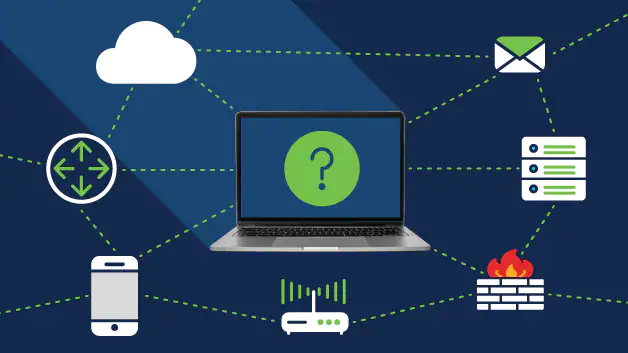
Network security and network administration are closely connected. Security teams may define policies and controls, but administrators make those controls real by configuring routers, switches, firewalls, wireless networks, identity systems, logging, backups, and monitoring. A secure network therefore depends on more than installing antivirus software or reacting to attacks after they happen. The original version of this article listed threats such as denial-of-service attacks, ARP poisoning, spoofing, rogue access points, packet sniffing, and physical attacks. Those threats are still relevant, but several of the suggested defenses were outdated, incomplete, or incorrect. For example, HTTP is not a secure protocol, MAC filtering is not a strong wireless-security control, and “hiding behind an Ethernet hub” is not a sensible way to detect a rogue access point. This updated guide explains modern network-security and administration principles using current NIST and CISA guidance, including the NIST Cybersecurity Framework 2.0, zero-trust concepts, phishing-resistant MFA, segmentation, secure configuration, monitoring, incident response, and recovery.
Network Security and Administration Are One Operational Discipline
Network security is the collection of policies, technologies, configurations, and operational practices used to protect networked systems and data from unauthorized access, disruption, misuse, alteration, or destruction. It includes: Identity and access control.; Firewalls and filtering.; Network segmentation.; Secure remote access.; Wireless security.; Encryption.; Monitoring and logging.; Vulnerability management.; Patch management.; Incident detection and response.; Backups and recovery.; Physical security. Good network security is layered. No single control is expected to stop every attack.
What Is Network Administration?. Network administration focuses on the day-to-day operation of the network. Administrators are responsible for availability, performance, configuration, access, troubleshooting, documentation, and often part of the security program. Typical responsibilities include: Configuring routers, switches, firewalls, and wireless controllers.; Managing IP addressing, DNS, DHCP, and VLANs.; Provisioning and removing user and device access.; Monitoring uptime and performance.; Applying firmware and software updates.; Maintaining configuration backups.; Reviewing logs and alerts.; Supporting incident response.; Documenting topology and dependencies.; Managing third-party and remote access. Security should be integrated into these tasks rather than treated as a separate project performed once a year.
NIST — Cybersecurity Framework 2.0 organizes cybersecurity risk management around Govern, Identify, Protect, Detect, Respond, and Recover. For network administrators, this helps prevent security from collapsing into a list of appliances: asset inventory, policy, identity, configuration, detection, incident response, and recovery all need owners and measurable processes.
Use NIST CSF 2.0 as a Risk-Management Structure
NIST released Cybersecurity Framework 2.0 in February 2024. It is designed for organizations of any size or sector and organizes cybersecurity outcomes around six functions: Govern; Identify; Protect; Detect; Respond; Recover. For network administrators, this creates a useful operating model. Governance defines responsibilities and risk tolerance. Identification maps assets and dependencies. Protection applies access controls and secure configuration. Detection uses logs and monitoring. Response manages incidents. Recovery restores services and improves the environment after failures.
Inventory Assets and Enforce Least Privilege
You cannot protect assets you do not know exist. A current inventory should include: Routers and switches.; Firewalls.; Wireless access points.; Servers and virtual machines.; Cloud resources.; User endpoints.; Printers and IoT devices.; Network-management systems.; VPN and remote-access infrastructure.; Critical applications and data stores. Inventory should include ownership, location, business purpose, software or firmware version, and criticality where practical. Unknown devices can create blind spots. Asset discovery should therefore be a continuing process rather than a spreadsheet created once and forgotten. Principle 2: Use Least Privilege. Least privilege means users, services, and administrators receive only the permissions required for their work. This reduces the damage caused by compromised credentials because an attacker who steals one account does not automatically gain access to the entire environment. Practical measures include:
Separate normal user accounts from administrator accounts.; Remove unnecessary privileges.; Review access periodically.; Disable unused or stale accounts.; Limit privileged network-management access.; Restrict service accounts to required systems.; Use role-based access control where appropriate. CISA — Require Multifactor Authentication recommends MFA as a high-value control for reducing account-takeover risk, especially for remote access, email, administrative accounts, and externally accessible services. The CISA — StopRansomware Guide reinforces that identity controls, backups, patching, segmentation, logging, and incident planning work together; no single firewall or endpoint product replaces the rest of the control system.
Strong Authentication and Identity Controls
Passwords alone are not sufficient protection for important systems. CISA recommends requiring multifactor authentication wherever possible and advises organizations to move toward phishing-resistant MFA. Stronger methods such as FIDO/WebAuthn security keys provide better phishing resistance than SMS codes. MFA should be prioritized for: Administrator accounts.; Remote access.; Email.; Cloud administration.; Network-device management.; VPN access.; Accounts with access to sensitive data. Cybercriminals often target executives and privileged users through social engineering. MyArticles’ guide to whaling attacks explains how highly targeted phishing can be used to steal credentials or manipulate senior employees.
Segmentation and Zero-Trust Thinking
Network segmentation divides systems into smaller trust zones rather than placing everything on one flat network. Segmentation can isolate: User workstations.; Servers.; Guest Wi-Fi.; Operational technology.; Payment systems.; Development environments.; Backup infrastructure.; IoT devices.; Network-management interfaces. Segmentation reduces lateral movement. If one user workstation is compromised, the attacker should not automatically be able to reach backup servers, domain controllers, or industrial systems. VLANs can support segmentation, but a VLAN by itself is not a complete security boundary. Routing and firewall rules must enforce the intended access policy. NIST — Zero Trust Networks emphasizes that network location should not automatically grant trust. Identity, device state, application context, policy, and continuous verification matter more than assuming anything “inside the LAN” is safe. Principle 5: Apply Zero-Trust Thinking. NIST describes zero trust as an approach that grants no implicit trust based solely on physical or network location. Access should be explicitly authenticated and authorized based on the user, device, resource, and context. Zero trust does not mean removing networks or buying one specific product. It means reducing assumptions such as:
“Anything inside the office network is trusted.”; “A VPN user can reach everything.”; “A managed device is safe forever.”; “Internal traffic does not need monitoring.”. Modern environments include cloud services, remote work, mobile devices, APIs, contractors, and SaaS systems, so perimeter-only security is not enough.
Secure Network Devices and Wireless Infrastructure
Routers, switches, firewalls, and wireless controllers are high-value targets. Poorly secured management interfaces can give attackers control over traffic flows. Administrators should: Change default credentials.; Use secure management protocols such as SSH and HTTPS.; Disable unnecessary services.; Restrict management interfaces to authorized networks.; Use MFA where supported.; Keep firmware updated.; Back up configurations.; Log administrative changes.; Use centralized authentication where practical.; Review vendor security advisories. The original article incorrectly listed HTTP as a secure protocol. HTTP sends data without transport encryption. Use HTTPS with properly configured TLS for web-based management and web applications. Principle 7: Protect Wireless Networks. Wireless security should not rely on hiding the SSID or filtering MAC addresses. MAC addresses can be observed and spoofed. Better controls include: Modern WPA2-Enterprise or WPA3 where supported.; 802.1X authentication for enterprise environments.; Strong credentials and certificate-based authentication where practical.; Guest-network separation.; Wireless intrusion detection or monitoring.; Removal of unauthorized access points.; Regular review of wireless configurations.
Centralize Logging, Monitoring, and Detection
Logs help administrators understand what happened before, during, and after an incident. Useful sources include: Firewall logs.; VPN logs.; Authentication logs.; DNS logs.; DHCP logs.; Endpoint security logs.; Cloud audit logs.; Switch and router logs.; Wireless-controller logs.; Application and server logs. Central collection can prevent an attacker from erasing the only local copy of evidence. Monitoring should prioritize meaningful events rather than generating so many alerts that administrators stop investigating them.
Patch, Prioritize Vulnerabilities, and Control Change
Network equipment and connected systems require regular updates. Old firmware can contain known vulnerabilities that attackers can exploit remotely. A practical process includes: Maintain an asset inventory.; Track vendor security advisories.; Scan systems for vulnerabilities.; Prioritize vulnerabilities based on exploitability and business impact.; Test updates where necessary.; Deploy patches within risk-based timelines.; Document exceptions.; Verify the fix. Critical internet-facing systems usually deserve faster action than isolated low-risk devices. NIST — SP 800-61 Revision 3 Incident Response Recommendations (2025) superseded the older Revision 2 and integrates incident response into CSF 2.0 risk management. The practical change is conceptual as well as procedural: preparation, detection, response, recovery, lessons learned, governance, and risk decisions are part of an ongoing program rather than a playbook opened only after an incident.
Prepare for Incidents Before They Happen
NIST finalized SP 800-61 Revision 3 in April 2025. The updated guidance integrates incident response with the six CSF 2.0 functions rather than treating incident handling as an isolated activity. Network administrators should know: Who declares an incident.; Who can isolate systems.; How evidence is preserved.; How to contact security leadership.; How to communicate if normal systems are unavailable.; How critical services are restored.; Where configuration backups are stored. Tabletop exercises are useful because they expose gaps before a real emergency.
Common Network Attack Patterns and Better Defenses
| Threat | What it does | Modern defensive approach |
|---|---|---|
| Denial of service / DDoS | Overwhelms services or network capacity | Upstream DDoS protection, rate limiting, CDN or scrubbing services, resilient architecture, provider coordination |
| Reflection/amplification | Uses spoofed requests and exposed services to multiply traffic | BCP 38-style source validation, secure DNS/NTP configuration, rate limiting, upstream filtering |
| ARP spoofing | Manipulates local address resolution to intercept or redirect traffic | Network segmentation, switch security features, DHCP snooping/dynamic ARP inspection where supported, encrypted protocols |
| Packet sniffing | Captures network traffic | TLS/HTTPS, SSH, VPN encryption, secure Wi-Fi, segmentation |
| IP spoofing | Uses forged source addresses | Ingress/egress filtering, stateful firewalls, authentication, anti-spoofing rules |
| Rogue access point | Introduces unauthorized wireless connectivity | Wireless monitoring, 802.1X, asset inventory, physical inspections, policy enforcement |
| Credential theft | Steals usernames and passwords | Phishing-resistant MFA, password managers, awareness training, identity monitoring |
| Physical attack | Accesses or damages equipment | Locked rooms/racks, access logs, cameras where appropriate, environmental monitoring |
Denial-of-Service and Traffic Spikes Are Not the Same. The original table treated a traffic spike almost as a security incident. Legitimate traffic spikes can happen because of a product launch, viral content, breaking news, or seasonal demand. The response may include: Autoscaling.; Content delivery networks.; Caching.; Load balancing.; Capacity planning.; Application optimization. A DDoS attack may look similar from a performance perspective but requires traffic analysis and attack mitigation. Administrators need observability that can distinguish legitimate demand from malicious traffic.
Smurf Attacks and Directed Broadcasts. Smurf attacks use ICMP echo requests sent to broadcast addresses with the victim’s spoofed source address, causing many hosts to reply to the victim. This attack was more prominent on older networks. Modern routers commonly disable directed broadcasts by default, but administrators should still ensure unnecessary broadcast forwarding is disabled and anti-spoofing controls are used. DNS Security. DNS is essential infrastructure and should be monitored and protected. Administrators should:
Avoid operating unintended open recursive resolvers.; Restrict recursion appropriately.; Patch DNS software.; Use rate limiting where appropriate.; Monitor unusual query patterns.; Protect administrative access.; Consider DNS filtering for known malicious domains.
Remote Access, Backups, and Physical Security
Remote work increases the importance of identity and endpoint security. Good remote-access design includes: MFA.; Encrypted connections.; Device-health checks where practical.; Restricted access based on role.; Session logging.; Shorter privileged sessions.; Protection against stolen credentials. A VPN should not automatically provide unrestricted access to the entire internal network. Backups and Recovery. Network administration must include recovery planning. Ransomware and destructive attacks can target backup infrastructure, so backups should not be reachable through the same credentials and trust relationships as ordinary production systems. Good practice includes: Multiple backup copies.; Offline or logically isolated copies.; Regular restore testing.; Configuration backups for network devices.; Documented recovery priorities.; Protected backup credentials. Physical Security Still Matters. Cybersecurity controls can be bypassed if attackers can physically reach sensitive equipment. Network closets, data centers, backup media, and administrative consoles should have appropriate physical controls. The level of control depends on risk, but options include locks, badge access, visitor records, cameras, tamper detection, environmental monitoring, and restricted console access.
Documentation, Change Management, and Recovery Readiness
Logical and physical network diagrams.; IP address plans.; Firewall rule documentation.; VLAN and segmentation maps.; Device inventory.; Configuration standards.; Change records.; Recovery procedures.; Vendor contacts.; Incident escalation contacts.; Remote-access architecture. Documentation should be protected but accessible during an outage. If all network diagrams are stored only on a server that becomes unavailable, they are not useful during recovery. Change Management. Many outages are caused not by attackers but by configuration errors. Security and availability both improve when changes are controlled. A change process can include: Document the proposed change.; Identify affected systems.; Assess security and availability risk.; Back up current configuration.; Schedule an appropriate maintenance window.; Test where practical.; Implement.; Verify expected behavior.; Record the final configuration.
A Practical Network-Security Checklist. Maintain an accurate asset inventory.; Use least privilege.; Require MFA, especially for privileged and remote access.; Move toward phishing-resistant MFA.; Segment sensitive systems.; Use encrypted management protocols.; Disable unused services.; Patch firmware and operating systems.; Centralize logs.; Monitor administrative activity.; Protect wireless networks with modern authentication.; Back up device configurations.; Test incident-response procedures.; Test restoration from backup.; Review firewall rules and stale accounts periodically. What are the most important network-security principles?. Asset visibility, least privilege, strong authentication, segmentation, secure configuration, encryption, continuous monitoring, vulnerability management, incident response, and recovery are among the core principles. Is a firewall enough to secure a network?. No. Firewalls are important, but modern attacks frequently use stolen credentials, cloud services, compromised endpoints, phishing, and trusted connections. Security requires multiple layers. Is MAC filtering good Wi-Fi security?. Not by itself. MAC addresses can be observed and spoofed. Use modern Wi-Fi encryption and authentication, with enterprise 802.1X where appropriate. What is the difference between segmentation and zero trust?. Segmentation separates network zones. Zero trust is a broader access model that avoids implicit trust and evaluates each access request based on identity, device, resource, and context. Segmentation can support zero-trust architecture. Why is logging important?. Logs provide evidence for troubleshooting, detection, investigation, and incident response. Without logs, administrators may know that something failed but not why or how an attacker moved through the environment.
Conclusion
Network security in 2026 is no longer about defending one trusted internal network from an untrusted internet. Organizations operate across offices, homes, cloud platforms, SaaS applications, mobile devices, contractors, and third-party services. Strong administration therefore combines reliable operations with cybersecurity risk management. Know your assets, limit privileges, require strong authentication, segment critical systems, secure management interfaces, patch vulnerabilities, centralize logs, prepare for incidents, and maintain recoverable backups. The original security issues—DDoS, spoofing, sniffing, rogue access points, ARP attacks, and physical access—still matter. The difference is that modern defense treats them as part of a broader system rather than matching each threat to one isolated tool.