
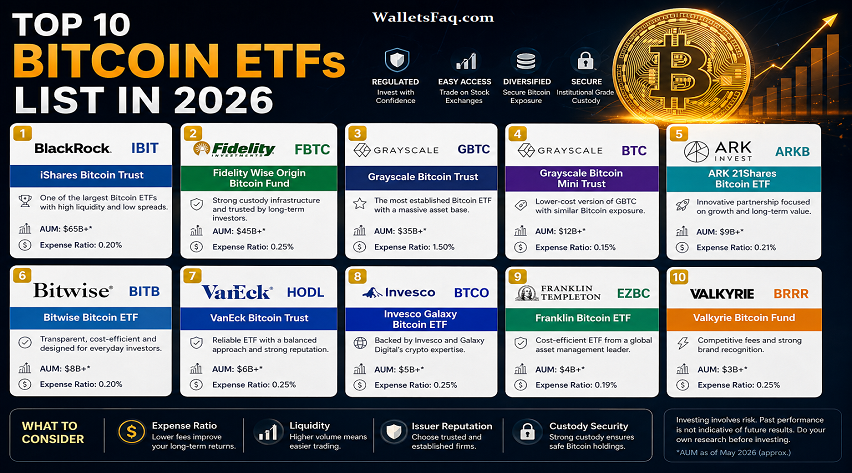
U.S. spot bitcoin exchange-traded products give investors a way to gain exposure to bitcoin through a brokerage account without directly managing private keys or transferring coins between wallets. They are often described as Bitcoin ETFs, although several are legally structured as commodity-based trusts or exchange-traded products rather than conventional funds registered under the Investment Company Act of 1940. The practical experience for many investors is still ETF-like: shares trade during U.S. market hours, the vehicle holds bitcoin through institutional custody arrangements, and the share price is designed to reflect bitcoin’s value minus fees and expenses.
This 2026 list focuses on ten large and widely followed U.S. spot products: IBIT, FBTC, ARKB, BITB, BTCO, EZBC, HODL, BRRR, GBTC, and BTC. It is not a ranking of which investment is “best,” because suitability depends on fees, liquidity, spreads, custody structure, trading platform, tax situation, and the investor’s tolerance for bitcoin’s extreme volatility. Readers comparing Bitcoin ETFs should verify current issuer information before trading because fees, assets, and market conditions can change.
The Main Spot Bitcoin Products in 2026
The iShares Bitcoin Trust ETF, IBIT, remains the largest U.S. spot bitcoin product by assets and trading activity. BlackRock’s BlackRock iShares IBIT page listed a 0.25% sponsor fee in August 2026 and showed tens of billions of dollars in net assets. Fidelity Wise Origin Bitcoin Fund, FBTC, is another large product backed by Fidelity’s digital-asset infrastructure, with current issuer information available through Fidelity ETF and ETP Data. ARK 21Shares Bitcoin ETF, ARKB, listed a 0.21% expense ratio in 2026 and remained one of the larger alternatives; investors can confirm current information at ARKB.
Bitwise Bitcoin ETF, BITB, competes partly on cost and crypto-market specialization. Invesco Galaxy Bitcoin ETF, BTCO, combines Invesco’s ETF platform with Galaxy’s digital-asset expertise, while the current issuer page for Invesco BTCO provides fee and trading details. Franklin Bitcoin ETF, EZBC, is offered by Franklin Templeton through Franklin EZBC. VanEck Bitcoin ETF, HODL, is available through VanEck HODL, and CoinShares Bitcoin ETF, BRRR, through CoinShares BRRR. Grayscale’s GBTC and lower-fee Bitcoin Mini Trust ETF, BTC, complete a widely watched group of ten.
Fees Matter, but Liquidity and Spreads Matter Too
Management or sponsor fees reduce returns gradually because they are deducted from the trust or fund over time. A difference of a few basis points can become meaningful for a long holding period, but the lowest advertised fee should not be the only decision factor. Investors who trade frequently may care more about bid-ask spreads and market depth, while very large positions may prioritize the ability to enter or exit without moving the market materially. IBIT’s scale, for example, has helped it develop very deep trading liquidity even though some competitors charge less.
A spot product can also trade slightly above or below its net asset value during the day. Authorized-participant creation and redemption mechanisms are designed to keep market price close to underlying value, but bitcoin trades continuously while U.S. securities markets have limited hours. Large overnight or weekend moves can therefore appear as gaps when the exchange opens. The fund’s share price is not guaranteed to equal the exact bitcoin price shown on a crypto exchange at every moment.
What You Own Is Different From Holding Bitcoin Directly
When you buy a spot bitcoin product, you own shares in the vehicle rather than bitcoin in a personal wallet. That removes the need to protect a seed phrase or manage on-chain transactions, which is convenient for brokerage and retirement accounts. It also means the investor depends on the product’s sponsor, custodian, operational controls, authorized participants, and legal structure. Direct holders control their own coins but accept personal responsibility for wallet security and transaction mistakes.
The ETF route can fit a diversified portfolio more easily from an account-administration perspective, but bitcoin itself remains a single volatile asset. Owning ten different Bitcoin ETFs does not create meaningful diversification because they are all designed to follow essentially the same underlying bitcoin market. Diversification comes from combining exposures whose risks are not identical, not from holding many wrappers around the same asset.
Custody, Tracking, and Tax Treatment Still Require Attention
Institutional custody can reduce some retail security problems but does not eliminate operational risk. Investors should understand who holds the bitcoin, how private keys are controlled, whether custody is concentrated with one provider, and what the prospectus says about theft, forks, market disruption, and valuation. Tracking difference can also arise from fees, operational costs, cash balances, and the exact benchmark used by the product.
Tax treatment depends on jurisdiction and account type, and U.S. spot bitcoin products can have different tax characteristics from registered stock or bond funds. Retirement-account access may make administration simpler for some investors, but account eligibility does not make bitcoin low risk. Anyone with a material tax question should use current product tax documents and qualified advice rather than relying on a generic article or crypto knowledge site.
How to Compare the Ten Products
A useful comparison starts with sponsor fee, average bid-ask spread, trading volume, assets under management, custody arrangements, benchmark methodology, and the investor’s brokerage platform. Larger funds may offer better liquidity, while smaller products may compete more aggressively on price. Brand reputation can matter for operational confidence, but it should not substitute for reading the prospectus and checking actual trading characteristics.
Investors should also distinguish spot bitcoin products from futures-based bitcoin ETFs and crypto-equity funds. Futures funds gain exposure through derivatives and can experience roll effects, while crypto-equity ETFs own companies such as miners, exchanges, or blockchain-service firms whose business performance can diverge sharply from bitcoin itself. A spot product is the most direct exchange-traded wrapper for bitcoin price exposure, but “more direct” does not mean safer.
Conclusion
The most important 2026 Bitcoin ETF choice is not finding a universal winner but deciding whether bitcoin exposure belongs in the portfolio at all. IBIT, FBTC, ARKB, BITB, BTCO, EZBC, HODL, BRRR, GBTC, and BTC all provide exchange-traded access to the same highly volatile underlying asset, with differences in fees, liquidity, custody, and structure. Compare current issuer data, understand what the vehicle owns, and judge position size in the context of overall financial risk. A low fee or famous sponsor cannot protect an investor from a large fall in bitcoin itself.