
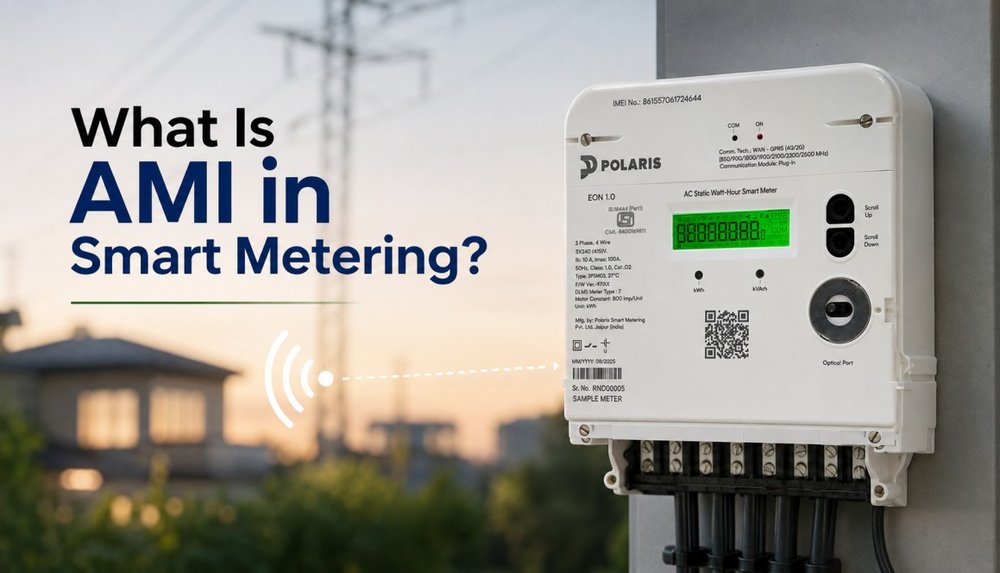
Anyone who has looked at an electricity bill and wondered how the utility actually knows how much power was used has run into AMI without realizing it. AMI stands for Advanced Metering Infrastructure, and it is the system that lets utility companies collect meter readings automatically, without sending someone door to door to check a dial. If a smart meter is already installed at a property, AMI is usually the technology working behind it.
Here is a plain look at what AMI actually is and why utilities have shifted toward it over the past decade.
The Old Way, and Why It Changed
Before AMI, meter reading was a manual job. Someone walked from property to property, wrote down the number showing on the meter, and moved to the next one. It worked well enough for decades, but it was slow, expensive to keep running, and prone to the kind of small errors that come from a person copying numbers by hand.
AMI removes that manual step entirely. A smart meter records usage at set intervals, often every fifteen minutes to an hour, and sends that reading back to the utility on its own. Nobody has to visit the property, and the data keeps flowing in the background.
The Pieces That Make Up an AMI System
AMI is not one single device sitting on a wall. It is a full system built from a few parts working together.
The smart meter itself sits at the property and measures electricity, gas, or water use. This is the part most people recognize, since it is usually the box mounted outside a home or building.
A communication network carries readings from the meter back to the utility. Depending on the setup, this might run over cellular networks, radio frequency mesh, or power line communication.
On the utility’s side, a data management system receives these readings, stores them, and turns them into something usable for billing, reporting, and grid planning.
What separates AMI from earlier systems is that the communication runs both ways. The meter sends data out, but the utility can also send instructions back, adjusting settings remotely or responding to an outage without dispatching a technician first.
AMI Compared to AMR
AMI often gets mentioned alongside AMR, or Automated Meter Reading, and the two are easy to mix up.
AMR came first. It allowed utilities to collect readings remotely, which was already a big step up from manual reading, but the communication only moved in one direction, from meter to utility. There was no way to send anything back.
AMI built on that by making the connection two way and by collecting data far more often. Instead of one reading a month, an AMI system can produce dozens of readings in a single day. That extra detail is what makes most of the benefits associated with smart metering possible in the first place.
Why This Actually Matters to Utilities
Automating meter reads is convenient on its own, but the real value shows up elsewhere.
Manual readings depend on a person recording the right number correctly, and that process naturally introduces errors over time. Automated collection removes most of that risk.
Because meters check in regularly, utilities can often detect an outage before a customer picks up the phone to report one. Detailed, frequent usage data also gives utilities a clearer picture of demand throughout the day, which helps with planning for peak periods instead of relying on rough monthly totals. It is also what makes time based pricing possible in the first place, since rates that shift by hour only work if usage is actually being measured in small intervals rather than once a month.
What Changes for the Person Paying the Bill
For most customers, AMI shows up mainly as better accuracy. Bills reflect real readings rather than estimates, and many utilities now offer an online portal where customers can check hour by hour or day by day usage, which makes it easier to see what is actually driving a bill up. It also cuts down on the kind of surprise bills that come from estimated readings based on averages. When a utility is working from actual data instead of a guess, there is a lot less room for that kind of error.
A Simple Way to Picture It
Imagine two neighboring homes with old style meters. Both bills are based on rough monthly estimates, and neither household has any real sense of when their electricity use actually spikes. Now picture the same two homes with AMI installed instead. The utility can see exactly when usage rises, whether that is evening cooking or an air conditioner running through a hot afternoon. That level of detail only exists because of the constant two way communication AMI provides.
Where AMI Fits Into the Bigger Picture
AMI is one of the core building blocks of what people call the smart grid. On its own, it might look like a more advanced way to read a meter. But once faster outage response, better planning data, and more accurate billing are added together, it becomes clear why so many utilities have moved toward it over the last several years. It is not a flashy piece of infrastructure, but it is the kind of system that quietly keeps the electricity, gas, or water grid running a little smarter than it used to.