
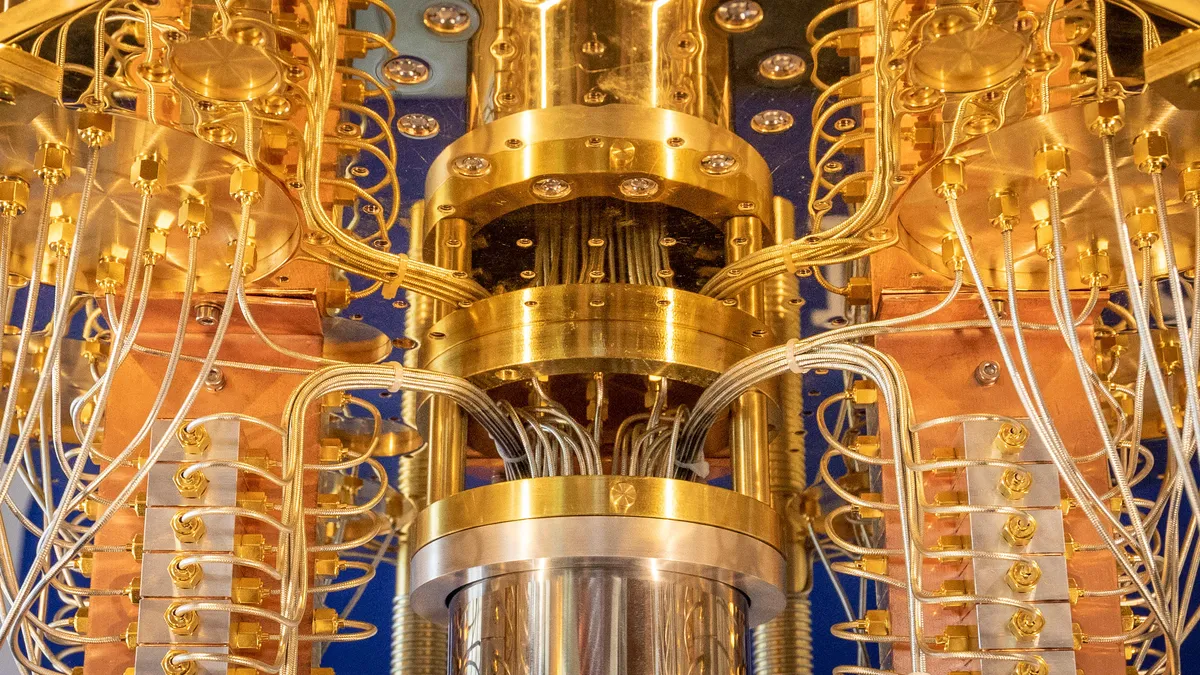
Quantum computers use quantum-mechanical effects to process information in ways that are fundamentally different from ordinary computers. They are not faster versions of laptops, and they are not expected to replace classical computing for everyday tasks. Their promise lies in a narrower idea: certain problems in physics, chemistry, materials science, optimization, and cryptography may be approached more efficiently when information is represented and manipulated through quantum states. In 2026, the field has moved beyond the earliest demonstrations but is still far from general-purpose, fault-tolerant quantum computing. Researchers can run increasingly large circuits, error-correction techniques have improved, and hybrid workflows increasingly combine quantum processors with classical high-performance computing. At the same time, noise, decoherence, hardware scale, control complexity, and the enormous cost of reliable logical qubits remain major engineering barriers. This distinction matters because quantum news is often reported as if one breakthrough means ordinary computers have become obsolete. A more accurate picture is that quantum computing is entering a period where useful scientific advantage can be demonstrated for carefully chosen tasks while classical CPUs and GPUs remain essential to almost every practical workflow. The likely future is quantum-centric supercomputing, where different processors perform the parts of a problem they handle best.
Qubits Are Not Just Classical Bits With More Values
A classical bit is usually represented as either 0 or 1. A qubit is described by a quantum state that can exist in a superposition of basis states until measurement. This does not mean the qubit literally stores every possible answer at once in a way that can simply be read out. Measurement produces classical outcomes, so useful algorithms have to manipulate probability amplitudes so that desirable answers become more likely. Interference is therefore as important as superposition. Quantum algorithms are designed so that amplitudes associated with some computational paths reinforce one another while others cancel. Entanglement adds another resource by creating correlations between qubits that cannot be described as independent classical variables. These properties give quantum computers a different computational model, not unlimited speed. Some problems may receive major advantages, while many ordinary tasks will remain better suited to classical hardware. Web browsing, spreadsheets, video streaming, databases, and most business applications do not become naturally faster merely because a quantum processor exists. Building a Qubit Is an Engineering Problem as Much as a Physics Problem: There is no single physical form of a qubit. Researchers use superconducting circuits, trapped ions, neutral atoms, photons, semiconductor spins, and other approaches. Each platform makes different tradeoffs in gate speed, fidelity, connectivity, manufacturing, cooling, control, and scalability. Superconducting systems used by companies such as IBM and Google operate at extremely low temperatures because heat can disrupt fragile quantum states. Those machines require dilution refrigerators, microwave control systems, shielding, calibration, and complex electronics. Other platforms may avoid some cryogenic requirements but introduce different engineering challenges. The central difficulty is decoherence: quantum information is fragile and interactions with the environment can destroy the state needed for computation. Even well-controlled systems experience gate errors, measurement errors, and qubit drift. The hardware problem is therefore not simply increasing the number of physical qubits; it is increasing the amount of reliable computation that can be performed before errors overwhelm the result.
Quantum Error Correction Is the Path From Physical Qubits to Logical Qubits
Fault-tolerant quantum computing depends on encoding one reliable logical qubit across multiple imperfect physical qubits. Error-correction codes detect and correct certain errors without directly measuring and destroying the encoded quantum information. The challenge is that this protection requires significant hardware overhead and very accurate control. Progress is measured not only by raw qubit count but by whether larger error-correcting codes actually reduce logical error rates. Google Quantum AI — Willow and Quantum Error Correction described a major 2024 milestone in which error rates decreased as the error-correcting code was scaled, a key requirement for practical fault tolerance. IBM’s longer-term target is a large-scale fault-tolerant system later this decade. The IBM Quantum Hardware and Fault-Tolerance Roadmap describes a path toward interconnected, modular systems and a fault-tolerant computer targeted for 2029. Roadmaps are plans rather than guarantees, but they show how strongly the industry has shifted from maximizing physical-qubit counts toward producing reliable logical computation.
2026 Brought Important Claims of Quantum Advantage
Quantum advantage means performing a useful or scientifically meaningful computation beyond what leading classical methods can practically achieve, not merely demonstrating a task designed to make a quantum device look good. The standard is demanding because classical algorithms and hardware continue improving, so any advantage claim must be compared with the best realistic classical alternative. In July 2026, IBM and researchers at the University of Chicago announced a demonstration they described as quantum advantage on logical circuits, using encoded computation and a method intended to establish confidence in results that are difficult to verify by brute-force classical simulation. The announcement is significant because trust and verification are central problems once a calculation moves beyond straightforward classical checking. IBM’s IBM Quantum Roadmap — 2026 had targeted scientific quantum advantage as a milestone for this period. The field should still be evaluated carefully: one advantage demonstration does not mean quantum computing is broadly superior to classical computing. It means researchers are beginning to identify specific regimes where quantum hardware can contribute something that leading classical methods cannot reproduce efficiently.
Quantum Computers Are Most Promising for Problems With Quantum Structure
Chemistry and materials science are natural targets because molecules and materials are quantum systems themselves. Accurately modeling electron behavior becomes extremely difficult as systems grow, and classical approximations can become computationally expensive. Quantum processors may eventually help calculate energies, reaction pathways, magnetic properties, or material behavior with greater efficiency for selected problems. Drug discovery is often mentioned in the same context, but claims should remain realistic. A quantum computer will not automatically “design a cure” from a molecular formula. Pharmaceutical discovery involves biology, toxicity, clinical testing, manufacturing, regulation, and many other stages. Quantum methods may become useful for particular chemistry or optimization subproblems inside that much larger process. Optimization and machine learning are other research areas, but advantage is not guaranteed. Many optimization problems already have powerful classical heuristics, and quantum machine-learning proposals often face data-loading and benchmarking challenges. The useful question is not whether a problem sounds difficult, but whether a quantum algorithm plus hardware can outperform the best classical method after total runtime and error are counted. Classical Computing Remains Part of Every Serious Quantum Workflow: Modern quantum systems depend heavily on classical computers. CPUs and GPUs compile circuits, optimize operations, control hardware, process measurements, run error-mitigation routines, and compare results with classical models. In practical research, quantum and classical computation are already intertwined. This is why the idea of quantum-centric supercomputing is more realistic than “quantum replaces classical.” A hybrid workflow can send only the quantum-sensitive part of a problem to a quantum processor while classical systems handle data preparation, simulation, optimization, orchestration, and post-processing. The relationship resembles other specialized computing trends. GPUs did not eliminate CPUs; they became powerful accelerators for workloads suited to parallel processing. MyArticles’ discussion of Edge AI and on-device intelligence shows a similar principle in another field: different computing architectures become valuable when they move the right workload to the right hardware.
Cryptography Is the Area Where Organizations Need to Act Before Large Quantum Computers Exist: A sufficiently capable fault-tolerant quantum computer could threaten widely used public-key cryptographic systems based on integer factorization and discrete logarithms. That future risk matters now because encrypted data can be collected today and stored until a stronger quantum computer exists—a strategy often described as “harvest now, decrypt later.” NIST has already standardized post-quantum cryptographic algorithms designed to resist attacks from both classical and quantum computers. The NIST — What Is Post-Quantum Cryptography? resource explains why migration is needed before a cryptographically relevant quantum computer arrives, while NIST — Post-Quantum Cryptography Standards and Migration provides the broader standardization and transition context. Organizations do not need to panic, but they do need crypto-agility. That means knowing where vulnerable algorithms are used, understanding which systems have long-lived confidentiality requirements, and designing software and infrastructure so cryptographic algorithms can be replaced without rebuilding everything from scratch. What Quantum Computers Still Cannot Do in 2026: Quantum computers cannot break all encryption today, replace cloud data centers, solve every optimization problem instantly, or run ordinary desktop software better than conventional machines. Current systems remain specialized research platforms with limited logical scale and significant engineering overhead. They also do not obtain correct answers simply by “trying every possibility simultaneously.” Quantum algorithms require carefully designed interference, and many problems do not have known quantum algorithms with meaningful speedups. Even when an algorithm offers theoretical advantage, physical hardware must be accurate and large enough to realize it. Another limitation is economic. Quantum systems are expensive to build and operate, require specialized expertise, and currently deliver value mainly through research, experimentation, and targeted scientific workflows. Cloud access allows universities and companies to experiment without owning the hardware, but broad commercial return still depends on discovering applications where quantum performance justifies the complexity.
How to Evaluate Quantum Breakthrough Claims
Quantum announcements are easier to interpret when several questions are asked. Was the task useful or mainly a benchmark? Was the comparison made against the best classical algorithm and hardware? Were error rates reported? Can independent teams reproduce the result? Does the claimed advantage include the full workflow or only the time spent on the quantum processor? Another useful question is whether the result scales. A demonstration can be scientifically important even if it is not yet commercially practical, but the distinction should be stated clearly. Quantum computing has enough genuine progress that it does not need exaggerated claims about replacing classical computers next year. Roadmaps should be read in the same spirit. Industry plans are valuable signals of engineering direction, but dates can move when hardware, fabrication, control, or error-correction milestones prove more difficult than expected. The best measure of progress is repeated improvement in reliable logical computation and applications that survive comparison with advancing classical methods. For organizations exploring the technology today, the sensible goal is capability-building rather than immediate replacement of existing systems. Teams can learn quantum programming models, experiment through cloud platforms, identify business problems with genuine mathematical structure, and track whether classical baselines are improving faster than the quantum approach. This creates useful institutional knowledge without assuming a commercial advantage before the evidence exists.
Workforce development matters for the same reason. Quantum computing combines physics, computer science, mathematics, control engineering, cryogenics, and software tooling, so successful programs usually require interdisciplinary teams rather than one “quantum expert.” Universities and companies are increasingly training people who can work across quantum and classical systems because hybrid architecture is likely to remain important even after fault tolerance improves. The organizations that benefit earliest may be the ones that learn where quantum adds value and where classical computing remains the better engineering choice. That practical judgment will matter more than adopting quantum technology simply because it is new, fashionable, heavily promoted, or commercially fashionable today.
Conclusion
Quantum computing in 2026 is entering a more mature phase. Qubit quality, error correction, logical circuits, hybrid workflows, and carefully defined advantage demonstrations matter more than raw qubit counts or futuristic marketing. Researchers are beginning to show tasks where quantum processors can contribute beyond leading classical simulation, but large-scale fault-tolerant computing is still under development. The most promising path is not a world where quantum computers replace ordinary machines. It is a computing ecosystem in which quantum processors work alongside CPUs, GPUs, and high-performance systems on problems suited to quantum methods. Chemistry, materials science, and selected optimization problems are important targets, while post-quantum cryptography is already an operational priority even before large fault-tolerant machines arrive. The field should be taken seriously without treating every announcement as a revolution. Quantum computers are becoming more capable, and 2026 has produced meaningful milestones, but their long-term value will depend on reliable logical computation, reproducible advantage, and applications that solve problems better than the best classical alternatives.