
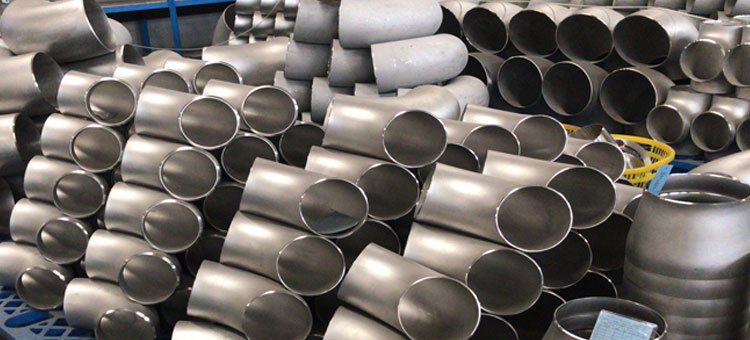
Inconel 625 is a nickel-chromium-molybdenum-niobium alloy used when process equipment must tolerate aggressive corrosion, demanding temperatures, and mechanical loads that ordinary stainless or carbon steel may not handle reliably. In chemical processing, that combination makes Inconel 625 pipe fittings useful in selected lines, reactor connections, heat exchangers, injection systems, pumps, valves, and offshore or seawater-related service. The alloy is expensive, so the engineering objective is not to specify it everywhere but to use it where corrosion failure, contamination, downtime, or replacement cost would be more expensive than the material premium.
The alloy’s performance comes from a balanced chemistry rather than one “magic” element. Nickel provides the matrix and broad corrosion resistance, chromium contributes oxidation and corrosion resistance, molybdenum helps in pitting and crevice-corrosion environments, and niobium strengthens the alloy without relying on the same precipitation-hardening system used in Inconel 718. The Special Metals — INCONEL Alloy 625 Technical Bulletin is a useful primary reference for composition, mechanical properties, corrosion data, and fabrication guidance.
Why Alloy 625 Is Valuable in Chemical-Process Piping
Chemical plants expose piping to combinations of chlorides, acids, wet gases, oxidizing and reducing conditions, pressure, heat, and contaminants that can change from one unit operation to another. Alloy 625 is attractive because it performs well across a broad range of corrosive environments, but it should never be described as immune to corrosion or suitable for every acid and alkali. Material selection still depends on exact chemistry, concentration, temperature, velocity, oxygen content, contaminants, crevice geometry, and expected service life.
This is why fittings deserve as much attention as straight pipe. Elbows, tees, reducers, branch connections, weld ends, socket-weld joints, threaded components, and flanges create local changes in flow, stress, crevice geometry, and fabrication history. A system that uses a corrosion-resistant pipe but poorly specified fittings can fail at the connection points. Related Pipe fittings should therefore be selected as part of the complete pressure boundary rather than treated as interchangeable accessories.
Typical Applications Include Heat Exchangers, Reactors, and Injection Systems
Heat exchangers are a common application because tubesheets, nozzles, channels, and fittings may face hot chlorides, seawater, process chemicals, and crevice conditions at gasketed joints. Reactor connections and process transfer lines can also benefit from Alloy 625 where the media would attack common stainless steels. In some vessels and large-diameter equipment, solid Alloy 625 may be too costly, so engineers use clad or weld-overlay construction while keeping fittings, nozzles, and localized high-risk components in the corrosion-resistant alloy.
Chemical injection systems are another logical use because small-bore piping can carry concentrated treatment chemicals whose leak or failure consequences are disproportionate to the pipe size. Offshore chemical-processing systems may combine chloride-rich seawater exposure with process chemicals, while flue-gas-desulfurization equipment can create wet, acidic, chloride-bearing conditions. Alloy 625 is also used in some sour-service and high-temperature applications, but those duties need review against the applicable materials, pressure-vessel, piping, and sour-service standards rather than relying on alloy reputation alone.
Welding and Fabrication Can Determine Corrosion Performance
Alloy 625 is generally considered weldable, but good results depend on qualified procedures, suitable filler metals, joint preparation, heat input, cleanliness, and welder skill. Gas tungsten arc, gas metal arc, and other approved processes may be used depending on component thickness and code requirements. Welding procedure qualification is important because a fitting can meet its material specification and still perform poorly if fabrication creates defects, contamination, lack of fusion, or an unsuitable weld profile.
Cleanliness is particularly important with nickel alloys. Tools contaminated by carbon steel can introduce embedded iron and surface contamination, while chloride-containing cleaners or residues can create avoidable corrosion risk. Dedicated stainless or nickel-alloy tools, clean work areas, appropriate surface treatment, and controlled handling reduce those problems. Engineers considering other Inconel applications should treat fabrication quality as part of material selection rather than assuming the base alloy alone guarantees performance.
Compare Alloy 625 With Real Alternatives, Not With a Generic “Stainless Steel”
316L stainless steel can be adequate and far less expensive in many services, while duplex and super duplex stainless steels may offer high strength and strong chloride resistance at a lower alloy cost in suitable conditions. Alloy C-276 can outperform Alloy 625 in some highly reducing or chemically aggressive environments. The best comparison therefore uses actual corrosion data, design temperature, pressure, weldability, availability, fabrication capability, and expected maintenance rather than selecting by alloy prestige.
Life-cycle cost often changes the decision. A fitting that costs several times more initially can still be economical if it avoids an unplanned shutdown, hazardous release, contamination event, or repeated replacement in an inaccessible location. Conversely, specifying Alloy 625 in a mild service can waste capital without adding useful reliability. The same principle applies to high-temperature service: the alloy must be matched to the actual temperature-dependent strength and corrosion mechanism rather than judged by room-temperature properties.
Procurement and Inspection Need Exact Documentation
Purchase specifications should identify the relevant fitting standard, alloy designation, dimensions, pressure class or schedule, end preparation, heat treatment where applicable, testing, and certification requirements. Material test certificates and traceability should connect each fitting to its heat or production lot. Positive material identification can help confirm alloy identity, but PMI is not a complete quality test; it does not prove dimensional accuracy, weld quality, heat treatment, surface condition, or mechanical performance.
Incoming inspection should therefore include documentation review, dimensions, visual condition, end preparation, surface cleanliness, markings, and any nondestructive examination required by the project. The broader collection of Special Metals — INCONEL Technical Bulletins can support engineering review, but supplier marketing should not replace project-specific corrosion and design analysis.
Conclusion
Inconel 625 pipe fittings are most valuable in chemical processing when corrosion resistance, temperature capability, and reliability justify their cost. They are commonly considered for corrosive process lines, heat exchangers, reactors, chemical injection, offshore systems, and other severe-service connections, but the alloy is not universally corrosion-proof. Successful use depends on matching the material to the actual environment, specifying the correct fitting standard, qualifying welding, controlling contamination, and inspecting the finished component. A lifecycle-cost comparison usually produces a better decision than choosing either the cheapest alloy or the most expensive alloy by default.