
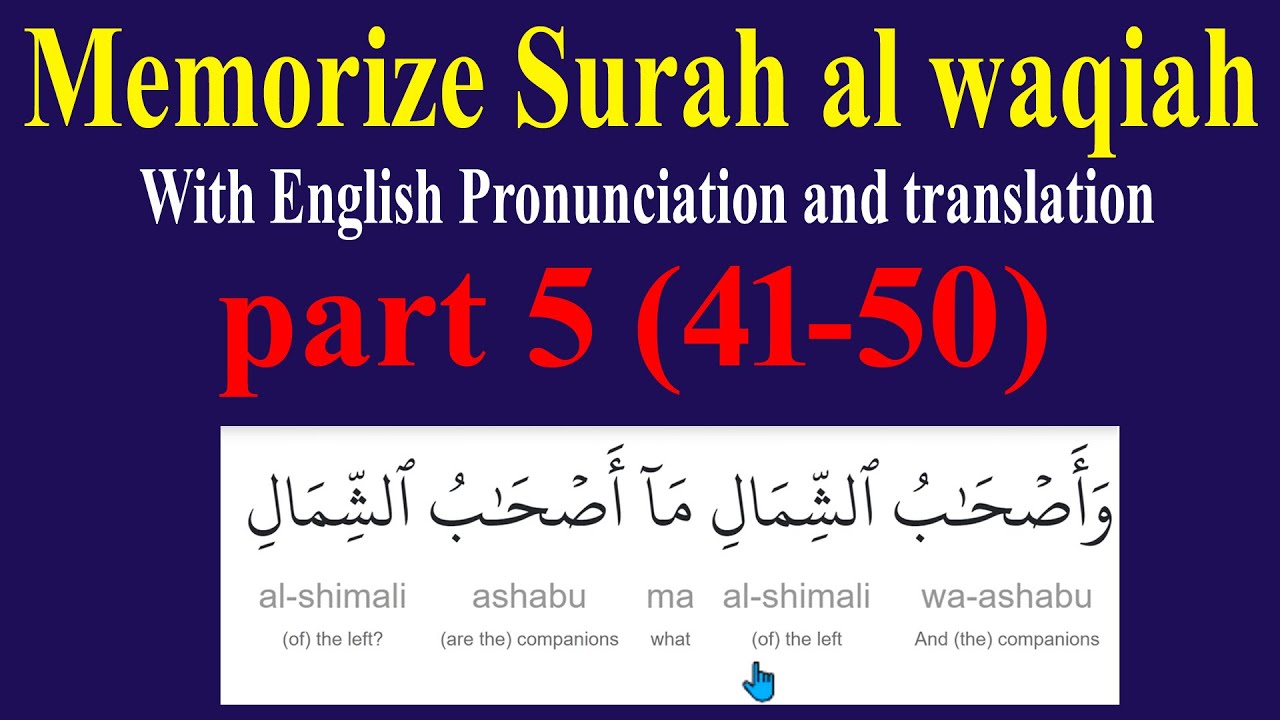
Surah Al-Waqiah is the 56th chapter of the Qur’an. Its name comes from the opening reference to “the Inevitable Event,” a description of the Day of Resurrection. The surah is commonly classified as Makkan and contains 96 verses. Its central message is not simply about fear of the afterlife. Surah Al-Waqiah presents a complete moral contrast between human life as it appears now and human reality as it will be revealed on the Day of Judgment. It asks the listener to think about resurrection, responsibility, gratitude, creation, death, and the certainty that worldly rank does not determine a person’s final standing before God. The surah is especially memorable because it divides humanity into three groups: the Foremost, the People of the Right, and the People of the Left. It then turns from the future to the present, asking people to reflect on ordinary realities they often take for granted—human reproduction, crops, water, and fire—as signs of divine power. Readers who want to follow the Arabic text and available translations can use https://surah-al-waqiah.com/ alongside a trusted Qur’an edition and recognized tafsir. This guide focuses on the structure, major themes, key questions, and practical reflections found in the surah without treating personal interpretation as a substitute for classical scholarship.
Al-Waqiah Begins With the Certainty of the Final Event
Surah Al-Waqiah is the fifty-sixth chapter of the Qur’an and takes its name from “the Event” or “the Inevitable Event,” referring to the final reality of resurrection and judgment. Readers can consult the Arabic text and translations at Quran.com — Surah Al-Waqiah, while https://surah-al-waqiah.com/ provides an additional reading resource. The surah opens by overturning ordinary assumptions about permanence, status and security: when the Event occurs, the familiar order of the world no longer defines who is truly elevated or brought low. The Arabic word al-Waqiah can be understood as the occurrence, the event, or the inevitable event. In the context of the surah, it refers to the Day of Resurrection. The opening creates a sense of certainty: this is not presented as a hypothetical possibility but as an event that will occur.
The Opening Theme: A World Turned Upside Down The surah begins with images of cosmic upheaval. It describes:
the earth being shaken;; mountains being broken down;; human ranks being reordered.. The message is clear: the structures people consider permanent are not permanent. Mountains, wealth, influence, status, and social hierarchy all belong to a temporary world.
The Three Groups Reframe Success, Rank and Accountability
One of the defining features of Surah Al-Waqiah is its division of people into three categories. 1. The Foremost The first group is commonly described as al-sabiqun—the foremost or those who are ahead. They represent people distinguished by closeness to God and excellence in faith and obedience. The surah describes them as brought near and given extraordinary reward. 2. The People of the Right The second group is the People of the Right. They are presented as people of salvation and blessing. The description of their reward includes: peace;; comfort;; shade;; fruit;; security;; honor.. 3. The People of the Left The third group is the People of the Left. Their condition is described through images of: heat;; distress;; punishment;; loss..
The contrast forces the listener to ask a personal question: Which direction is my life taking me? The Surah Changes How Status Is Measured Human societies usually measure status through: wealth;; family;; education;; profession;; political power;; fame.. Surah Al-Waqiah presents a completely different measure. The decisive categories are spiritual and moral. The person who appears powerful in worldly life may not be honored in the hereafter, while someone ignored by society may be among the people closest to God. The Foremost and the Idea of Spiritual Excellence The category of the Foremost encourages believers not to think only in terms of minimum religious obligation. There is a difference between: doing only what is required;; seeking excellence in faith, character, generosity, worship, and service..
The surah therefore contains both warning and aspiration.
Paradise and Punishment Make the Consequences of Moral Choice Concrete
The rewards described in the surah use imagery people can understand: gardens;; shade;; fruit;; comfort;; companionship;; peace.. These descriptions communicate security, abundance, dignity, and freedom from the difficulties associated with earthly life. Descriptions of Punishment The People of the Left are described through opposite imagery: scorching heat;; boiling water;; smoke;; distress.. The contrast gives moral choices a seriousness that is easy to lose during ordinary daily life.
Creation, Crops, Water and Fire Become Arguments for Resurrection
The middle of the surah turns from the Hereafter to ordinary realities that people see but do not control completely: human creation, crops, water and fire. The rhetorical force comes from asking the listener to consider dependence. People sow, drink, kindle and reproduce, but the deeper conditions that make life possible remain beyond individual command. This section therefore connects gratitude in the present with belief in resurrection rather than treating the natural world as a separate topic. After describing the hereafter, the surah asks listeners to consider things directly in front of them. The questions concern: human reproduction;; agriculture;; water;; fire.. The argument is powerful because these are ordinary experiences rather than abstract philosophical concepts. Reflection on Human Creation The surah asks human beings to think about their own origin. The basic idea is humility. People may become proud of: intelligence;; strength;; appearance;; achievements..
Yet they did not create themselves. Reflection on human origin challenges arrogance. Reflection on Crops and Agriculture People plant seeds and manage land, but they do not independently create life inside the seed. A farmer can: prepare soil;; plant;; irrigate;; protect the field.. But many factors remain outside human control. The surah uses agriculture to teach gratitude and dependence. Reflection on Water Water is another everyday necessity that people can easily take for granted. The surah asks people to consider the source of the water they drink. The reflection is not only theological. It also changes how a believer may think about: waste;; gratitude;; resource use;; dependence on creation..
Reflection on Fire Fire represents another basic human tool. It provides: heat;; light;; cooking;; industrial use.. The surah again asks the listener to look beyond human use of a resource and reflect on who created the underlying means by which it exists. Why These Four Examples Matter Human reproduction, crops, water, and fire together represent major dimensions of life: existence;; food;; drink;; energy.. The message is that the signs of divine power are not hidden only in extraordinary miracles. They are present in ordinary life. Resurrection and the Logic of Creation The surah’s reflections on creation also support its argument about resurrection. If God has the power to: create human life;; bring plants from seeds;; send water;; create the materials through which fire is produced,. then resurrection should not be dismissed simply because it lies beyond ordinary human experience.
Revelation, Death and the Limits of Human Control
The later verses move from the signs of creation to the status of revelation and then to the moment of death. The Quran.com — Tafsir Resources for Surah 56 can help readers compare interpretive explanations of difficult phrases and transitions. The death scene is especially important because it brings the surah’s argument into the most immediate human experience: when life is departing, family and witnesses may be physically present, but they cannot reverse the process by their own power. Later in the surah, attention turns to the Qur’an itself. The text emphasizes the seriousness and honored nature of revelation. This part of the surah asks the listener not only: “Do I believe there will be a Day of Judgment?” but also: “How do I respond to revelation while I still have time to act?” The Moment of Death One of the most emotionally powerful sections describes the moment when life reaches the throat. At that moment: family may be present;; medical help may be present;; wealth may exist;; social status may still exist..
Yet human control reaches its limit. Why the Death Scene Is Central The surah challenges people who behave as though they are completely independent. If human beings truly controlled existence, the text asks in effect, why can they not return life when death arrives? The question breaks the illusion of complete human control. The Three Groups Return at the End The closing returns to the three human outcomes. This creates a strong structure: Resurrection is announced. Human beings are divided into groups. Rewards and punishment are described. Creation is presented as evidence. Revelation is emphasized. Death is presented as unavoidable. The final outcomes are repeated.. A Surah About Reality, Not Escapism Surah Al-Waqiah does not tell the believer to ignore worldly life. Instead, it gives worldly life a correct scale. Work, family, wealth, and achievement matter, but they are not ultimate. The surah encourages people to live in the present while remembering accountability beyond it.
Wealth, Rizq and Gratitude Should Be Read Through the Surah’s Main Argument
Surah Al-Waqiah is sometimes circulated online primarily as a surah for increasing wealth, but the text itself is much broader and more serious. Its central movement concerns resurrection, accountability, the categories of humanity, signs of divine power, revelation and death. A reader may certainly connect the surah with gratitude for provision and dependence on God, but a claim that recitation mechanically guarantees material wealth goes beyond what the surah explicitly states. Surah Al-Waqiah is sometimes popularly associated with wealth or protection from poverty. It is important to separate the Qur’an’s actual message from claims circulated in popular devotional culture. The surah itself does not state that reciting it guarantees wealth or prevents poverty. Reports sometimes quoted for that claim have been discussed and disputed by hadith scholars. A believer may certainly recite the surah for worship, reflection, and spiritual benefit, but it should not be presented as a guaranteed financial formula. A Better Way to Understand Rizq The surah’s discussion of: crops;; water;; human life;; creation. can deepen awareness that provision ultimately depends on God. That spiritual understanding is different from promising a specific amount of money because someone recites the chapter a certain number of times.
A Better Way to Read the Surah Is to Follow Its Movement From Judgment to Creation to Death
One useful approach is to divide the surah into sections. Verses 1–26 Resurrection and the Foremost. Verses 27–56 The People of the Right and People of the Left. Verses 57–74 Signs in human creation, crops, water, and fire. Verses 75–82 The status of revelation. Verses 83–96 Death, final outcomes, and glorification of God. Questions to Ask While Reading What worldly things do I treat as permanent? What does the surah teach me about status? Where do I see ingratitude in my daily habits? Which ordinary blessings do I overlook? Do I behave as though death is far away? What would it mean to become spiritually “foremost”?. Surah Al-Waqiah and Gratitude Gratitude in the surah is not only verbal. Reflection on food and water can lead to:
less waste;; greater appreciation;; charity;; humility;; awareness of people who lack basic needs.. Surah Al-Waqiah and Anxiety About the Future The surah does not promise that believers will avoid every worldly difficulty. Instead, it places worldly fear inside a larger framework. A believer may still face: financial hardship;; illness;; loss;; uncertainty.. But the surah reminds the reader that the final outcome is not determined by temporary difficulty. Surah Al-Waqiah and Environmental Awareness The Qur’anic signs of:
agriculture;; water;; fire. can also encourage responsible use of resources. Recognizing a resource as a blessing should make waste more difficult to justify. Use translation and tafsir together, especially for difficult verses. A useful study method can include: Read the Arabic if able. Read a reliable translation. Identify the major sections. Read a recognized tafsir. Write down questions. Connect themes with other Qur’anic passages. Reflect on personal application.. Use Tafsir for Difficult Verses A translation cannot reproduce every shade of Arabic meaning. Classical and contemporary tafsir can help explain: word choice;; historical context;; theological questions;; connections between verses;; interpretive differences.. Do Not Build Theology From Social-Media Clips Short clips can be useful reminders, but complex religious claims need stronger sources. For questions involving: hadith authenticity;; legal rulings;; doctrinal interpretation;; specific devotional practices,. consult qualified scholarship.
Conclusion
Surah Al-Waqiah presents life from the perspective of its final outcome. It begins by announcing an event that will overturn every temporary worldly hierarchy and ends by returning the listener to the certainty of death and accountability. Between those two points, it offers both warning and hope. The Foremost and the People of the Right receive descriptions of honor and peace, while the People of the Left face the consequences of denial and moral failure. The surah also refuses to let spiritual reflection remain abstract. It asks the reader to look at human birth, crops, water, and fire—ordinary realities that demonstrate dependence on God every day. Its practical lesson is therefore broader than fear of Judgment. It teaches humility, gratitude, moral seriousness, awareness of death, and the need to prepare for a reality that worldly success cannot cancel. For a deeper study, read the Arabic text alongside a reliable translation and recognized tafsir, and treat popular claims about special material rewards carefully unless they are supported by sound scholarship.