
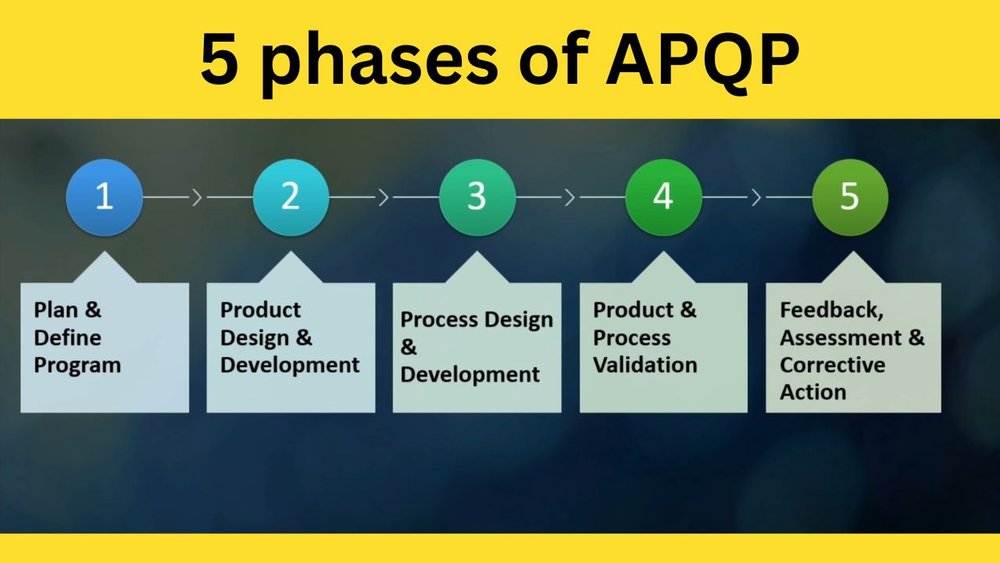
Advanced Product Quality Planning, or APQP, is most effective when it is treated as a cross-functional launch system rather than a paperwork requirement. The purpose is to reduce product and process risk before full production begins by connecting customer requirements, design decisions, manufacturing feasibility, supplier readiness, process controls, validation, and launch feedback. Organizations can complete every form in an APQP file and still fail if the documents do not reflect real engineering decisions. The current reference point for automotive organizations is AIAG: Advanced Product Quality Planning (APQP) 3rd Edition, which updates the framework and places greater emphasis on risk management, change management, sourcing, metrics, and gated reviews. Successful implementation therefore begins with ownership, evidence, and decision discipline rather than with a checklist of documents that teams rush to complete before an audit or customer review.
Build APQP Around Cross-Functional Ownership
APQP should bring together product engineering, manufacturing engineering, quality, purchasing, supply chain, production, maintenance, logistics, and other functions that affect launch readiness. Each deliverable needs an accountable owner, a required completion date, and a clear relationship to the next decision. The team should understand which customer requirements are critical, which technical risks could prevent compliance, which process characteristics need control, and which suppliers influence those outcomes. The broader AIAG: Quality Core Tools framework is useful because APQP is connected to DFMEA, PFMEA, control plans, measurement-system analysis, statistical process control, and PPAP rather than operating separately from them. When these tools are managed independently, contradictions appear easily: a high-risk failure mode may not reach the control plan, or a special characteristic may be measured with an inadequate gauge.
Weak APQP systems usually fail at the handoffs between functions. Engineering may release a drawing without confirming that the chosen tolerance can be manufactured consistently. Purchasing may select a supplier before quality and engineering have evaluated process capability. Production may receive equipment or tooling too late for meaningful trial runs. Quality may prepare inspection plans after process decisions are already fixed. These failures often appear as late design changes, repeated trial builds, missed capability targets, excess sorting, premium freight, or delayed PPAP approval. A stronger system uses formal gate reviews to ask whether the evidence is sufficient to proceed. A gate should not be passed because the scheduled date has arrived. It should be passed because major risks have owners, open issues have defined actions, feasibility has been demonstrated, and the next phase can begin without depending on assumptions that nobody has validated.
Planning and Product Design Need Early Feasibility
The planning stage should translate customer needs into measurable requirements and identify risks while changes are still relatively inexpensive. Teams should understand intended use, regulatory or customer-specific requirements, reliability expectations, lessons from similar products, special characteristics, capacity assumptions, packaging needs, and timing constraints. Product design then needs to be reviewed through the lens of manufacturability as well as function. A design can be technically correct yet difficult to produce repeatedly if tolerances are unnecessarily tight, inspection access is poor, materials are unstable, or critical dimensions depend on several uncontrolled process variables. Design reviews and DFMEA should therefore involve manufacturing and quality early enough to influence the solution. The goal is not simply to complete a DFMEA form but to use risk analysis to change designs, add prevention, improve detection, or create evidence that the remaining risk is acceptable.
Feasibility should be evidence-based. If a team says a tolerance can be held, it should understand the process capability, measurement method, equipment condition, tooling strategy, operator influence, and environmental conditions that support that statement. Prototype and pre-launch builds can reveal assembly problems, ambiguous specifications, supplier variation, cycle-time constraints, and inspection difficulties before production volumes make those problems expensive. Changes during this phase should also be controlled carefully because updates to drawings, specifications, software, tooling, or supplier processes can invalidate earlier analyses. APQP 3rd Edition’s increased emphasis on change management reflects this practical reality: an approved plan is only useful while the underlying design and process remain the same. Every significant change should trigger review of the affected risk analyses, controls, validation evidence, and customer requirements.
Process Design Must Connect Flow, Risk, and Controls
Process development should begin with the actual manufacturing sequence. The process flow diagram needs to represent how material moves through receiving, storage, operations, inspections, rework, subcontracted processes, packaging, and shipment. The PFMEA should then analyze failure modes within that real flow, not a simplified version created only for documentation. High-risk process causes should lead to prevention or detection controls that appear in the control plan and are supported by appropriate work instructions, error proofing, maintenance, and measurement systems. This linkage is central to APQP. If the PFMEA identifies a serious risk but the control plan contains no corresponding control, the system is incomplete. Likewise, if the control plan requires a measurement that the gauge cannot perform repeatably, the documented control provides little protection. APQP works when each core tool supports the others and the shop-floor process reflects what the documents say.
Supplier readiness deserves the same discipline because a capable internal process can still fail if purchased parts, tooling, raw materials, or outsourced operations are unstable. Supplier decisions should consider technical capability, capacity, quality history, change control, traceability, sub-tier risk, timing, and the evidence required before production approval. Capacity planning should also distinguish theoretical machine rates from demonstrated production performance. Run-at-rate or equivalent production trials can expose downtime, staffing constraints, tool wear, bottlenecks, changeover losses, and material-handling problems that are invisible in spreadsheets. The team should evaluate whether normal production conditions can repeatedly meet quality and volume requirements, including realistic scrap and maintenance assumptions. If launch depends on overtime, manual sorting, temporary inspection, or unusually high management attention, the process may not yet be stable even if the first parts meet specification.
Validation and PPAP Should Prove Readiness
Product and process validation should demonstrate that the complete system can produce conforming output under intended conditions. PPAP is part of that evidence, not merely a package assembled at the end. Dimensional results, material and performance tests, capability data, measurement-system studies, control plans, process flow, FMEAs, appearance requirements where applicable, and customer-specific evidence should tell a consistent story. If capability is weak, the response should not be to hide the result behind extra inspection without addressing the cause. Temporary containment may be necessary during launch, but permanent readiness requires process improvement. Teams seeking formal APQP training should therefore learn how the core tools connect and how evidence supports gate decisions rather than memorizing the names of forms. The original training resource at https://www.excedify.com/courses/apqp-training remains relevant to that practical learning objective.
APQP does not end when the customer approves PPAP or when standard production begins. Early production should be monitored closely for scrap, rework, customer complaints, warranty signals, downtime, capability drift, supplier defects, premium freight, and deviations from the intended control plan. Launch feedback should be converted into corrective action and lessons learned that improve future programs. Metrics should help teams understand whether risk is actually decreasing rather than simply whether documents are completed on time. Useful measures include open high-risk actions, overdue gate items, capability attainment, first-pass yield, supplier readiness, change volume, trial-build results, and launch defects. The AIAG: APQP 3rd Edition and Standalone Control Plan Overview provides useful context for the revised framework and the stronger separation of the Control Plan as its own reference.
Conclusion
Successful APQP implementation depends on the quality of decisions made before production, not the thickness of the final file. A strong system connects customer requirements to design risk, manufacturing feasibility, supplier capability, process flow, PFMEA, measurement systems, control plans, validation, PPAP, and launch feedback. It assigns real owners, uses evidence-based gate reviews, controls changes, and refuses to treat temporary containment as proof of a stable process. Training is valuable when it teaches why the core tools connect and how information should move from one tool to another. Organizations that use APQP this way can identify problems while design and process changes are still manageable, reduce expensive launch disruption, and create a clearer basis for customer approval. The central discipline is simple: every requirement should be understood, every important risk should be controlled, and every claim of readiness should be supported by evidence from the actual product and production process.