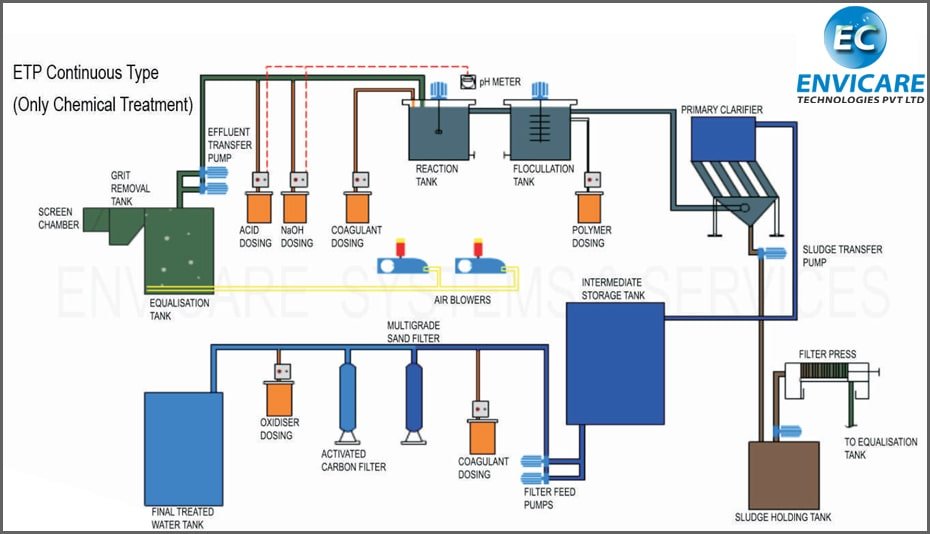
An Effluent Treatment Plant, or ETP, is a system designed to treat industrial wastewater before it is discharged, reused, or sent to another treatment facility. Industrial effluent can contain suspended solids, oils, acids, alkalis, organic matter, heavy metals, salts, solvents, color, nutrients, or other pollutants depending on the process. Because no two factories produce exactly the same wastewater, an ETP should be designed from real influent data rather than copied from a generic flow diagram.
Companies selling an Effluent Treatment Plant may offer standard modules, but the treatment sequence must still match the pollutants and discharge requirement. In India, the Central Pollution Control Board and State Pollution Control Boards or Pollution Control Committees regulate industrial discharges through sector-specific standards and consent conditions.
Wastewater Characterization Comes Before Equipment Selection
Design begins by measuring flow and sampling wastewater across a representative production cycle. Important parameters can include pH, BOD, COD, suspended solids, oil and grease, dissolved solids, nutrients, metals, temperature, toxicity, and sector-specific chemicals. Peak loads matter as much as average values because a treatment plant can fail during a short production upset even if the daily average looks acceptable.
Source segregation can reduce cost significantly. A small high-strength stream may require special treatment rather than being diluted into the entire wastewater flow. Clean cooling water, stormwater, concentrated chemical waste, and biodegradable process wastewater should not automatically be mixed simply because all of them eventually leave the same site.
Preliminary and Physicochemical Treatment Remove the First Pollutant Load
Screens remove large debris, oil traps or dissolved-air flotation can separate oils and floatable solids, and equalization tanks smooth out changes in flow and concentration. pH adjustment prepares the wastewater for later treatment, while coagulation and flocculation can destabilize fine particles so they settle or float more easily.
Primary clarification separates settled solids from water. The chemical doses should be optimized through testing rather than increased blindly because excessive chemical use raises sludge production and operating cost. Good equalization and pH control often determine whether downstream biological treatment remains stable.
Biological Treatment Removes Biodegradable Organic Pollution
Aerobic systems use microorganisms and oxygen to convert biodegradable organic matter into biomass, carbon dioxide, and water. This is where Blowers can become important because aeration may be one of the largest energy consumers in an ETP. Anaerobic treatment can be useful for high-strength biodegradable wastewater and may produce biogas, but it requires different operating conditions.
Biological systems need stable pH, suitable nutrients, appropriate temperature, and protection from toxic shock loads. A sudden chemical discharge can kill or inhibit the microbial population and cause treatment performance to collapse. Operators therefore need production communication and emergency storage rather than discovering an upset only after the final outlet fails.
Tertiary Treatment Depends on the Final Water Destination
After biological treatment and secondary clarification, filtration, activated carbon, membranes, disinfection, or other polishing steps may be used depending on reuse or discharge requirements. Reverse osmosis can remove dissolved salts and produce higher-quality water, but RO is not a complete ETP by itself because it transfers contaminants into a concentrated reject stream that still requires management.
Water intended for process reuse may require a different quality from water discharged to a sewer or surface-water body. The correct design target is therefore the actual final destination and applicable consent condition, not a generic number copied from another industry.
Sludge and Reject Streams Are Part of the Treatment Problem
An ETP does not make pollution disappear. Clarification produces sludge, membrane systems produce concentrate, and chemical treatment can create additional solids. These residuals need dewatering, characterization, storage, transport, and disposal according to their composition and regulatory requirements. Industrial sludge should not be assumed safe for compost or land application without appropriate analysis.
Mass balance helps operators understand where contaminants are going. If a pollutant is removed from water, it should appear in sludge, gas, recovered material, or another stream. Tracking this balance prevents the false impression that a good-looking final effluent automatically means the entire waste problem has been solved.
Compliance Standards Are Industry-Specific
The CPCB: Effluent and Emission Standards provides sector-specific information, and State Boards can impose conditions through consent orders. Industrial standards vary because textile wastewater, pharmaceuticals, food processing, metal finishing, and petrochemicals produce different pollutants. Some receiving environments may also justify stricter requirements than a broad national baseline.
This is why articles about general wastewater treatment principles are useful for understanding pollution control but cannot replace the specific permit requirements that apply to a facility. Operators should keep current laboratory records, calibration data, flow measurements, chemical consumption, sludge logs, and required online monitoring records.
Reliable Operation Depends More on Management Than on One Piece of Equipment
Common ETP failures include inadequate equalization, wrong chemical dosing, overloaded biology, poor aeration, membrane fouling, missing spare parts, uncalibrated instruments, weak sludge handling, and operators who are not trained to recognize trends. A plant can be technically well designed and still fail if nobody monitors pH, dissolved oxygen, sludge condition, flow, or chemical inventory consistently.
Lifecycle cost should therefore be considered alongside purchase price. Energy, chemicals, membrane replacement, sludge disposal, labor, laboratory testing, and downtime can cost more than the original equipment over the life of the plant. Supplier guarantees should define influent range, treated-water target, flow, operating assumptions, and acceptance testing rather than promising one output quality under every possible factory condition.
Conclusion
An Effluent Treatment Plant works by matching a sequence of physical, chemical, biological, and tertiary processes to the actual pollutants in industrial wastewater. Good design begins with representative sampling and flow data, then addresses equalization, pH, solids, biodegradable load, dissolved contaminants, sludge, and the final discharge or reuse requirement. In India, CPCB and State Board standards make compliance industry-specific. The most reliable ETP is not the one with the most equipment; it is the one designed around real mass loads, operated by trained staff, monitored consistently, and supported by a clear plan for residual waste and process upsets.