
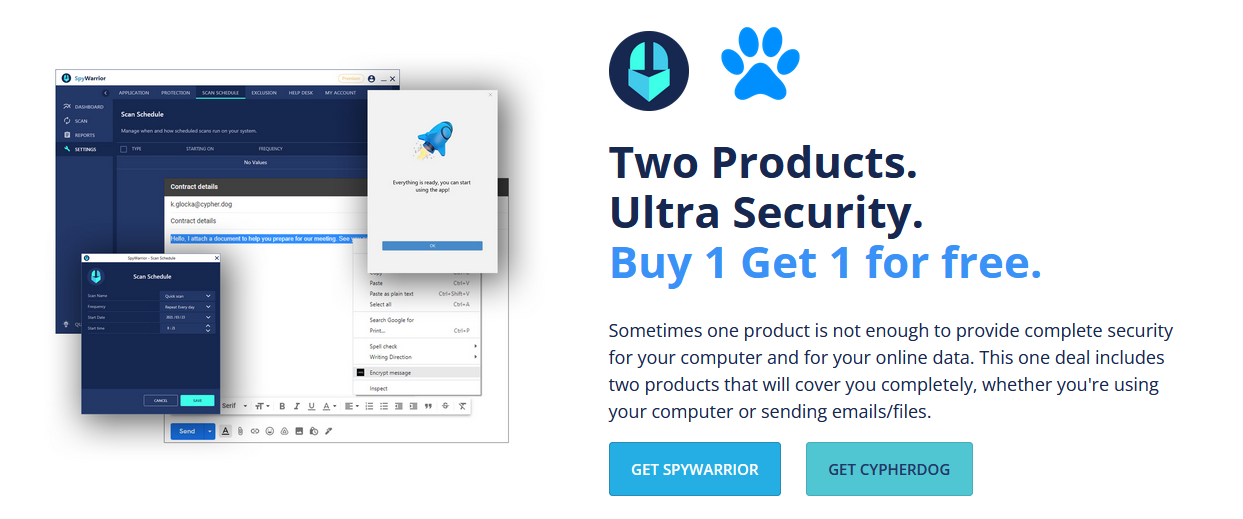
The SpyWarrior and Cypherdog bundle is an unusual security package because it combines two products that solve different problems. SpyWarrior is positioned as Windows anti-malware software, while Cypherdog is designed to encrypt message content and files so that unauthorized parties cannot read them. That combination can be useful, but only if buyers understand where each layer helps and where it does not. The original promotion was built around the phrase “SpyWarrior and Cypherdog are offering one of the best cyber deals in 2023.” That wording is now dated, yet the vendor’s bundle page was still live when reviewed in September 2026 and continued to display a €60 price for the package. Because software pricing, licensing and checkout availability can change independently of a marketing page, treat the displayed offer as something to verify at purchase time rather than a guaranteed long-term price. This review therefore focuses less on the old “deal” claim and more on the practical 2026 question: does pairing endpoint malware protection with content encryption make sense for your security needs?
The Bundle Covers Two Different Security Layers
A computer can be secure in one respect and exposed in another. Antivirus software may stop a malicious executable, yet it does not automatically protect a sensitive document after the document has been legitimately opened or emailed. Encryption can protect the contents of a file or message, yet it does not remove malware from an infected computer. The value of this bundle comes from that separation of roles.
| Layer | SpyWarrior | Cypherdog | What it does not replace |
|---|---|---|---|
| Endpoint malware defense | Primary role | Not its main purpose | Patching, backups, secure configuration |
| Ransomware risk reduction | Vendor advertises real-time and ransomware protection | Can reduce exposure of encrypted content, but does not stop ransomware execution | Offline/immutable backups and recovery planning |
| Email/file confidentiality | Limited | Primary role | Account security, MFA, anti-phishing controls |
| Key management | Not applicable in the same way | Critical to the security model | Documented recovery and access procedures |
That distinction matters because security products are often marketed as if one purchase can provide “complete” protection. In practice, cyber defense works best as overlapping controls: endpoint protection, authentication, backups, safe configuration, user awareness, and protected data exchange.
SpyWarrior in 2026: Capabilities and Evidence Limits
SpyWarrior’s current FAQ describes the product as an anti-virus and anti-malware application that can detect threats including adware, browser hijackers, potentially unwanted programs, trojans, rootkits, viruses, ransomware and other malware. The vendor also describes real-time protection, scheduled scanning, exclusions/whitelisting and a help-desk workflow for infections the program cannot remove automatically. Those are familiar endpoint-security functions, and the product may be valuable to a user who wants an additional Windows security layer. The important limitation is evidence quality. A vendor feature list tells you what the software is designed to do; it does not establish how consistently it detects brand-new threats, how often it produces false positives, or how it compares with established alternatives under independent laboratory testing.
That is especially relevant for ransomware protection. Ransomware defense is not a single feature. Modern incidents can involve credential theft, privilege escalation, lateral movement, data exfiltration and only then encryption. An endpoint product can reduce risk, but no responsible security plan should assume that a “ransomware protection” toggle guarantees recovery. There is also a compatibility point that deserves attention in 2026. The SpyWarrior FAQ page reviewed for this article lists Windows 7, Windows 8/8.1 and Windows 10 under supported operating systems, but it does not list Windows 11 in that requirements section. That does not prove Windows 11 is unsupported, because web documentation can lag behind software releases, but it is a reason to confirm current Windows 11 compatibility with the vendor before paying or deploying it.
What to test during a SpyWarrior trial. The vendor advertises a seven-day trial for certain subscription plans. If you use it, do more than run one scan. Check startup impact, scheduled scans, update behavior, false-positive handling, quarantine restoration, whether another real-time antivirus conflicts with it, and how quickly support responds to a real technical question. On a business computer, test it first on a non-critical device before organization-wide deployment. Also confirm the renewal terms. The vendor FAQ states that card or PayPal details are entered when activating eligible free trials and that billing can begin after the trial if the subscription is not canceled. The practical lesson is simple: security value includes transparent licensing and support, not just malware detection.
Cypherdog Adds a Confidentiality Layer Rather Than Another Antivirus
Cypherdog approaches security from a different direction. Its current product material describes an encryption application for Windows, macOS and Linux, with browser or email-client integrations for services such as Gmail, Outlook and Thunderbird. The software is designed to encrypt text or files before they are sent through the ordinary transport channel. This matters because ordinary email security and content encryption are not the same thing. TLS can protect traffic while mail moves between supporting servers, while SPF, DKIM and DMARC help with domain authentication and anti-spoofing policy. Content encryption is intended to make the message or attachment itself unreadable without the required cryptographic key.
Cypherdog’s current published specifications describe asymmetric RSA-3072, symmetric AES-256 and SHA-512 as part of its cryptographic design. The vendor also promotes a zero-knowledge model and states that the intended recipient controls the private key needed for decryption. Those are meaningful technical claims, but buyers should still treat them as vendor documentation unless they can also review independent security assessments relevant to the current software version. The vendor’s architecture documentation says encryption and decryption are performed locally and that third-party transport providers are excluded from the cryptographic process. That can be attractive when users need to send encrypted data through normal email, cloud-storage or messaging channels without trusting the transport provider with readable content.
Key Recovery, Identity, and Operational Reality
Strong algorithms do not solve the operational problem of losing a key. If the private key is lost and there is no valid recovery mechanism, the user may lose access to protected data. Cypherdog’s documentation describes backup options for private keys and a different model for business deployments, where an organization can manage keys using its own infrastructure. This is why key-management questions should be answered before sensitive data is encrypted: Where is the private key generated and stored?; Who can make a backup of it?; What happens when a laptop is lost or replaced?; Can an employer recover business records after an employee leaves?; How is a recipient’s identity verified before encryption?; What is the recovery process if the account password is forgotten?. NIST’s NIST: Cryptographic Key Management material is useful here because it treats key management as an entire lifecycle—generation, storage, distribution, use, protection, backup and destruction—not as an afterthought.
Where the bundle can reduce risk. The bundle makes the most sense when a user genuinely needs both endpoint malware defense and a separate way to protect sensitive message or file content. Consider a small consultancy that receives confidential client documents on Windows laptops. Endpoint protection can help prevent malicious software from taking control of those devices, while content encryption can reduce exposure if files need to travel through ordinary email or sharing services. It may also appeal to remote workers, small firms without a large security stack, or individuals who exchange legal, financial or commercially sensitive documents and want a transport-independent encryption workflow. The strongest benefit is therefore layering. If one control fails, another may still reduce the damage. A malicious attachment blocked at the endpoint never reaches the file layer. A sensitive document encrypted before transmission may remain unreadable even if the transport service or mailbox is exposed.
What the Bundle Does Not Solve
The package does not remove the need for the controls that stop many real-world breaches. A user can have antivirus and encrypted attachments yet still approve a fraudulent MFA prompt, reuse a stolen password, send money to an impersonator, expose an API key, or lose access to files because the only backup was connected to the infected computer. Business email compromise. Encryption cannot by itself stop business email compromise. BEC frequently relies on stolen credentials, impersonation or manipulated payment instructions. If an attacker controls a legitimate mailbox, they may be able to communicate as the victim even when encryption technology exists elsewhere in the workflow. Sensitive-payment changes still need independent verification, and email accounts need strong authentication.
Backups and ransomware recovery. No endpoint product replaces recoverable backups. The CISA: StopRansomware Guide emphasizes backups and restoration as part of ransomware resilience. Keep critical backups offline, immutable or otherwise separated from the credentials and systems an attacker could compromise, and test restoration instead of assuming the backup will work during an incident. Account takeover. Neither malware scanning nor content encryption substitutes for multifactor authentication. The CISA: Require Multifactor Authentication guidance reflects the importance of adding a second factor because passwords are routinely phished, reused and stolen. Where practical, phishing-resistant MFA provides a stronger control than password-only access. Email authenticity and deliverability. Businesses should still configure SPF, DKIM and DMARC correctly. These controls address domain-level authentication and policy; content encryption serves a different purpose. NIST’s NIST: Trustworthy Email guidance explains the broader set of technologies used to improve the confidentiality and trustworthiness of email systems.
Price should not drive the security decision. The original bundle page can be viewed here. At the time of this September 2026 review, the page still showed SpyWarrior anti-malware and Cypherdog E-mail Encryption together for €60 and used “buy 1 get 1 for free” language. Interestingly, the same page also calls the promotion a one-time offer. Because the page remains available years after the original campaign, do not infer exact billing terms from the marketing language alone. Before paying, confirm the checkout total, tax, license duration, number of devices or users, whether renewal is automatic, current cancellation rules, refund conditions and what happens to the Cypherdog license after the first term. Price is also less important than overlap. Windows already includes built-in security capabilities, and many Microsoft 365 or Google Workspace environments already provide authentication, anti-phishing and administrative controls. A business should map what it already has before buying another security layer. Duplicate tools can add alerts, conflicts and administration without adding meaningful protection.
A Practical Decision Framework
| If this describes you | How to think about the bundle |
|---|---|
| You use Windows and want an additional anti-malware product | Test SpyWarrior carefully and confirm current OS support and independent evidence. |
| You regularly send highly sensitive files through normal email/cloud channels | Cypherdog’s content-encryption workflow may add value if recipient setup and key recovery fit your needs. |
| You mainly want protection from phishing and account takeover | Prioritize MFA, password hygiene, email authentication and user training; this bundle is not a substitute. |
| You have no reliable backups | Fix backup and recovery first. Antivirus cannot guarantee ransomware recovery. |
| Your organization already uses managed EDR and enterprise encryption | Check for duplication before adding another agent or encryption system. |
| You depend on Windows 11 | Confirm SpyWarrior compatibility directly because the current FAQ requirements page does not list Windows 11. |
For a business deployment, assign ownership. Someone should be responsible for licenses, endpoint policy, encryption-key recovery, support escalation, updates, offboarding and periodic recovery tests. Security software that nobody administers eventually becomes another unmanaged risk.
Evidence Quality Matters as Much as the Feature List
One of the most important differences between evaluating security software and evaluating an ordinary utility app is that the product is expected to resist an adversary. Marketing screenshots can show a scan button, but they cannot demonstrate how well a detection engine handles new malware, how quickly signatures and behavior models are updated, or whether an encryption implementation has subtle weaknesses. For SpyWarrior, look for recent independent malware-detection and false-positive testing that identifies the exact product version and test date. If that evidence is unavailable, treat the product as less independently validated rather than assuming either that it is poor or that vendor claims prove effectiveness. For Cypherdog, ask whether current cryptographic implementation or application code has undergone an independent security review, and whether the vendor publishes a vulnerability-reporting or patch process.
Privacy deserves the same scrutiny. Endpoint tools may collect diagnostic information to identify threats, and encryption services still need account information, license data or operational metadata even when message contents are designed to remain inaccessible. Review each privacy policy for the categories of data collected, purpose of processing, retention periods, subprocessors and deletion options. “Zero knowledge” should be understood narrowly as a claim about access to protected content or keys, not as a promise that the provider collects no account or service data at all. Finally, check maintenance signals. A security product needs regular software updates, documentation that matches current operating systems, responsive support and a credible process for fixing vulnerabilities. The age of a marketing page is less important than whether the underlying software is actively maintained today.
Conclusion
The SpyWarrior and Cypherdog pairing is conceptually stronger than a bundle made of two overlapping products. Endpoint anti-malware and content encryption address genuinely different failure modes, so the combination can provide broader protection than either category alone. Its value in 2026 depends on verification, not the 2023 promotional claim. SpyWarrior’s current documentation advertises real-time malware and ransomware defenses but leaves a notable Windows 11 compatibility question in its published requirements. Cypherdog publishes more detailed current information about its encryption architecture, supported platforms, key ownership and cryptographic methods, which makes it easier to understand what the encryption layer is intended to do. For an individual or small business that needs both functions and finds the workflows practical, the package can be one useful layer in a larger security plan. It should not be treated as “complete protection.” Keep systems patched, use strong MFA, maintain tested backups, secure email domains, control administrator privileges and have a recovery plan for both malware incidents and lost encryption keys. Those controls determine whether a security stack works when something actually goes wrong.