
Predictive maintenance is useful when it turns equipment data into better maintenance decisions, not when it merely creates dashboards and alerts. The basic idea is to monitor signs of deterioration—such as vibration, temperature, lubricant condition, current draw, pressure, or process behavior—and use those signals to identify when intervention is likely to be more valuable than waiting for failure or following a fixed calendar. The profitability comes from avoiding expensive consequences: lost production, secondary damage, emergency labor, scrap, missed deliveries, and unnecessary preventive work. A predictive-maintenance program therefore needs to begin with maintenance economics and asset risk rather than with a sensor catalog.
This is also why predictive maintenance should not be treated as automatically superior to preventive or reactive maintenance. A low-cost, noncritical fan with a stocked spare may be cheaper to run to failure, while a compressor that can stop an entire production line may justify continuous condition monitoring. The right strategy depends on failure consequence, detectability, repair lead time, redundancy, safety, and the value of uptime. The NIST — Manufacturing Machinery Maintenance work emphasizes that maintenance decisions have both engineering and economic dimensions, and the NIST — 2025 Condition Monitoring Systematic Review similarly highlights the need to evaluate condition-monitoring technologies in terms of measurable technical and financial performance.
Choose Assets by Failure Consequence, Not by Technology Appeal
The strongest predictive-maintenance opportunities usually sit where failures are both costly and detectable. Asset criticality should therefore be assessed before a company buys sensors or builds a model. Useful criteria include safety impact, production loss, quality consequences, repair cost, spare-part lead time, environmental exposure, and whether another machine can temporarily carry the load. Once those factors are scored, the business can rank assets and focus on a small number of high-value failure modes rather than trying to connect every machine in the plant at once.
A simple business case starts with expected failure cost. If a bearing failure occurs four times per year and each event causes $15,000 in lost contribution, $5,000 in repair expense, and $2,000 in scrap, the annual exposure is about $88,000. A monitoring system costing $25,000 annually does not need to prevent every event to create value, but the avoided cost has to be demonstrated rather than assumed. The maintenance team should record whether an alert led to a verified fault, whether intervention actually prevented a failure, how much downtime changed, and whether parts or labor were scheduled more efficiently. Without that baseline, “savings” can become a marketing estimate rather than a financial result.
Match the Monitoring Method to the Failure Mode
Different problems leave different signatures, so no single sensor type is appropriate for every asset. Vibration analysis is often useful for rotating equipment such as motors, pumps, fans, gearboxes, and compressors because imbalance, misalignment, bearing defects, looseness, and gear damage can alter vibration patterns. Oil analysis can reveal wear metals, contamination, water, viscosity changes, or lubricant degradation. Infrared thermography can identify abnormal heating in electrical systems, motors, bearings, and process equipment, while ultrasound can be useful for compressed-air leaks, lubrication problems, steam traps, and some forms of electrical discharge. Existing PLC, SCADA, historian, and MES data may also contain valuable indicators, so plants should audit the signals they already collect before adding hardware.
Sampling strategy matters just as much as sensor choice. A slowly changing temperature may be useful with one reading every minute, while meaningful vibration analysis can require thousands of samples per second. Plants that force every signal into one data architecture often either overspend on storage and bandwidth or lose the resolution needed for diagnostics. Edge processing can help by extracting spectral or statistical features close to the machine and sending only useful summaries or anomalies upstream. Central platforms remain valuable for fleet comparison, model training, historical analysis, and enterprise planning, so the most practical architecture is often hybrid rather than entirely edge-based or cloud-based.
Use Machine Learning Where It Improves a Maintenance Decision
machine learning can help identify patterns that are difficult to capture with simple thresholds, but it does not remove the need for engineering judgment. Supervised models require reliable examples of healthy and faulty behavior, yet high-quality industrial equipment may not fail often enough to create a large labeled dataset. In those cases, anomaly detection can be more realistic: the system learns a normal operating envelope and flags meaningful deviation. The model still needs context because vibration or temperature can change with speed, load, product mix, ambient conditions, or a legitimate process change.
Alert quality is critical. Too many false positives create alarm fatigue and convince technicians that the system is noise; false negatives create false confidence and can leave a major failure undetected. Precision, recall, lead time, and severity classification are therefore more useful than a vague claim that a model is “accurate.” Remaining-useful-life estimates should also include uncertainty. A model that says a bearing has an elevated probability of reaching a failure threshold within a range of days is more credible than one that claims it will fail at an exact time without explaining confidence or assumptions.
Connect Every Alert to a Real Maintenance Workflow
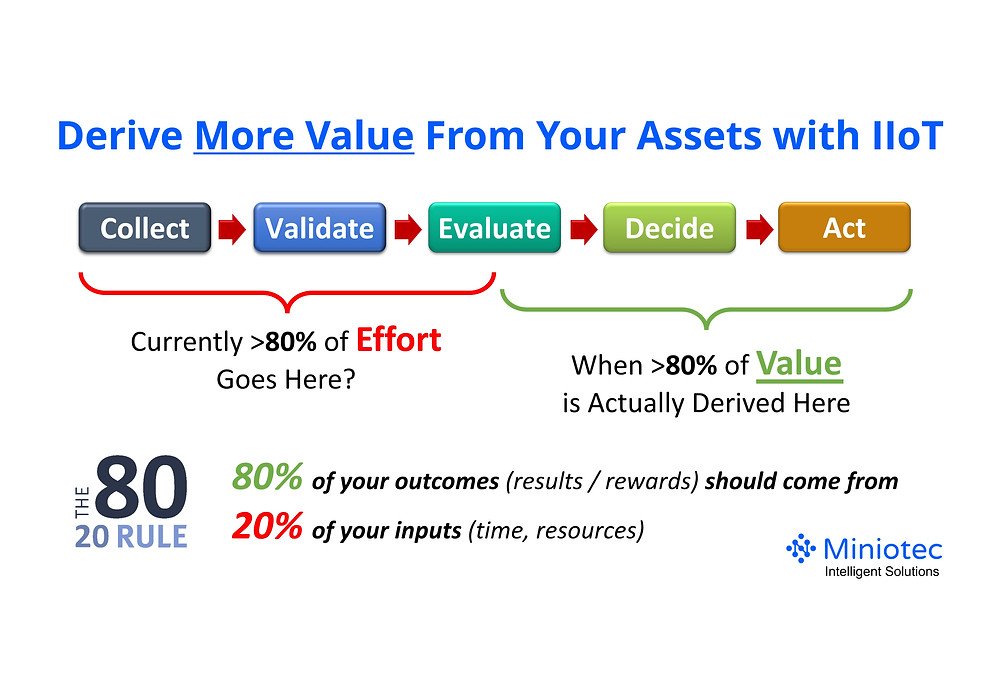
A prediction has no business value unless someone can act on it. Successful programs connect condition alerts with inspection, work orders, parts reservation, labor planning, and approved downtime windows. In many plants, the best first action is not an automatic shutdown but a technician inspection that confirms noise, heat, lubrication, vibration, or visible condition. That human-in-the-loop process both protects operations from weak predictions and generates better feedback for future models. Automatic control should be reserved for highly validated conditions where safety, model confidence, and operating procedures justify it.
Maintenance records also need enough structure to support learning. Notes such as “fixed machine” are difficult to analyze. A better record identifies asset, component, fault mode, suspected cause, corrective action, date, downtime, and whether the prediction was confirmed. Standard codes for bearing, seal, motor, alignment, lubrication, electrical, and other failure classes make it easier to compare assets and improve models. Data quality problems—wrong timestamps, changed asset IDs, sensor drift, inconsistent mounting, missing operating context—can undermine predictive maintenance even when the analytical model itself is sophisticated.
Build the Pilot Around ROI, Technician Trust, and Reliability
A pilot should use assets with meaningful failure cost, known failure modes, reasonably good data, and technicians who are willing to engage with the process. Starting on the most complicated machine in the plant can slow learning because the team struggles to separate data problems from model problems from process problems. A simpler pump, motor, or compressor can provide clearer feedback. Before the pilot begins, management should define success in operational terms: fewer unplanned stops, higher alert precision, faster diagnosis, reduced overtime, lower scrap, or documented avoided cost. The baseline should be recorded before deployment so that results can be compared honestly.
Scaling should occur only after the workflow is proven. The organization can then standardize sensor installation, data models, asset naming, failure taxonomies, CMMS integration, user training, and cybersecurity controls. Connected sensors create new endpoints and credentials, so segmentation, authentication, patching, encrypted communication, and controlled remote access need to be designed without destabilizing PLCs, SCADA systems, or other operational-technology networks. The purpose of predictive analytics is to make the plant more reliable; an analytics deployment that introduces OT instability defeats its own objective.
Conclusion
Predictive maintenance increases profitability when it is selective, measurable, and tied to real maintenance decisions. The most successful programs begin with financially important failure modes, choose condition signals that can actually detect those problems, establish a baseline, and connect alerts to inspections, work orders, parts, and scheduled intervention. Sensors, edge analytics, and machine-learning models can improve those decisions, but they cannot compensate for weak maintenance records, poor data quality, lack of technician trust, or unrealistic savings claims. Companies that prove value on a focused pilot and then scale a standardized process are far more likely to gain durable uptime and cost benefits than companies that begin by installing technology everywhere.