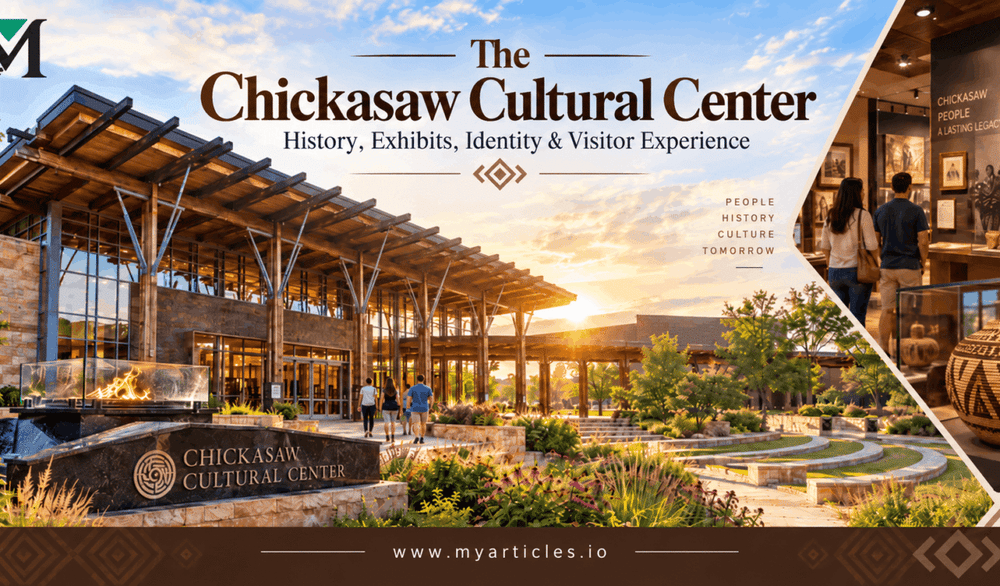
The Chickasaw Cultural Center – History, Exhibits, Chickasaw Identity, and Visitor Experience

The Chickasaw Cultural Center

The Chickasaw Cultural Center in Sulphur, Oklahoma, is a cultural and educational campus created by the Chickasaw Nation to share Chickasaw history, language, art, traditions, and contemporary life. It is not simply a museum filled with objects from the past. Its exhibits, architecture, traditional village, demonstrations, gardens, archives, food, and public programs present Chickasaw culture as a living culture that continues today.

Opened in 2010, the Chickasaw Cultural Center describes itself as one of the largest tribal cultural centers in the United States. The 184-acre campus combines indoor exhibit spaces with outdoor landscapes and a historically interpreted traditional village. Its stated goals include preserving Chickasaw history, revitalizing cultural traditions, providing educational opportunities, supporting research, and sharing Chickasaw culture with visitors from around the world.

The earlier version of this MyArticles page briefly introduced the center but then moved into unrelated discussions of the U.S. Holocaust Memorial Museum, Wrigley Field, the Oklahoma City National Memorial, and the Oklahoma City Zoo. This updated guide focuses entirely on the Chickasaw Cultural Center itself: what it represents, what visitors can experience, how its major spaces fit together, and why it matters as a Chickasaw institution.

Where Is the Chickasaw Cultural Center?

The Chickasaw Cultural Center is located at 867 Cooper Memorial Drive, Sulphur, Oklahoma, in south-central Oklahoma within the Chickasaw Nation. Sulphur is also associated with the Chickasaw National Recreation Area, so the region combines significant cultural and natural destinations.

The center is designed as a campus rather than a single museum building. Visitors move among exhibition halls, research facilities, outdoor spaces, a traditional village, an honor garden, art areas, a theater, a café, and other facilities.

According to the Cultural Center, the campus covers approximately 184 acres. The landscape is intentionally part of the experience. Stone, wood, water, native plants, gardens, pathways, and open views help connect exhibits about Chickasaw history with the natural world that has always been important to Chickasaw life.

Why the Chickasaw Cultural Center Was Created

The Cultural Center’s official goal statement identifies five main purposes:

  • capture the essence of Chickasaw culture;
  • revitalize and share Chickasaw culture and traditions;
  • preserve, protect, and expand the historical record;
  • provide educational opportunities for Chickasaw people;
  • share Chickasaw culture with the wider world.

These aims are important because cultural centers operated by Indigenous nations are different from museums that simply interpret Indigenous peoples from an outside perspective. The Chickasaw Cultural Center is a Chickasaw institution telling a Chickasaw story through its own cultural framework, language, community participation, and priorities.

For visitors, that means the center is best approached not as a collection of “Native American artifacts” in general, but as a place devoted specifically to the history and living culture of the Chickasaw people.

Who Are the Chickasaw People?

The Chickasaw are a sovereign First American nation whose original Homeland was in the southeastern United States. Chickasaw history is deeply connected with areas that are now Mississippi, Alabama, Tennessee, and Kentucky.

The Cultural Center describes pre-removal Chickasaw communities as sophisticated towns supported by agriculture, trade, political leadership, diplomacy, and military strength. Chickasaw people traded with other Indigenous nations as well as European powers that entered the Southeast.

European colonization transformed the region through warfare, trade, disease, treaty-making, and land pressure. During the nineteenth century, federal Indian-removal policy forced the Chickasaw from their southeastern Homeland to Indian Territory, in what is now Oklahoma.

The Center does not treat removal as the ending of Chickasaw history. Instead, its narrative emphasizes survival, adaptation, sovereignty, cultural continuity, and contemporary Chickasaw life.

Readers interested in the wider development of the American South and neighboring regions may also find our updated overview of Arkansas history useful for additional regional context.

Start With the Chikasha Poya Exhibit Center

The Cultural Center recommends beginning a visit at the Chikasha Poya Exhibit Center. “Chikasha Poya” is presented by the Center as “We are Chickasaw,” and the exhibit uses interactive media, objects, sound, visual design, and reconstructed environments to introduce the Chickasaw story.

The exhibit does not follow only one narrow historical period. It moves from Chickasaw life in the Southeast through European contact, trade, removal, adaptation in Indian Territory, military service, cultural continuity, and contemporary identity.

The Aaishtaya’ Room

The Aaishtaya’ Room—described by the Center as “where our journey begins”—introduces visitors to Chickasaw identity through art, maps, symbolism, and historical representation. One feature is an etched-glass replica of a 1723 deerskin map, which provides a very different way of thinking about geography from conventional European maps.

This is an important interpretive choice. Maps are not neutral. They reveal how communities understand space, relationships, territory, travel, and neighboring peoples. Seeing an Indigenous map alongside later historical narratives helps visitors recognize that the Chickasaw had sophisticated geographic and political knowledge long before the United States existed.

The Removal Corridor

One of the most emotionally significant parts of the Chikasha Poya Exhibit Center is its treatment of removal. The Cultural Center’s Removal Corridor uses art, sound, and stories to interpret the forced displacement that followed federal Indian-removal policies in the nineteenth century.

For visitors unfamiliar with this history, it is important to understand that “removal” was not ordinary migration. Indigenous nations faced sustained political pressure, coercive treaties, loss of land, forced movement, illness, death, and the disruption of communities and economies.

The exhibit places this painful history within a longer story of Chickasaw resilience rather than presenting Indigenous history as ending with dispossession.

The Stomp Dance Room

Stomp dance is an important cultural tradition, and the Cultural Center uses both exhibit interpretation and live demonstrations to help visitors understand its place in Chickasaw life. Visitors should approach these traditions as living cultural practices rather than performances invented for tourism.

The Chikasha Inchokka’ Traditional Village

One of the most distinctive parts of the Cultural Center is the Chikasha Inchokka’ Traditional Village. The Center describes it as a historically accurate recreation of a Chickasaw village representing life in the 1700s.

The village includes recreations of:

  • a Council House;
  • summer houses;
  • winter houses;
  • a replica mound;
  • a corn crib;
  • a stickball field;
  • a stockade fence.

Visitors reach the village by crossing the 40-foot Aba’ Aanowa’ Sky Bridge. Depending on the schedule and weather, cultural demonstrators may present stomp dance, stickball, traditional art, cooking, storytelling, and Chickasaw language.

The village is valuable because it provides spatial context. A diagram in a textbook can show the parts of a historic settlement, but walking among reconstructed structures makes it easier to understand how community, housing, food storage, governance, ceremony, and recreation related to one another.

Stomp Dance Demonstrations

The Cultural Center currently presents stomp dance demonstrations as a regular activity. The exact schedule can change, so visitors should check the official daily-activities page before traveling.

A respectful visitor should understand that a cultural demonstration is not equivalent to a generic entertainment show. The purpose is educational and cultural. The best approach is to listen to the interpretation provided by Chickasaw staff, follow photography or participation guidance, and avoid treating sacred or community traditions as curiosities.

Stickball and Traditional Games

Stickball has deep historical roots among southeastern Indigenous peoples and remains culturally significant. Demonstrations at the Traditional Village can help visitors understand that games can have social, physical, ceremonial, and community meanings beyond recreation.

The stickball field within the village reinforces the larger design philosophy of the Center: Chickasaw history is communicated through lived spaces and activities, not only through text panels.

Holisso: The Center for Study of Chickasaw History and Culture

Visitors interested in deeper research should know about Holisso, the Center for Study of Chickasaw History and Culture. The Cultural Center describes Holisso as a 20,000-square-foot specialty library focused on the Chickasaw Nation and other tribes of the southeastern United States.

The facility supports historical, genealogical, and cultural research. The Chickasaw Nation also identifies genealogy and archive services at the Cultural Center.

Holisso is important because preservation is not limited to displaying artifacts. Historical research depends on documents, photographs, oral histories, maps, genealogical records, books, and archival collections. These materials allow Chickasaw citizens, historians, students, and families to study the past in greater depth.

For students learning to work critically with historical evidence, our guide to analyzing primary historical sources provides a useful introduction to evaluating documents within their historical context.

Aaholiitobli’ Honor Garden

The Aaholiitobli’ Honor Garden honors Chickasaw leaders, elders, and warriors. Gardens and memorial landscapes function differently from enclosed exhibits: visitors experience memory through movement, open space, sculpture, vegetation, and architecture.

The Honor Garden reinforces a recurring theme throughout the Center—that Chickasaw history is carried by people and generations, not simply by isolated events.

Fine Art and Chickasaw Artists

The Cultural Center includes spaces for permanent and rotating art exhibitions. Contemporary Native art is particularly important because many people encounter Indigenous culture primarily through historical objects. Current Chickasaw artists demonstrate that artistic traditions are evolving, experimental, personal, and contemporary.

The Aachompa’ Gift Shop also features work such as jewelry, pottery, baskets, bows, flutes, beadwork, clothing, music, and other items associated with Chickasaw artists and makers.

When possible, purchasing work directly through Indigenous institutions and artists is a more respectful way to engage with Native art than buying mass-produced objects that imitate tribal styles without cultural connection.

Chickasaw Language at the Center

Language is one of the strongest expressions of cultural identity. Throughout the Cultural Center, visitors encounter Chickasaw words in the names of rooms, buildings, exhibits, and activities.

This matters because many Indigenous languages in the United States experienced severe disruption through removal, assimilation policies, boarding schools, and English-only education. Chickasaw language revitalization is therefore not simply about preserving vocabulary; it is part of cultural continuity.

The Cultural Center also highlights language-learning efforts, including work developed with Chickasaw speakers and language-learning platforms.

Food as Cultural Interpretation

The Aaimpa’ Café gives visitors another way to encounter Chickasaw culture through food. Cuisine can communicate relationships among land, agriculture, seasonal resources, family traditions, and historical change.

Food should not be treated as a side attraction disconnected from history. Agricultural practices, corn, plants, hunting, trade, removal, and adaptation all influenced what Chickasaw communities ate and how food traditions developed.

Architecture and Landscape

The Cultural Center’s architecture uses natural materials and symbolic design. Its official description emphasizes wood, stone, copper, water, and landscapes intended to create a connection between cultural interpretation and the natural environment.

The Center’s logo and architectural imagery also use symbols including the spiral, ogee or “eye,” and sun. According to the Cultural Center, the spiral represents wind and the passage through life, the eye reflects a way of viewing the world, and the sun represents light, rebirth, and the heavens.

Visitors who pay attention to architecture will therefore find that cultural meaning exists outside the exhibit cases. Patterns, materials, pathways, gardens, bridges, and building orientation are all part of the interpretation.

Understanding Chickasaw Removal

A visit is more meaningful when the removal story is placed within the larger history of U.S. expansion. During the nineteenth century, federal policy pushed southeastern tribal nations to give up ancestral lands and relocate west of the Mississippi.

The Chickasaw negotiated removal differently from some neighboring nations, but the outcome still involved displacement from a Homeland occupied for generations. Chickasaw people eventually reestablished political and community life in Indian Territory.

The Center’s emphasis on being “unconquered and unconquerable” reflects this continuing identity. Removal changed geography but did not eliminate Chickasaw sovereignty, culture, kinship, or memory.

The Chickasaw Nation Today

One of the most important lessons visitors can take from the Cultural Center is that the Chickasaw Nation is a contemporary sovereign nation, not merely a historical tribe.

Tribal sovereignty includes governmental institutions, citizenship, programs, economic activity, cultural initiatives, education, health services, and relationships with federal, state, local, and other tribal governments.

Seeing Indigenous peoples only through eighteenth- or nineteenth-century history can unintentionally erase contemporary Native life. The Cultural Center deliberately connects the past with present-day Chickasaw citizens and institutions.

Planning a Visit in 2026

As of September 2026, the Cultural Center’s official visitor information lists the campus and Chikasha Poya Exhibit Center as open Tuesday through Saturday, 10 a.m. to 5 p.m., with Sunday and Monday closures. The Traditional Village is generally listed as open Tuesday through Saturday from 10 a.m. to 4:30 p.m., weather permitting.

Because schedules, holidays, demonstrations, admission prices, and events can change, visitors should always verify details on the official Cultural Center website shortly before traveling.

Current Admission Structure

The campus includes several areas that can be explored without charge, while admission is charged for the Chikasha Poya Exhibit Center. As of September 2026, official prices list:

  • Chickasaw citizens: free;
  • other federally recognized tribal citizens: $6;
  • adults: $7;
  • students, seniors age 55+, and military: $6;
  • children 12 and under: free.

Again, these are time-sensitive details and should be checked before a visit.

How Much Time Should You Allow?

A quick stop cannot fully communicate what the campus offers. Visitors interested in both exhibits and the Traditional Village should allow several hours. Those who want to explore Holisso, attend scheduled demonstrations, watch films, eat at the café, walk the grounds, or study art should consider making the Cultural Center a substantial part of the day.

The best sequence for a first visit is usually:

  1. begin at the Welcome Center;
  2. visit the Chikasha Poya Exhibit Center for historical context;
  3. walk to the Traditional Village;
  4. attend cultural demonstrations if available;
  5. explore the Honor Garden and grounds;
  6. visit Holisso or the art galleries according to your interests;
  7. leave time for the café and gift shop if desired.

Visiting Respectfully

The Cultural Center welcomes visitors, but respectful cultural tourism requires more than arriving with a camera.

  • Use the terminology and pronunciations taught by Cultural Center staff.
  • Listen to Chickasaw interpretations rather than relying on stereotypes about Native peoples.
  • Follow photography rules around demonstrations, people, and culturally sensitive material.
  • Do not treat ceremonial traditions as costumes or spectacles.
  • Ask thoughtful questions, but recognize that not every cultural or spiritual practice is public information.
  • Remember that Chickasaw culture is contemporary and living.

Why the Cultural Center Matters

The Chickasaw Cultural Center matters because control over historical interpretation matters. For much of U.S. history, Native peoples were frequently described by outsiders—government officials, settlers, anthropologists, schoolbooks, filmmakers, and museums. Those accounts often contained stereotypes or presented Indigenous peoples as belonging only to the past.

A tribal cultural institution can change the direction of interpretation. Chickasaw people decide which stories to emphasize, which language to use, how to interpret removal, how to represent living traditions, and how to connect history with sovereignty today.

That makes the Center valuable for Chickasaw citizens and for non-Chickasaw visitors. It offers a chance to learn history through a source grounded in the nation whose history is being presented.

What Students Can Learn From a Visit

The Cultural Center can support learning in American history, Indigenous studies, anthropology, art, government, geography, language, environmental studies, and museum studies.

Students can consider questions such as:

  • How does a sovereign tribal nation tell its own history?
  • How are oral histories and written archives used differently?
  • How can architecture communicate cultural ideas?
  • What changed after European contact and U.S. expansion?
  • How did removal affect communities without ending cultural identity?
  • How does language revitalization support cultural continuity?
  • What is the difference between preserving tradition and freezing a culture in the past?

Conclusion

The Chickasaw Cultural Center is best understood as the cultural home of a living sovereign nation rather than simply another Oklahoma tourist attraction. Its exhibits, Traditional Village, archives, gardens, language, art, food, and demonstrations connect centuries of Chickasaw history with Chickasaw life today.

The most valuable part of a visit is the perspective. Instead of encountering Chickasaw history as a short chapter in a general American-history narrative, visitors experience a story centered on Chickasaw people—their Homeland, political relationships, forced removal, resilience, traditions, creativity, and continuing nationhood.

For anyone interested in Indigenous history, Oklahoma, American history, cultural preservation, or tribal sovereignty, the Chickasaw Cultural Center offers an unusually rich opportunity to learn directly from a Chickasaw institution.

Sources and Visitor Information

Leave a Reply

Reading is essential for those who seek to rise above the ordinary.

MyArticles

Welcome to MyArticles, an author-oriented website. A place where words matter. Discover without further ado our countless community stories.

Build great relations

Explore all the content from MyArticle community network. Forums, Groups, Members, Posts, Social Wall and many more. You can never get tired of it!

Become a member

Get unlimited access to the best stories and articles on MyArticles, support our lovely authors and share your stories with the World.