
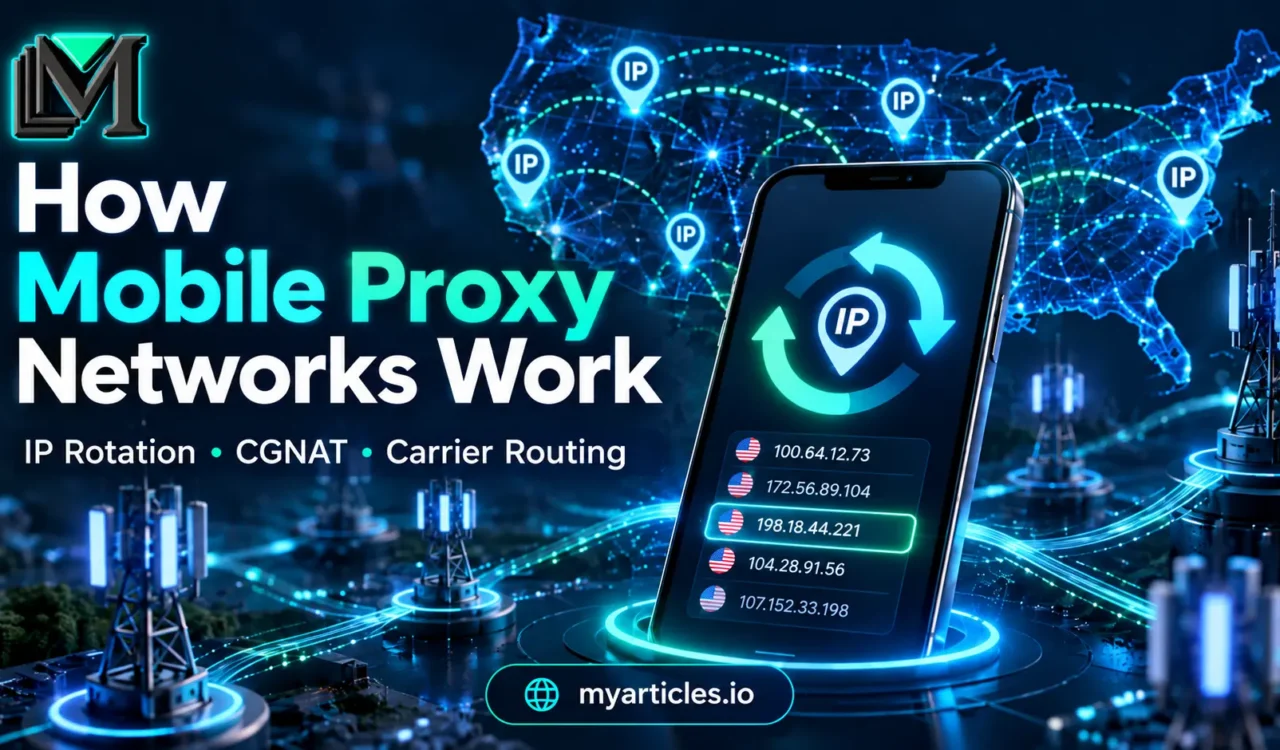
Modern internet infrastructure relies heavily on IP addresses to determine where traffic originates, how sessions are handled, and whether a connection appears legitimate. For ordinary users, most of this happens invisibly. A smartphone connects to a cellular network, receives network access, and begins communicating with websites and applications without the user needing to understand how the underlying routing works. Mobile proxy networks build on this same infrastructure by routing internet requests through cellular connections rather than conventional data-center servers. This difference matters because mobile networks handle addressing very differently from traditional hosting environments. Mobile carriers manage enormous pools of subscribers, frequently reuse addresses, and rely on network address translation to make efficient use of available IPv4 space. Mobile proxies take advantage of this architecture to provide connections that exit through carrier networks while also allowing IP addresses to change periodically. Understanding how mobile proxy networks work therefore requires looking beyond the proxy server itself and examining the proxy gateway, cellular connection, carrier network, IP allocation system, Carrier-Grade NAT, session management, and rotation mechanisms that work together behind every request.
What Makes a Mobile Proxy Different
A proxy acts as an intermediary between a user and the destination being accessed. Instead of a website receiving a connection directly from the user’s original internet address, the request first travels through the proxy infrastructure, and the destination sees the proxy’s exit address. With a traditional data-center proxy, that exit address normally belongs to a hosting company or cloud provider, and such networks can often be identified through their autonomous system number, network ownership information, and IP ranges. A mobile proxy takes a different route because traffic eventually passes through infrastructure associated with a mobile network operator, so from the destination’s perspective the public IP belongs to a cellular network rather than a conventional hosting center. A simplified connection path is User → Proxy Gateway → Cellular Connection → Mobile Carrier → Internet → Destination Website. The cellular portion may involve smartphones, LTE or 5G modems, SIM cards, or provider-managed mobile networking hardware, depending on the provider’s architecture.
For organizations that specifically require U.S.-based carrier connectivity, services offering mobile proxies USA can provide access to mobile-network exit points located within the United States. The important distinction is not simply that the visible IP address changes. It is that the address belongs to the same broad networking ecosystem used by ordinary cellular subscribers. This can be valuable for applications that need carrier-based routing, regional testing, or session behavior that reflects real mobile network conditions. At the same time, the quality of a mobile proxy depends heavily on how the provider manages its gateways, cellular connections, authentication, uptime, and IP rotation rather than on the label “mobile” alone.
How Cellular Networks Assign IP Addresses
When a smartphone connects to a mobile network, the carrier must provide connectivity between the device and the wider internet, which means establishing a data session and assigning the addressing needed for that session. Unlike a home broadband connection that may keep the same public IP for relatively long periods, cellular networks are designed to support enormous numbers of devices that constantly connect, disconnect, move between towers, switch radio technologies, and restart sessions. As a result, addresses in cellular environments are highly dynamic. A device may keep the same address during one session and receive another after reconnecting, while the exact behavior depends on the carrier’s network configuration, available address pools, session state, and how quickly the connection is re-established. This dynamic allocation is one reason IP rotation fits naturally into mobile proxy infrastructure because the system can refresh a cellular session and potentially receive a different address from the carrier’s available pool instead of relying only on a fixed server-side address.
The process is not completely predictable, however. Reconnecting a modem or cellular session does not guarantee that a carrier will always assign a new public IP, because address allocation ultimately follows the carrier’s own network policies. Some carriers may reuse the same address if the previous session is resumed quickly, while others may assign a different address depending on network load and pool availability. This means that mobile proxy providers usually build control systems around carrier behavior rather than assuming that every reconnection will create a new identity. Reliable rotation therefore depends on both the proxy platform and the underlying mobile network.
The Role of Carrier-Grade NAT
One of the most important concepts behind mobile proxy networking is Carrier-Grade Network Address Translation, commonly known as CGNAT. IPv4 contains a limited number of addresses, while cellular operators may serve millions of connected devices simultaneously, so assigning every smartphone a permanently dedicated public IPv4 address would be inefficient and in many environments impractical. CGNAT helps solve this problem by placing large numbers of subscribers behind shared public addressing infrastructure. Individual devices communicate internally using private or shared addresses, while carrier gateways translate those connections before traffic reaches the public internet. This means numerous subscribers may appear online through the same public IP while the carrier keeps track of individual connections using ports, translation tables, and session information. The result is an addressing model that is highly efficient for mobile operators and also explains why carrier-based IPs behave differently from dedicated hosting-server addresses.
This architecture has an important consequence for proxy traffic because a public mobile IP is generally associated with a carrier network that also serves ordinary subscribers, and it is not necessarily dedicated exclusively to one proxy user. CGNAT and IP rotation should not be confused, however. CGNAT primarily explains how addresses are shared, while IP rotation explains how the visible exit address changes over time. The two technologies interact because a refreshed mobile session may pass through different translation resources or receive a different external address, but they still perform separate functions. Understanding that distinction makes it easier to interpret why mobile IPs can be dynamic, shared, and difficult to compare directly with dedicated data-center proxies.
How Mobile IP Rotation Actually Works
IP rotation is the process of replacing one proxy exit IP with another, and in mobile infrastructure this can occur in several ways depending on how the provider operates its network. One common method involves reconnecting the cellular data session. When a modem or connected device disconnects from the carrier network and establishes a new session, the carrier may assign another address from the available pool. Some systems perform this automatically after a configured period, while others allow users to request rotation manually through a dashboard, API, or special connection endpoint. Providers may therefore support time-based rotation, where the address changes after a predefined interval; session-based rotation, where one IP is retained for the duration of a configured session; on-demand rotation, where a new address is requested only when needed; and connection-based rotation, where different exits may be assigned as new proxy connections are established.
The real process is more complicated than simply selecting a random IP from a database. With genuine mobile infrastructure, the carrier remains involved in address allocation, so the proxy system mainly controls when connections are refreshed while the carrier determines which address becomes available next. This is why high-quality mobile proxy networks usually focus on controlling session timing, reconnection behavior, and gateway assignment rather than promising a completely deterministic sequence of IPs. A strong rotation system therefore combines carrier-side dynamics with provider-side orchestration to deliver predictable enough behavior for real-world workflows.
Rotating Sessions Versus Sticky Sessions
Not every proxy task benefits from changing addresses constantly. Some operations involve many independent requests, and in those cases regularly rotating addresses can help distribute traffic across different network exits. Large-scale public web research, regional content verification, and automated testing are examples where rotation may be useful when performed in accordance with the target service’s rules. Other applications require continuity, especially when one user session includes several dependent steps. A shopping cart or mobile application test may involve login, navigation, item selection, checkout preparation, and multiple API requests, and if the IP changes repeatedly during that process, the application may interpret the traffic as coming from separate connections or trigger additional security verification.
A sticky session solves this problem by retaining one exit IP for a defined period. The best mobile proxy infrastructure therefore does not simply rotate addresses as quickly as possible; it provides control over session duration so the network behavior matches the task. Short sessions are useful for workloads involving many independent requests, while longer sessions are more appropriate when authentication, state, and connection consistency matter. The technical objective is to match the rotation strategy to the application rather than treating maximum rotation frequency as automatically better.
Why Geography Matters in Mobile Proxy Routing
IP addresses contain network ownership and routing information that can also influence how geolocation databases classify a connection. When a carrier operates its network in the United States, its public IP ranges are generally associated with U.S. network infrastructure, and websites may use that address as one of several signals when determining the approximate location of a visitor. This capability has legitimate technical applications. Developers can test how websites behave for U.S. mobile visitors, advertising teams can verify region-specific campaigns, e-commerce businesses can inspect localized storefronts, quality-assurance teams can evaluate mobile experiences from different network environments, and researchers can examine publicly accessible information as presented to users in a particular country. In these situations, the value comes from the network appearing through a real mobile carrier ecosystem rather than merely through a generic hosting provider.
Geolocation should still be understood as an approximation rather than a precise positioning technology. An IP address does not provide GPS coordinates, and different geolocation databases can sometimes associate the same address with different cities or regions. A mobile proxy should therefore not be treated as equivalent to physically placing a device at an exact street-level location. The practical goal is usually to obtain country- or region-appropriate network routing, and teams that need highly precise location testing should verify how their chosen proxy provider maps available carrier exits before relying on them in production.
Mobile Proxy Networks and Web Automation
One reason mobile proxies have become important in modern infrastructure is the growth of automated web operations. Companies increasingly automate legitimate tasks such as application testing, search-result monitoring, price research, advertising verification, public-data collection, and localized website testing, and at scale these systems can generate significantly more requests than a human user. A well-designed proxy layer helps distribute that traffic while allowing developers to control geographic routing and connection sessions, and mobile networks add another option when the project specifically needs carrier-based connectivity. For teams building automation systems, the benefit is not simply the availability of more IP addresses but the ability to control where traffic exits, how long sessions persist, and when a new carrier-assigned address should be introduced.
However, proxies do not eliminate the need for responsible automation. A technically sound system should still respect website terms, authentication requirements, rate limits, applicable privacy rules, robots directives where relevant, and legal restrictions governing data collection. Proxy rotation should primarily be viewed as a networking and session-management capability rather than a mechanism for ignoring a website’s access controls. In practice, the most reliable automation stacks combine measured request rates, session persistence, retry logic, appropriate geographic routing, and clear compliance rules instead of relying on aggressive IP changes alone.
Performance Depends on More Than IP Rotation
Rotation often receives most of the attention when mobile proxies are discussed, but it is only one component of network quality. Latency is equally important because every proxy introduces another network hop, meaning traffic travels through the proxy gateway and cellular network before reaching its destination. Poor infrastructure can therefore create noticeable delays, especially if the proxy server is geographically far from the carrier gateway or if the cellular network is congested. Throughput also matters when workloads involve images, APIs, large pages, or file transfers, and other important factors include modem capacity, carrier signal strength, server location, concurrent connection limits, uptime, session stability, and routing efficiency. A proxy network with excellent rotation but weak throughput or unstable carrier links may still perform poorly in real-world automation.
5G connectivity can provide better bandwidth and lower radio-network latency in some environments, but simply labeling a proxy “5G” does not guarantee superior performance. The complete route between the user, gateway, carrier, and destination determines the actual experience. For this reason, organizations evaluating mobile proxy services should test real response times, concurrency, stability, and failure rates rather than relying entirely on advertised network-generation labels or headline IP counts. A short trial under realistic workload conditions usually reveals much more about quality than specification sheets alone.
Security and Authentication
A proxy gateway must control who can use it, and two of the most common authentication methods are username-and-password credentials and IP whitelisting. Credential authentication allows applications to connect using dedicated proxy usernames and passwords, which is convenient when connections originate from changing locations. IP whitelisting permits access only from approved source IP addresses and can work well for servers with fixed outbound addresses, although it becomes less practical when the client itself uses a dynamic internet connection. Strong providers may support both methods so teams can choose the model that best fits their infrastructure.
Encryption is another consideration. When HTTPS traffic is sent through a standard proxy tunnel, the connection between the browser and destination website remains protected by TLS, although the precise visibility available to the proxy depends on the proxy protocol and configuration. Organizations handling sensitive workflows should therefore evaluate not only proxy speed and IP availability but also authentication, logging policies, access controls, infrastructure security, retention practices, and data handling. Security should be treated as part of proxy architecture rather than as an afterthought added after the network has already been deployed.
Choosing the Right Rotation Strategy
There is no single ideal IP rotation interval because the correct setting depends on the workflow. A monitoring system making isolated requests may benefit from frequent changes, while a long authenticated workflow may need the same address for 30 minutes or several hours. Software testing may require both approaches depending on whether the test is measuring isolated responses or complete user sessions. Before configuring rotation, teams should ask how long a normal session lasts, whether the target application associates authentication with an IP address, how many requests occur during each workflow, whether geographic consistency is required, what level of concurrency is needed, and how much latency is acceptable. These questions are more important than choosing the shortest available rotation interval.
Answering them produces a much more effective architecture because the goal should be predictable session behavior rather than constant change for its own sake. In well-designed deployments, rotation frequency, sticky-session duration, gateway selection, and retry behavior are all coordinated so that the network supports the application instead of disrupting it. This is particularly important in production systems, where unnecessary IP changes can cause avoidable login challenges, state loss, or inconsistent testing results.
Conclusion
Mobile proxy networks are built around a combination of conventional proxy routing and cellular networking infrastructure. Traffic first reaches a proxy gateway, passes through a mobile connection, enters the carrier network, and finally reaches the public internet using an IP associated with the mobile operator. Behind this process, carrier address pools, CGNAT, modem sessions, routing gateways, authentication systems, and rotation controls determine what the destination ultimately sees. IP rotation is therefore not simply a cosmetic feature that replaces one number with another; in genuine cellular infrastructure, it is closely connected to how mobile data sessions are established and how carriers dynamically manage their available addresses.
Understanding this architecture makes it easier to choose between rotating and sticky sessions, evaluate network performance, configure geographic routing, and design reliable automation systems. For businesses conducting legitimate testing, public-web research, localization checks, application development, and other network-dependent operations, the most effective mobile proxy setup is ultimately the one that combines appropriate carrier connectivity with controlled rotation, stable sessions, responsible usage, and sound security practices. The best results come from treating mobile proxies as part of a broader network design rather than as a standalone shortcut, because routing quality, session logic, carrier behavior, and application requirements all influence how well the system performs.