
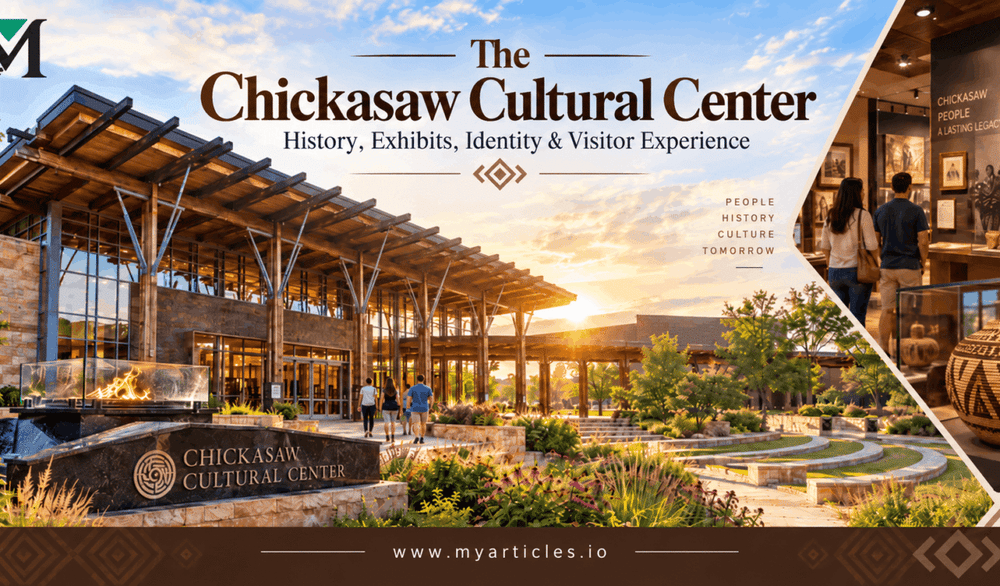
The Chickasaw Cultural Center in Sulphur, Oklahoma, is a major cultural institution created by the Chickasaw Nation to present Chickasaw history, language, art, traditions, and contemporary identity through exhibits, landscapes, research resources, demonstrations, and community programming. It is not simply a museum about a people from the past. The center presents the Chickasaw Nation as a living sovereign nation whose culture continues to evolve.
Visitors who arrive with broad assumptions about Native American history will find that the center emphasizes tribal specificity. Chickasaw history, removal, governance, language, foodways, family traditions, and contemporary life are presented from a Chickasaw perspective rather than through a generic “Native American” narrative.
The Cultural Center Was Built as a Chickasaw Cultural Home
The Chickasaw Cultural Center — Official Website describes a campus designed to preserve, share, and celebrate Chickasaw culture. The Chickasaw Cultural Center — Our Cultural Home explains the institution’s role as a place for Chickasaw people as well as for visitors who want to learn respectfully.
This dual purpose affects the visitor experience. Exhibits are educational, but the campus also represents cultural continuity and community identity. Visitors should approach it as a living cultural space, not merely as an attraction containing historical artifacts.
Exhibits Connect History With Contemporary Chickasaw Identity
The Chickasaw Cultural Center — Campus and Exhibits overview shows that the site combines indoor and outdoor spaces. The Chikasha Poya Exhibit Center introduces Chickasaw history and culture through immersive exhibits that help visitors understand both historical experience and living identity.
Interpretation is strongest when visitors connect objects and stories to specific people and institutions. Skills involved in analyzing primary historical sources are useful here because museums are not neutral containers; curatorial choices determine whose voices and evidence shape the story.
The Traditional Village Makes Everyday Culture More Visible
The Chikasha Inchokka’ Traditional Village provides a setting for learning about traditional structures, community life, and cultural practices. Depending on programming and season, visitors may encounter demonstrations, interpretation, or events that make material culture easier to understand than a display case alone can do.
The value of the village is not that it freezes Chickasaw life in one historical period. Instead, it helps visitors understand traditions that remain meaningful within a modern nation. Cultural continuity involves adaptation as well as preservation.
Removal Is Central to Understanding Chickasaw History
Any serious account of Chickasaw history must address forced removal from ancestral homelands in the Southeast during the nineteenth century. The process involved land loss, political pressure, migration, hardship, and the rebuilding of government and community in Indian Territory. It should not be treated as a brief transition between two geographic locations.
A broader overview of Arkansas history can help place Indigenous displacement within wider U.S. expansion, but Chickasaw removal has its own specific treaties, experiences, and consequences. Tribal sources are essential for understanding that specificity because they preserve community perspectives, political context, and cultural memory that can be flattened or omitted in generalized accounts of nineteenth-century expansion.
Language and Research Resources Support Cultural Continuity
The cultural center’s role extends beyond public exhibits. Research, language, education, and archival work help support Chickasaw people who want to study family, culture, and history. This is important because cultural preservation depends on access to knowledge as well as public presentation.
Language is especially significant because it carries concepts, relationships, and ways of understanding that cannot always be translated perfectly into English. Cultural institutions can therefore support revitalization by creating spaces where language is visible, taught, recorded, and used.
Planning a Visit Should Start With the Official Schedule
Hours, admission, programs, closures, and event schedules can change, so visitors should use Official Hours and Admission information rather than relying on an old travel article. The Chickasaw Nation — Chickasaw Cultural Center page provides another official source for location and institutional context.
Allow enough time for both indoor exhibits and outdoor spaces rather than treating the center as a quick stop. Visitors should follow photography and event guidance, avoid treating sacred or ceremonial elements as props, and use the names and terminology presented by Chickasaw interpreters.
Conclusion
The Chickasaw Cultural Center matters because it presents Chickasaw history through a living Chickasaw institution. Its exhibits, traditional village, language work, research resources, landscapes, and programming connect removal and historical change with contemporary sovereignty and cultural continuity. Visitors gain the most when they move beyond generic Native American stereotypes and pay attention to Chickasaw-specific voices, places, and traditions. The center is both an educational destination and a cultural home, which is why respectful visitation begins with recognizing that difference.