
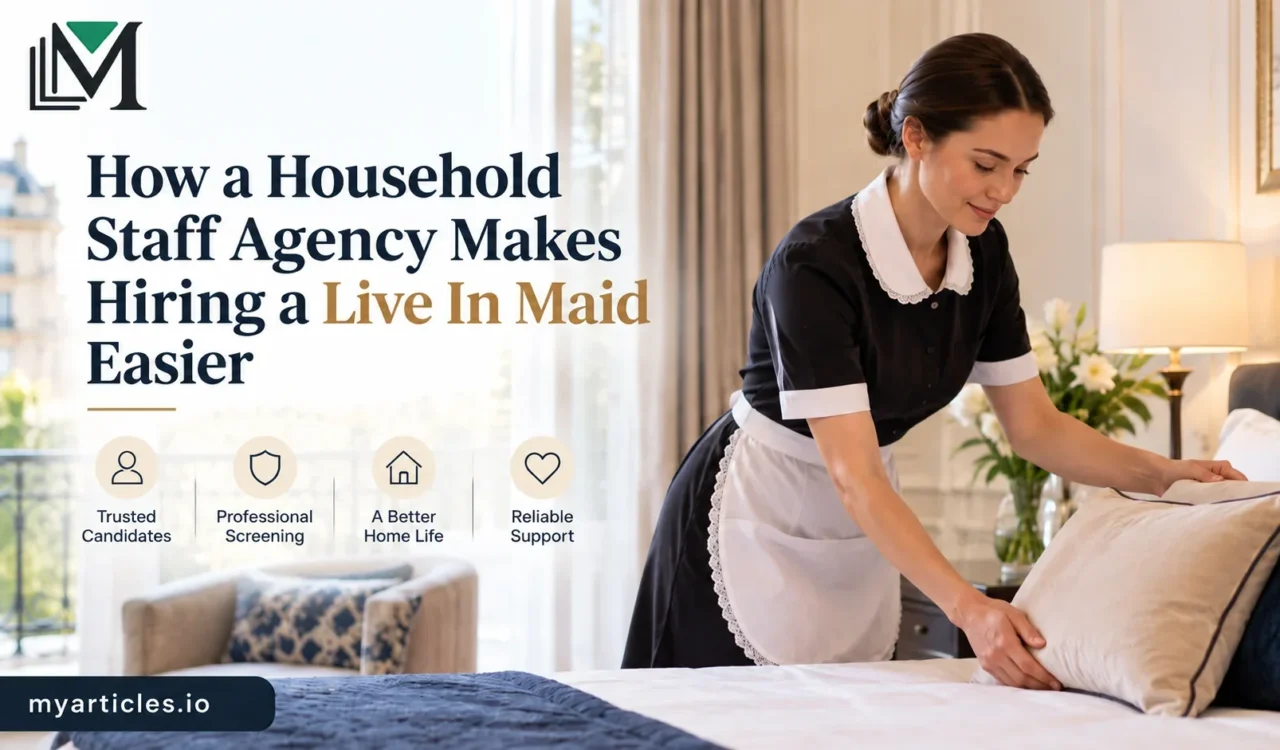
Hiring a live in maid can make everyday household management considerably easier, but finding someone trustworthy, experienced, and compatible with a family’s lifestyle is rarely as simple as placing an advertisement. Domestic employees often work closely with families, spend significant time inside private homes, and may be entrusted with responsibilities ranging from housekeeping and laundry to meal preparation and general household organization. Because of this level of access and responsibility, choosing the right candidate requires much more consideration than reviewing a few applications. A professional household staff agency simplifies the process by identifying suitable candidates, checking their experience, and matching their abilities with the expectations of the household.
For families with demanding careers, frequent travel, children, multiple residences, or extensive household responsibilities, professional domestic help can provide valuable consistency. Recruitment agencies such as 24householdstaff specialize in connecting households with people whose skills and professional backgrounds correspond with the particular requirements of a position. Instead of spending weeks searching through general employment platforms, families can approach recruitment with clearly defined expectations and a more structured selection process.
Why Hiring a Live In Maid Through an Agency Is Easier
Hiring domestic staff independently can quickly become time-consuming. An advertisement may generate numerous applications, yet only a small proportion of the applicants may possess the required experience. The household then needs to review résumés, communicate with applicants, organize interviews, assess references, discuss responsibilities, and determine whether the candidate understands the standards expected in a private residence. When families already have demanding schedules, managing this recruitment process can become an additional responsibility rather than a solution to their existing workload.
A household staff agency helps organize these stages. Rather than beginning with a broad collection of applicants, professional recruiters can focus on candidates whose backgrounds are relevant to domestic employment. This is particularly important when searching for a live in maid because the working arrangement requires more than technical housekeeping skills. The employee and household must also be comfortable with the practical realities of someone living at the residence.
Recruiters can discuss factors such as working schedules, accommodation, household size, expected duties, travel requirements, childcare involvement, cooking responsibilities, pet care, and previous private-household experience before presenting candidates. Defining these expectations early reduces the likelihood of misunderstandings after employment begins.
Professional recruitment can therefore help with several important aspects of hiring:
- Identifying candidates with relevant household experience
- Reviewing employment histories and professional backgrounds
- Clarifying duties before interviews begin
- Matching candidates with the household’s working environment
- Coordinating interviews and communication
- Discussing schedules, accommodation, travel, and availability
- Helping families compare candidates more efficiently
These steps do not eliminate the family’s role in making the final decision. Instead, they allow the household to spend more time evaluating genuinely suitable candidates rather than sorting through large numbers of unrelated applications.
What to Look for When Choosing a Live In Maid
Every household operates differently, which means there is no single profile that suits every family. Some employers primarily need someone who can maintain a large residence, while others require assistance with laundry, wardrobe management, shopping, cooking, children, guests, pets, or travel. Before recruitment begins, families should therefore establish what they actually expect from the position.
Experience is naturally important, but experience alone does not determine whether someone will succeed in a particular household. A candidate who has worked successfully in a formal residence with several staff members may have different working habits from someone accustomed to independently managing a smaller family home. Neither background is necessarily better; suitability depends on the environment into which the employee is being recruited.
Communication also matters significantly. A live in maid may receive instructions from one or several members of the household and needs to understand priorities without creating unnecessary disruption. Employers should similarly communicate their expectations clearly. Working hours, days off, private accommodation, confidentiality, household rules, responsibilities, and boundaries should be discussed before employment begins rather than gradually introduced afterward.
Reliability and discretion deserve particular attention because domestic staff work within private spaces. They may become familiar with family routines, personal possessions, travel arrangements, visitors, and other information that households reasonably expect to remain confidential. A professional attitude toward privacy is therefore an important characteristic alongside practical housekeeping ability.
How Professional Recruitment Improves Candidate Matching
One of the biggest advantages of using a specialist agency is that recruitment can begin with the household rather than with the candidate database. A recruiter can first understand what the employer actually needs and then search for people whose experience corresponds with those requirements. This approach is considerably more focused than posting a generic job advertisement and hoping suitable applicants respond.
For example, one household may require a live in maid who is particularly strong in cleaning, laundry, and wardrobe care. Another may want someone capable of preparing family meals and assisting with children when necessary. An international household might value language skills or previous experience working with families who regularly travel between countries. Large residences may require candidates who understand how to cooperate with nannies, chefs, chauffeurs, gardeners, estate managers, and other members of household staff.
Compatibility also involves personality and working style. Domestic employment takes place in an unusually personal environment, so the relationship between employer and employee can influence the success of the arrangement as much as practical ability. Some families prefer someone highly independent who can organize household tasks without constant supervision. Others prefer close communication and detailed instructions. Recognizing these differences during recruitment can help both parties establish realistic expectations.
Agencies such as 24householdstaff operate within the household staffing sector, where understanding these distinctions is an essential part of finding appropriate candidates. Professional recruitment is therefore less about simply filling a vacancy and more about identifying someone whose experience, availability, responsibilities, and working approach align with the household.
Why Screening Matters for Household Staff
Recruitment for a private residence requires careful consideration because household employees often work in environments that involve a high degree of trust. General employment advertisements can provide access to many potential candidates, but employers still need a method for deciding whose background deserves further investigation.
A structured recruitment process can help narrow the field before interviews take place. Employment history, relevant experience, responsibilities in previous positions, professional references, and availability can all contribute to determining whether someone should proceed to the next stage. The precise checks required may vary according to the role, country, employer, and applicable regulations, but screening remains an important part of responsible household recruitment.
Interviews should then explore more than whether someone knows how to clean a home. Employers may want to understand how candidates organize their day, respond when priorities change, protect household privacy, communicate with family members, manage special clothing or household materials, and work alongside other employees. Situational questions can often reveal considerably more than a simple list of previous duties.
For a live-in position, both sides should also discuss the arrangement from the employee’s perspective. Accommodation, privacy, working and non-working hours, meals, travel expectations, and use of household facilities should be clearly explained. Transparency helps prevent circumstances in which employer and employee begin the role with completely different interpretations of what living at the workplace involves.
A Live In Maid Can Bring Greater Consistency to the Home
The main advantage of employing a live in maid is not simply that someone is physically present in the residence. The greater benefit is continuity. A regular household professional becomes familiar with routines, preferences, clothing-care requirements, storage systems, cleaning standards, family schedules, and the numerous small details that allow a home to operate smoothly.
This familiarity can be particularly valuable in larger households, where maintaining consistent standards requires considerable organization. Rather than repeatedly explaining where items belong or how particular rooms should be prepared, families can establish routines that become part of normal household management. Over time, an experienced employee may also be able to anticipate routine requirements and organize tasks efficiently.
However, live-in employment should not be confused with permanent availability. Clearly defined working hours and appropriate personal time remain important to a professional relationship. Establishing boundaries helps create a sustainable arrangement in which the household receives reliable assistance while the employee understands when responsibilities begin and end.
Families should also regularly communicate about changing expectations. Household circumstances rarely remain exactly the same. Children grow older, work schedules change, families travel, properties change, and responsibilities may expand or decrease. Discussing these developments openly helps ensure that the position continues to work effectively for everyone involved.
Choosing a Household Staff Agency
Families considering professional recruitment should evaluate the agency as carefully as they evaluate potential employees. Household recruitment is a specialist area, and the agency should demonstrate an understanding of private-service roles rather than treating domestic positions in exactly the same way as conventional office employment.
The initial conversation can reveal a great deal. A professional recruiter should want to understand the property, family structure, expected responsibilities, schedule, accommodation, required experience, and any unusual aspects of the position. Agencies that gather detailed information are better positioned to identify candidates who realistically match the vacancy.
Employers should also be clear about what matters most to them. Creating an excessively long list of requirements can sometimes make recruitment unnecessarily difficult, while vague expectations can result in unsuitable candidates. Separating essential qualifications from desirable qualities provides recruiters with a clearer basis for searching.
The final hiring decision should still involve meaningful interaction between the family and candidate. Recruitment agencies can facilitate introductions and reduce the number of unsuitable applications, but employers ultimately need to determine whether they are comfortable welcoming a particular person into their home. Interviews therefore remain an essential part of the process.
Conclusion
Hiring household staff becomes considerably easier when recruitment is approached as a professional process rather than a simple search for someone who can perform domestic tasks. Families need to consider experience, reliability, communication, discretion, responsibilities, schedules, working arrangements, and personal compatibility, particularly when the employee will live within the residence.
A professional household staff agency can reduce the administrative burden by helping define the position, identifying relevant candidates, coordinating recruitment, and allowing employers to focus their attention on applicants who more closely match their needs. When searching for a live in maid, this structured approach can be especially valuable because successful placement depends on both professional ability and compatibility with the household’s daily environment.
Careful recruitment at the beginning can establish clearer expectations and provide a stronger foundation for a dependable long-term working relationship. For households that want reliable assistance without managing every stage of recruitment independently, working with an experienced household staffing agency can make the entire hiring process more organized, efficient, and manageable.