
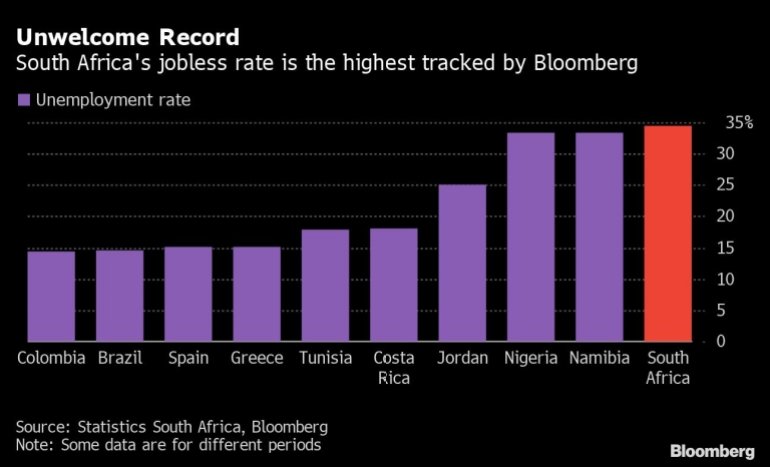
South Africa continues to face one of the world’s most difficult labor-market challenges, with high unemployment, particularly among young people, and large differences in access to work across education levels, regions, and population groups. The headline unemployment rate is important, but it does not capture the full problem by itself. Statistics South Africa’s Statistics South Africa – Q2 2026 Quarterly Labour Force Survey Key Findings and the related Statistics South Africa – Q2 2026 QLFS Media Release provide the current official framework for interpreting employment, unemployment, labor-force participation, and discouraged work-seekers. The country’s labor challenge is therefore best understood as a combination of weak job creation, structural inequality, skills mismatches, infrastructure constraints, and barriers that make it difficult for many people to move from education or informal activity into stable employment.
Youth Unemployment Reflects More Than a Lack of Vacancies
Young South Africans often face the labor market with less work experience, weaker professional networks, limited access to transport, and qualifications that do not always match employer demand. The Statistics South Africa – Youth and the Labour Market in Q1 2026 highlights the scale of the challenge among younger age groups. Entry-level employment is particularly important because the first job provides not only income but also references, workplace skills, and a record that makes subsequent hiring easier. When large numbers of young people remain outside employment for long periods, the disadvantage can become cumulative. Training programs therefore need to be connected with actual labor demand rather than measured only by enrollment. Apprenticeships, internships, work-integrated learning, entrepreneurship support, and stronger links between education providers and employers can help when they lead to credible work experience or qualifications that businesses genuinely use.
Education remains closely connected to employment prospects, but expanding qualifications alone cannot solve unemployment if the economy does not create enough productive jobs. Employers may report difficulty filling technical or specialized positions while large numbers of job seekers remain unemployed, indicating a mismatch between available skills and available work. At the same time, highly educated graduates can also struggle when entry-level positions are scarce or concentrated in cities that are expensive to reach. Improving foundational education, vocational pathways, digital skills, technical training, and career information can support mobility, but the quality and relevance of training matter as much as the number of certificates issued. Labor-market policy should therefore connect skills development with sector investment, infrastructure, business formation, and the practical costs of reaching employment opportunities.
Infrastructure and Business Conditions Affect Job Creation
Electricity reliability, transport, ports, municipal services, broadband, logistics, and public infrastructure influence whether businesses can invest, expand, and hire. When firms face repeated operational disruption or high costs for backup systems, they may delay expansion or automate activities that would otherwise support more employment. Infrastructure reform can therefore affect the labor market indirectly by improving the environment in which private and public investment takes place. The World Bank – South Africa Infrastructure and Job-Creation Reforms illustrates the connection between infrastructure modernization, investment, and employment objectives. The actual employment effect of any reform still depends on implementation, procurement, private-sector response, local capacity, and whether projects create sustainable economic activity beyond temporary construction jobs.
Small and medium-sized businesses are another important part of employment growth because they can create jobs across sectors and regions that large corporations do not reach. Entrepreneurship is often promoted as a response to unemployment, but starting a sustainable business requires customers, finance, infrastructure, reliable payments, skills, and a regulatory environment that does not make formalization unnecessarily difficult. Not every unemployed person can or should become an entrepreneur. Policy is stronger when it supports viable businesses rather than treating self-employment as a substitute for the absence of wage jobs. Access to procurement, credit, training, digital tools, and business-development support can help firms grow, but programs should be evaluated by survival, revenue, and employment outcomes rather than by the number of registrations or grants issued.
Inequality Shapes Who Can Access Available Work
South Africa’s historical and spatial inequalities continue to influence employment because many people live far from major economic centers, face costly commuting, or attend schools with uneven resources. Household income affects the ability to search for work, relocate, obtain internet access, complete unpaid internships, or wait through long recruitment processes. Gender, disability, caregiving responsibilities, and regional differences can add further barriers. These factors mean that two job seekers with similar motivation may face very different practical costs in reaching the same vacancy. Labor-market reform therefore needs to consider transport, housing, childcare, digital access, and discrimination alongside formal employment rules. Reducing unemployment is not only about creating a national number of vacancies; it is also about improving the ability of people in disadvantaged communities to compete for and physically reach those opportunities.
Conclusion
South Africa’s unemployment problem is a structural challenge that cannot be explained by one policy, one industry, or one age group. Weak job creation interacts with youth disadvantage, education quality, infrastructure constraints, spatial inequality, skills mismatches, and the difficulty small businesses face when trying to grow. Official labor-force data remain essential for tracking progress, but the headline unemployment rate should be interpreted with participation, discouraged work-seeker, education, and demographic information. Effective reform requires both stronger demand for labor and better pathways that connect people to available jobs. Infrastructure modernization, skills development, work experience, business growth, transport access, and credible public institutions all contribute to that objective. Sustainable improvement will depend less on short-term programs that create impressive participation numbers and more on whether the economy can generate productive, accessible work that allows people to build stable careers and incomes over time.