
In a busy kitchen, sharp knives are a productivity and consistency issue as much as a cutting issue. Dull edges increase the force needed for slicing, make delicate work harder to control, and slow prep when several cooks share the same tools. The challenge is that sharpening competes with service, cleaning, receiving, and every other task on a crowded schedule. Choosing the right knife sharpeners setup therefore requires balancing edge quality with speed, repeatability, staff skill, knife steel, blade geometry, and the number of knives that need attention each week. A system that creates an exceptional edge but takes too long or depends on one highly skilled employee may fail operationally. Conversely, a very fast system that removes too much metal or forces every knife to the same angle can shorten blade life and produce poor results on specialized knives.
Start With the Kitchen’s Real Sharpening Workload
Before comparing sharpening systems, estimate how many knives are maintained, what kinds of blades the kitchen uses, how frequently they become dull, and who will be responsible for the work. A small café with a dozen general-purpose knives has different needs from a hotel kitchen maintaining chef’s knives, slicers, boning knives, Japanese blades, and high-hardness specialty steels. The expected edge standard matters as well. A working kitchen may prioritize a durable, repeatable edge that can be restored quickly, while a fine-dining team may accept more time for greater refinement. Storage and workflow should also be considered because sharpening needs a stable surface, safe handling, good lighting, and a way to keep abrasive debris away from food-preparation areas. Defining these conditions first prevents the common mistake of buying an impressive tool that staff rarely use correctly.
Honing rods are useful for maintenance but should not be confused with full sharpening. A steel or ceramic rod can help realign or lightly refine an edge that has begun to lose crispness, extending the time between more substantial sharpening sessions. It cannot reliably restore a severely rounded, chipped, or heavily worn edge because those conditions require controlled removal of metal. Pull-through sharpeners offer speed and simplicity, which can be useful for inexpensive house knives when convenience is the priority, but fixed-angle designs may not match every blade and aggressive abrasives can remove more steel than necessary. In a professional kitchen, these tools work best when their limitations are understood. A quick maintenance tool should support the main sharpening system rather than become the only response to every kind of edge damage.
Electric, Stone, and Guided Systems Solve Different Problems
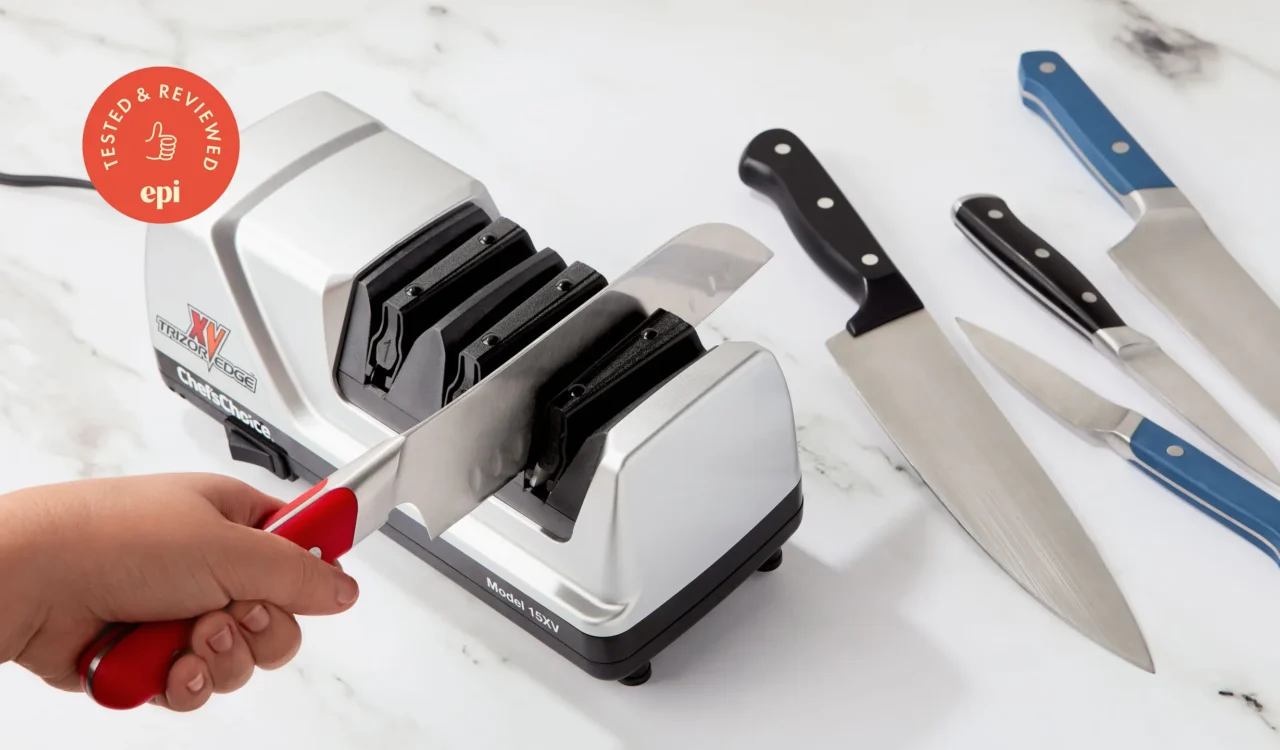
Electric sharpeners can suit high-throughput environments because they provide a repeatable process with relatively little training. Their usefulness depends on the abrasive stages, angle design, material-removal rate, and compatibility with the knives being maintained. A machine designed around one fixed geometry may be inappropriate for a mixed collection of Western and Japanese blades. Whetstones provide far more control and can produce excellent edges with limited equipment cost, but results depend strongly on technique. The user must maintain a consistent angle, understand stone progression, keep stones flat, and know when enough material has been removed. In a kitchen where one or two trained people own the sharpening process, stones can work very well. In a team where anyone may need to sharpen during a busy shift, the training burden can make them difficult to standardize.
Guided sharpening systems occupy a useful middle ground by mechanically supporting angle control while still allowing the user to choose abrasives and edge progression. They can be slower than an electric machine for emergency touch-ups, but they reduce one of the hardest variables in freehand sharpening: maintaining a stable angle from heel to tip. This makes them attractive for kitchens that want repeatable results across valuable knives without depending entirely on one person’s freehand skill. The system still needs an accountable operator because clamping, stone selection, pressure, burr formation, and finishing technique affect the final edge. A guided system is therefore best viewed as a process-control tool rather than an automatic sharpener. It can make good technique easier to repeat, but it cannot compensate for poor judgment about blade condition, steel type, or how much metal should be removed.
Standardize the Process Instead of Buying More Equipment
Kitchens often accumulate sharpening gadgets because dull knives are treated as isolated emergencies rather than a maintenance program. A better approach assigns responsibility, defines how frequently knives are inspected, separates daily honing from actual sharpening, and records which tools are appropriate for each blade family. Staff should know how to recognize a rolled edge, a genuinely dull bevel, a chip, and damage that requires professional repair. They should also understand that aggressive sharpening every time a knife feels slightly less sharp wastes steel. Edge testing should be simple and safe, using controlled cutting performance rather than fingers drawn across the edge. Once a kitchen has a standard process, purchasing decisions become easier because tools are selected to support the workflow. The result is usually more consistent than allowing every employee to sharpen according to personal preference.
Total cost should include more than the initial sharpener price. Replacement stones, belts, wheels, diamond plates, lubricants, flattening tools, cleaning, training time, and blade wear all contribute to the economics of the system. A low-cost sharpener that removes excessive material may become expensive if knives need replacement sooner. Outsourced professional sharpening can also be a rational choice for some kitchens, especially when the knife count is modest or specialized repair is occasionally required. The trade-off is turnaround time and the need for enough spare knives to keep service running. Many operations benefit from a hybrid model: routine maintenance and straightforward sharpening are handled in-house, while damaged, very expensive, or unusual blades go to a specialist. The best system is the one that delivers dependable sharpness at the required pace without creating unnecessary complexity or shortening tool life.
Conclusion
Choosing a knife sharpener for a busy kitchen is ultimately a workflow decision. Honing rods, pull-through tools, electric sharpeners, whetstones, guided systems, and professional services can all be useful when matched to the right knives and the right level of staff skill. The priority should be repeatability, safety, reasonable metal removal, and a process that can be maintained during normal operations rather than only when the kitchen is quiet. Start by defining the knife inventory, edge standards, weekly workload, and person responsible for sharpening, then select the simplest system that can meet those needs consistently. A kitchen with a clear maintenance routine will usually get more value from a well-chosen primary system and a few appropriate touch-up tools than from a drawer full of unrelated sharpeners. Sharp knives then become part of normal equipment care rather than a recurring service-time emergency.