
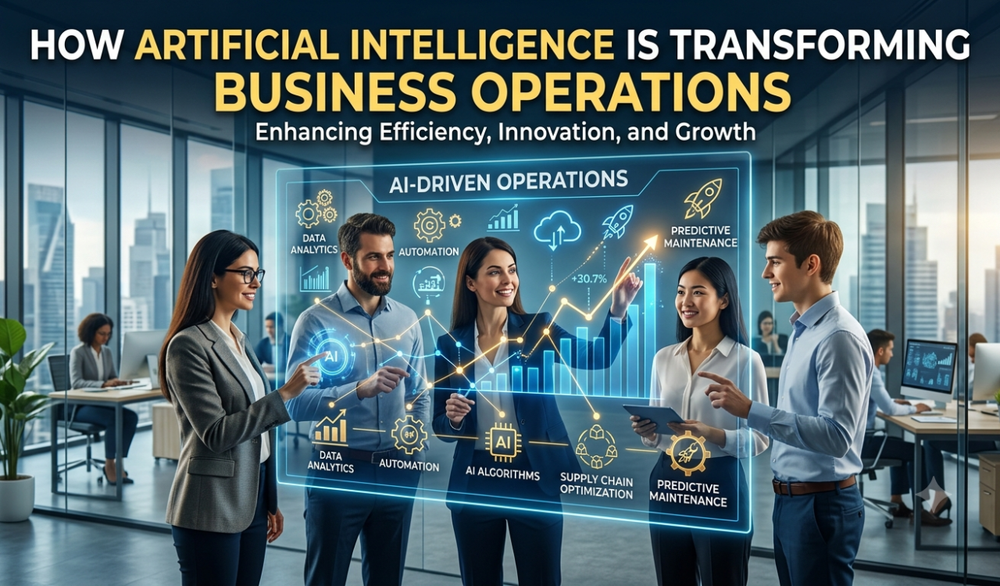
Artificial Intelligence (AI) has moved beyond being a futuristic concept and has become a practical technology that is reshaping how organizations operate, make decisions, and deliver value to customers. From automating repetitive tasks to improving business intelligence, AI is helping companies increase efficiency, reduce operational costs, and create more personalized experiences.
Businesses across industries are adopting AI-driven solutions to improve productivity, manage large volumes of data, and respond faster to market changes. According to research from global technology organizations, AI adoption continues to grow as companies recognize its potential to optimize workflows and support strategic decision-making.
Rather than replacing human capabilities, artificial intelligence is becoming a powerful tool that enables employees to focus on creative thinking, problem-solving, and higher-value activities. Organizations that successfully integrate AI into their operations can build more agile, competitive, and customer-focused business models.
Understanding the Role of Artificial Intelligence in Business Operations
Artificial Intelligence refers to computer systems designed to perform tasks that traditionally require human intelligence, such as learning, reasoning, decision-making, language understanding, and pattern recognition.
In business environments, AI uses technologies such as machine learning, natural language processing, computer vision, and predictive analytics to analyze information and automate complex processes. These capabilities allow businesses to identify opportunities, predict future trends, and make informed decisions based on real-time insights.
Modern businesses generate massive amounts of data every day. AI helps organizations process this data efficiently and transform it into meaningful information. Whether it is analyzing customer behavior, optimizing supply chains, or improving internal operations, AI provides businesses with valuable insights that were previously difficult to obtain.
AI-Powered Automation Improves Operational Efficiency
One of the most significant impacts of artificial intelligence is automation. Many organizations spend considerable time managing repetitive administrative tasks, data entry, scheduling, reporting, and customer inquiries. AI-powered automation helps streamline these activities, allowing employees to focus on strategic responsibilities.
For example, businesses can use AI-powered systems to automate invoice processing, inventory management, employee onboarding, and document analysis. These solutions reduce manual errors, improve processing speed, and create more consistent workflows.
Robotic Process Automation (RPA) combined with AI is also helping organizations handle complex business processes. Unlike traditional automation, AI-powered automation can learn from patterns, adapt to changes, and make decisions based on available information.
As companies continue to adopt intelligent automation, operational processes become faster, more accurate, and more scalable.
Enhancing Decision-Making Through Data Analytics
Data has become one of the most valuable assets for modern organizations. However, collecting data alone is not enough. Businesses need effective methods to analyze information and convert it into actionable strategies.
AI-powered analytics tools help organizations identify trends, predict customer behavior, and understand operational performance. Machine learning algorithms can analyze historical data to forecast demand, identify risks, and recommend better business strategies.
For example, retailers use AI analytics to predict customer purchasing patterns and optimize inventory levels. Financial institutions use AI to detect fraudulent transactions and assess risks. Healthcare organizations use AI models to improve diagnosis processes and enhance patient services.
By supporting data-driven decision-making, artificial intelligence enables businesses to make faster and more accurate decisions while reducing uncertainty.
Improving Customer Experience With AI Technologies
Customer expectations have changed significantly in the digital era. People expect faster responses, personalized recommendations, and seamless interactions across multiple platforms. AI helps businesses deliver improved customer experiences by understanding individual preferences and behaviors.
AI-powered chatbots and virtual assistants are widely used to provide instant customer support. These systems can answer common questions, process requests, and assist customers 24/7. This improves response times while reducing the workload on customer service teams.
Recommendation engines are another example of AI-driven customer personalization. Online platforms analyze user behavior to suggest relevant products, services, or content. This creates personalized experiences that increase customer satisfaction and engagement.
Businesses investing in AI-based customer solutions can build stronger relationships and improve long-term customer loyalty.
AI Transforming Marketing and Sales Operations
Artificial intelligence is also changing how companies approach marketing and sales. Traditional marketing strategies often rely on broad customer targeting, but AI enables businesses to create more personalized and effective campaigns.
AI tools analyze customer data, online behavior, and purchasing patterns to identify potential leads and understand customer needs. Sales teams can use these insights to prioritize prospects and improve conversion rates.
Marketing professionals use AI for content optimization, customer segmentation, campaign analysis, and predictive modeling. These capabilities help organizations deliver the right message to the right audience at the right time.
AI-driven sales forecasting also helps companies estimate future revenue opportunities and improve resource planning.
Strengthening Supply Chain and Inventory Management
Supply chain operations involve multiple factors, including demand forecasting, transportation, inventory management, and supplier coordination. AI is helping businesses improve supply chain visibility and efficiency.
Predictive analytics allows organizations to forecast demand more accurately and maintain optimal inventory levels. AI systems can analyze market trends, customer behavior, seasonal changes, and historical sales data to improve planning.
In logistics, AI helps optimize delivery routes, reduce transportation costs, and improve shipment tracking. Companies can identify potential disruptions and take preventive actions before problems affect operations.
By improving supply chain management, AI enables businesses to become more resilient and responsive to changing market conditions.
The Growing Importance of AI in Mobile Business Solutions
As businesses increasingly rely on digital platforms, AI integration within mobile applications has become an important strategy for improving customer engagement and operational efficiency. AI-powered mobile solutions can provide personalized recommendations, intelligent assistants, predictive analytics, and automated workflows.
Organizations looking to develop advanced mobile solutions often collaborate with technology partners that understand AI integration, user experience design, and scalable application architecture. iQlance Solutions Canada helps businesses explore modern digital solutions by combining mobile technologies with emerging innovations such as artificial intelligence, automation, and intelligent data-driven features. For example, a mobile app development company in saskatchewan can help businesses create intelligent applications that combine modern mobile technologies with AI capabilities.
AI-enabled mobile applications allow businesses to connect with customers more effectively while providing employees with real-time access to important business information.
Improving Cybersecurity With Artificial Intelligence
Cybersecurity threats continue to increase as businesses become more digitally connected. Artificial intelligence is playing an important role in identifying and preventing security risks.
AI-powered security systems analyze network activity, detect unusual patterns, and identify potential threats in real time. Unlike traditional security methods that rely mainly on predefined rules, AI systems can continuously learn from new threats and improve detection capabilities.
Organizations use AI for fraud detection, identity verification, threat monitoring, and automated security responses. This helps businesses protect sensitive information and maintain customer trust.
The Role of Skilled Developers in Building AI-Driven Business Solutions
Implementing artificial intelligence into business operations requires more than adopting new tools. Organizations need well-designed digital platforms that can integrate AI capabilities, manage data effectively, and provide seamless user experiences. Skilled developers play an important role in creating applications and systems that allow businesses to utilize AI technologies efficiently.
From intelligent automation platforms to AI-powered mobile applications, developers help transform business requirements into practical digital solutions. They focus on creating secure architectures, integrating advanced technologies, and ensuring that AI-driven systems can scale according to future business needs.
As businesses continue exploring AI adoption, selecting the right development approach becomes an important consideration. Companies looking to build technology solutions should understand the importance of experienced development teams, proper planning, and scalable application strategies. You can learn more about the factors involved in choosing the right development expertise in this guide: Why Hire App Developers in Toronto for Your Business?.
Challenges Businesses Face When Implementing AI
Although AI offers significant benefits, businesses must carefully plan their AI adoption strategies. Implementing artificial intelligence requires investment in technology infrastructure, skilled professionals, data management practices, and security measures.
Data quality is one of the biggest factors affecting AI performance. AI systems depend on accurate and reliable information to generate meaningful results. Poor-quality data can lead to incorrect insights and ineffective outcomes.
Organizations must also consider ethical concerns, including data privacy, transparency, and responsible AI usage. Businesses should establish clear guidelines to ensure AI technologies are used fairly and securely.
Employee training is another important consideration. Companies need to help employees understand how AI tools work and how these technologies can support their roles.
The Future of AI in Business Operations
The adoption of artificial intelligence will continue to accelerate as businesses explore new ways to improve efficiency and innovation. Future AI systems are expected to become more advanced, providing deeper insights and greater automation capabilities.
Generative AI, conversational AI, and autonomous systems are already influencing business strategies across industries. Companies that embrace AI responsibly will have better opportunities to improve productivity, enhance customer experiences, and create new growth opportunities.
The future of business operations will not be based on humans versus machines but on collaboration between human expertise and intelligent technologies. Organizations that successfully combine creativity, strategic thinking, and AI capabilities will be better positioned for long-term success.
Conclusion
Artificial Intelligence is transforming business operations by improving automation, decision-making, customer experiences, cybersecurity, and operational efficiency. As businesses continue to generate more data and face increasing competition, AI provides the tools needed to operate smarter and adapt faster.
Successful AI adoption requires a balanced approach that combines technology investment, employee skills, responsible practices, and clear business objectives. Companies that strategically implement AI solutions can unlock new opportunities and build stronger foundations for future growth.
AI is no longer just an emerging technology; it has become a key driver of modern business transformation. Organizations that understand its potential and integrate it effectively will continue to lead in an increasingly digital economy.