
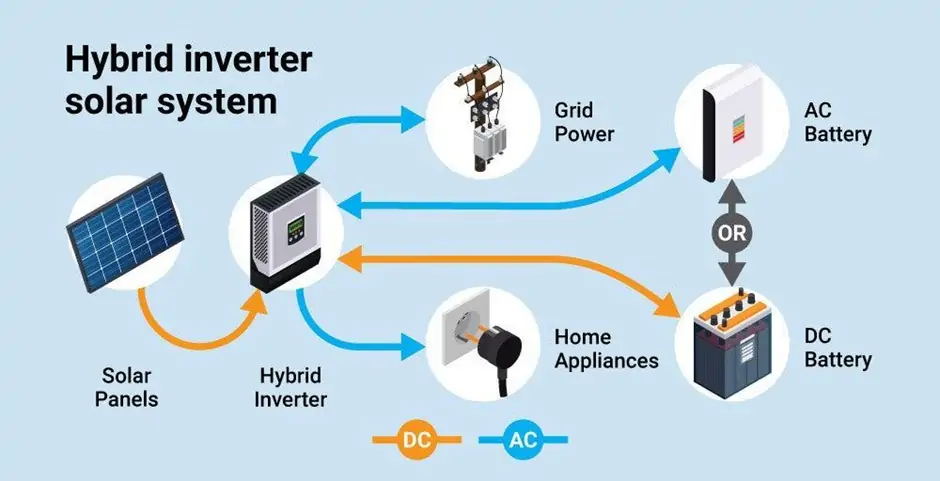
A hybrid solar inverter is a power-conversion and energy-management device that can coordinate solar panels, a battery, household or business loads, and the utility grid within one system. Unlike a conventional grid-tied solar inverter that mainly converts solar DC electricity into AC electricity for immediate use or export, a hybrid inverter can also charge and discharge compatible battery storage. That makes a hybrid solar inverter useful for households that want to increase solar self-consumption, shift energy use to different times of day, add backup capability, or reduce dependence on grid electricity. However, “hybrid” does not automatically mean that the home will stay powered during a blackout. Backup operation requires the correct system architecture, isolation/transfer equipment, battery capacity, wiring, protection, commissioning, and local electrical approval.
Products such as the Sigen Energy Controller illustrate the modern approach of combining solar conversion, battery management, monitoring, and grid interaction in one energy-control platform. When comparing products, buyers should focus on usable power, battery compatibility, backup behavior, PV input limits, efficiency, warranties, certifications, and installer support rather than only the headline inverter size. This guide explains how hybrid solar inverters work, how they differ from ordinary string inverters and battery inverters, DC-coupled vs. AC-coupled storage, backup power, battery sizing, single-phase and three-phase systems, monitoring, safety, and the questions to ask before installation. What Does a Solar Inverter Do?. Solar photovoltaic panels produce direct-current electricity. Most building loads and utility grids operate on alternating current. The inverter therefore performs the essential job of converting DC electricity from the PV array into AC electricity at the voltage and frequency required by the building and grid.
What Makes a Hybrid Solar Inverter Different?
The preserved U.S. Department of Energy — Solar Plus Storage explains the solar-plus-storage concept at a consumer level: batteries can store solar generation for use later and, when the system is designed for it, can support selected loads during an outage. A hybrid inverter coordinates these flows, but the label “hybrid” does not by itself guarantee whole-home backup, islanding capability, or compatibility with every battery. A hybrid inverter adds the ability to coordinate energy storage. Depending on the design, it can: convert PV DC to AC; send PV energy to household loads; charge a battery; discharge the battery; export surplus energy to the grid; import grid electricity; control backup loads during an outage where configured; provide monitoring and operating modes.
Energy Flow and Solar Self-Consumption
Basic Energy Flow. Imagine a sunny afternoon when the PV array produces 6 kW and the house is using 2 kW. A hybrid system might: supply the 2 kW household load from solar; use some of the remaining 4 kW to charge the battery; export any remaining surplus to the grid once battery limits are reached. Later in the evening, the battery can discharge to serve loads after solar production falls. Solar Self-Consumption. Self-consumption means using more of the electricity produced by your own solar system instead of exporting it immediately. A battery can increase self-consumption by storing midday solar production for: evening cooking; lighting; air conditioning; electronics; overnight base loads. Why Self-Consumption Economics Vary. Battery economics depend on: electricity price; export compensation; time-of-use tariffs; battery cost; round-trip losses; cycle life; household load pattern. A battery is not automatically profitable just because it stores solar electricity. Hybrid Inverter vs. Grid-Tied Inverter.
| Grid-Tied Solar Inverter | Hybrid Inverter |
|---|---|
| Converts PV DC to AC | Converts PV DC to AC |
| Usually no direct battery port | Designed to work with compatible battery storage |
| Exports surplus to grid | Can charge battery before/alongside export |
| Normally shuts down during outage | May support backup when the full system is designed for it |
Backup Power During Grid Outages
Why Ordinary Grid-Tied Solar Shuts Down During an Outage. Many people assume rooftop solar should keep the lights on whenever the sun is shining. Conventional grid-tied PV systems typically shut down when utility power disappears because the inverter must stop energizing the grid during an outage. This protects: utility workers; equipment; the building electrical system. This anti-islanding behavior is an essential safety feature. Backup Power Requires More Than a Battery. To provide backup, the system must be able to create and operate an electrically isolated local supply. That can require: hybrid inverter or battery inverter capable of grid-forming/backup operation; automatic or manual transfer/islanding equipment; protected backup-load panel or whole-home architecture; battery; controls; proper neutral/earthing design; local code compliance.
Essential-Loads Backup. Many systems back up only selected circuits. Typical essential loads include: refrigerator; lighting; internet router; small electronics; selected outlets; medical equipment where appropriately designed. This reduces the required inverter and battery size. Whole-Home Backup. Whole-home backup is possible with some systems but requires careful load analysis. High-power loads can include: central air conditioning; electric water heating; electric ovens; EV charging; pumps; large motors. The battery may have enough stored energy but still be unable to supply the instantaneous power or motor starting current required.
Battery Sizing, Power, and Runtime
Power vs. Energy. These two concepts are often confused. Power is measured in kW and describes how much electrical demand can be supplied at one moment. Energy is measured in kWh and describes how much electricity can be supplied over time. A 10 kWh battery cannot necessarily run a 10 kW load for one hour because usable capacity, inverter limits, losses, and battery discharge limits matter. How to Estimate Battery Runtime. A rough calculation is: Usable battery energy ÷ average backup load = approximate runtime. For example, if usable energy is 9 kWh and average loads are 1.5 kW: 9 ÷ 1.5 = about 6 hours before considering all real-world losses and reserve settings.
DC vs. AC Coupling, MPPTs, and Battery Compatibility
The National Renewable Energy Laboratory — Solar Power Electronics provides additional technical context on power electronics. The practical design decision is to match inverter topology, PV voltage/current limits, battery voltage window, charge/discharge power, communications protocol, and grid requirements as one system. A battery that is electrically similar but not approved by the inverter manufacturer can create commissioning, warranty, or safety problems. DC-Coupled Solar and Battery Storage. In a DC-coupled architecture, solar and battery connect on the DC side through a compatible hybrid inverter or associated DC power electronics. Potential advantages include: fewer conversion stages when charging battery directly from solar; integrated control; clean architecture for new installations; potential ability to capture PV energy that would otherwise be clipped, depending on design.
AC-Coupled Battery Storage. In an AC-coupled system, the solar array normally has its own solar inverter and the battery has a separate battery inverter. This can be attractive when: solar already exists; you want to add storage later; the existing PV inverter remains useful. The trade-off can be additional power-conversion stages when solar charges the battery. Which Architecture Is Better?. Neither is universally better. DC coupling often makes sense for a new solar-plus-storage installation. AC coupling can make sense for retrofit projects. Compare: compatibility; efficiency; installation complexity; backup behavior; expandability; warranty; service support. MPPTs and Solar Array Design. Hybrid inverters typically include Maximum Power Point Tracking inputs.
MPPTs help the inverter operate solar strings at voltage/current conditions that maximize available PV power. When selecting an inverter, check: maximum PV input voltage; MPPT operating voltage range; number of MPPT channels; maximum input current per MPPT; allowed PV oversizing. Why Multiple MPPTs Matter. Multiple MPPT channels can help when arrays face: different roof directions; different tilt angles; different shading conditions; different string designs. Battery Compatibility. A hybrid inverter cannot necessarily work with any battery. Compatibility can depend on: battery voltage; communication protocol; battery management system; firmware; maximum charge/discharge current; approved product list. Always check the manufacturer’s compatibility matrix. Low-Voltage vs. High-Voltage Batteries. Residential batteries can use different DC voltage architectures.
Higher-voltage battery systems can reduce current for the same power level, which can influence: cable sizing; conversion efficiency; system design. Do not mix batteries and inverters across incompatible voltage ranges. Lithium Iron Phosphate Batteries. Many modern stationary battery systems use lithium iron phosphate, often abbreviated LFP or LiFePO4. LFP is widely used because it can offer: long cycle life; good thermal stability; useful stationary-energy performance. Battery quality still depends on cell design, BMS, enclosure, thermal management, certification, and installation. Depth of Discharge. A battery may have a nameplate capacity and a smaller usable capacity. For example, software may reserve part of the battery to: protect battery life; preserve emergency backup; maintain system operation.
Use usable kWh for runtime calculations. Round-Trip Efficiency. Energy is lost when: charging the battery; storing energy; discharging; converting between DC and AC. Round-trip efficiency describes how much of the stored energy returns as usable electrical output. Compare values under comparable test conditions. Single-Phase vs. Three-Phase Hybrid Inverters. The correct inverter must match the building’s electrical service and local grid requirements. Three-phase systems are common in: larger homes in some markets; commercial buildings; workshops; industrial facilities. Backup performance across phases requires careful design.
Grid Services, Export Limiting, and Time-of-Use Control
Export Limiting. Some utilities limit how much solar power can be exported. Hybrid systems may support: zero export; fixed export limit; dynamic export control. This normally requires a meter or current sensor that measures power at the grid connection point. Time-of-Use Optimization. Where electricity tariffs vary by time, a battery may be scheduled to: charge from solar when available; avoid expensive grid consumption during peak hours; preserve a backup reserve. Whether grid charging is economically or contractually allowed depends on tariff and local rules. Peak Shaving. Commercial users may use batteries to reduce short periods of high demand. This can matter where the electricity bill includes: demand charges; capacity charges; peak-period tariffs.
Battery Backup Reserve. Many systems let the owner reserve a percentage of battery capacity for outages. A high reserve: improves emergency readiness; reduces energy available for daily bill optimization. The best setting depends on outage frequency and priorities. Black Start. Some systems can restart after a complete shutdown without the utility grid when enough battery energy is available. This capability is called black start in some contexts. Do not assume every hybrid inverter supports it. Solar Recharging During a Long Outage. A well-designed backup system may recharge the battery from solar while the grid remains down. This can greatly extend outage endurance. But the system must manage: daytime PV variability; battery state of charge; household demand; PV curtailment when the battery is full; restart thresholds. Inverter Efficiency. Inverter efficiency varies with: load; DC voltage; temperature; operating mode. Do not compare only the best single efficiency number. Review: weighted efficiency; battery conversion efficiency; standby consumption; low-load performance.
Sizing, Monitoring, Warranty, and Expansion
Inverter Sizing. A 10 kW PV array does not automatically require a 10 kW inverter. Solar systems are often designed with a DC/AC ratio that intentionally allows the PV array to be somewhat larger than the inverter’s AC rating. The correct ratio depends on: climate; roof orientation; inverter limits; utility rules; battery charging behavior. Clipping. Clipping occurs when available PV power exceeds the inverter’s maximum AC conversion capacity. Some clipping can be economically acceptable because panels rarely operate at nameplate power for long periods. Battery Power Rating. Check both: continuous charge/discharge power; short-duration peak power. Peak power matters for motors and appliances with high startup current.
Monitoring and Apps. Modern hybrid systems often show: solar production; house load; battery state of charge; grid import; grid export; historical energy flows; fault alerts. Useful monitoring can help identify abnormal consumption or equipment problems. Cloud Monitoring and Privacy. Ask: Does the system require a cloud account?; What happens if internet access fails?; Who can access energy data?; Can the owner export data?; How long will the app be supported?. Firmware Updates. Hybrid inverters are software-controlled equipment. Firmware can affect: battery compatibility; grid compliance; operating modes; monitoring; fault response. Use authorized update procedures.
Safety, Interconnection, and Installation
Safety. Solar-plus-storage involves potentially hazardous DC voltage and substantial stored energy. Installation should include appropriate: overcurrent protection; isolators; earthing/grounding; surge protection; battery protection; fire and clearance requirements; signage; commissioning tests. Grid Interconnection. The inverter must meet the applicable grid-interconnection requirements of the country, utility, or distribution operator. Do not import an inverter solely because its voltage appears correct. Grid certification can involve: anti-islanding; frequency response; voltage response; power quality; reactive power; remote control capabilities. Installation Location. Follow manufacturer requirements for: temperature; sun exposure; weather protection; clearance; ventilation; wall loading; fire separation. Heat can reduce inverter output and accelerate component aging. Warranty. Compare: inverter warranty; battery warranty; throughput or cycle limits; retained-capacity guarantee; labor coverage; shipping/replacement terms.
A long headline warranty is less useful if local service is unavailable. Future Expansion. Ask whether the system can support: additional battery modules; more PV; EV charging; generator integration; smart loads. Expansion limits should be documented before purchase. Retrofitting a Hybrid Inverter. If a home already has solar, replacing the existing inverter with a hybrid model may require: new string design; rewiring; new approvals; warranty review; changes to monitoring. An AC-coupled battery may be simpler in some cases. Common Buying Mistakes. Assuming “hybrid” guarantees blackout power. Backup needs dedicated system design. Matching only inverter kW. Check PV voltage/current, battery power, MPPTs, and grid requirements. Ignoring battery compatibility. Not every battery communicates with every inverter.
Sizing battery only from daily electricity use. Backup load and peak power matter too. Buying unsupported equipment. Local installer and warranty support are important over a 10–15 year system life. Questions to Ask an Installer. Which loads will operate during a blackout?; How many kW can the system supply continuously?; What is the battery’s usable kWh?; Can solar recharge the battery while the grid is down?; How fast is the transfer to backup mode?; Which batteries are approved?; How is export controlled?; What local grid approvals are required?; What monitoring remains available without internet?; Who provides warranty service?. Frequently Asked Questions. Can a hybrid inverter work without a battery?. Some models can operate as solar inverters before a battery is added; others have specific configuration requirements. Check the manufacturer.
Will solar panels work during a blackout?. Only if the installed system is specifically designed to form an isolated backup supply and operate PV safely without the grid. Can a hybrid inverter charge a battery from the grid?. Many can, but whether that mode is enabled or economically appropriate depends on product settings, tariffs, and local rules. Is DC-coupled storage more efficient?. It can reduce conversion stages when charging directly from solar, but total system performance depends on the actual equipment and operating pattern. How large should my battery be?. Size it from the desired backup loads, outage duration, daily energy use, tariffs, solar production, and budget—not from house size alone.
Conclusion
A hybrid solar inverter is valuable because it coordinates solar generation, battery storage, household loads, and the grid instead of treating each as a separate system. That can increase self-consumption, support time-of-use optimization, and provide backup when the entire installation is designed for outage operation. The word “hybrid,” however, is not enough to make a buying decision. Compare PV input limits, MPPT design, battery compatibility, continuous and peak backup power, usable battery capacity, grid certification, transfer equipment, monitoring, warranty, and local support. For new solar-plus-storage installations, an integrated hybrid architecture can be clean and efficient. For an existing solar system, AC-coupled storage may sometimes be the simpler retrofit. A qualified installer should model both options against the real load profile and backup goals. Most importantly, define what you want the system to do during a power outage before buying the inverter. “Run the refrigerator and lights overnight” and “run the entire house including air conditioning and EV charging” are very different engineering problems.