
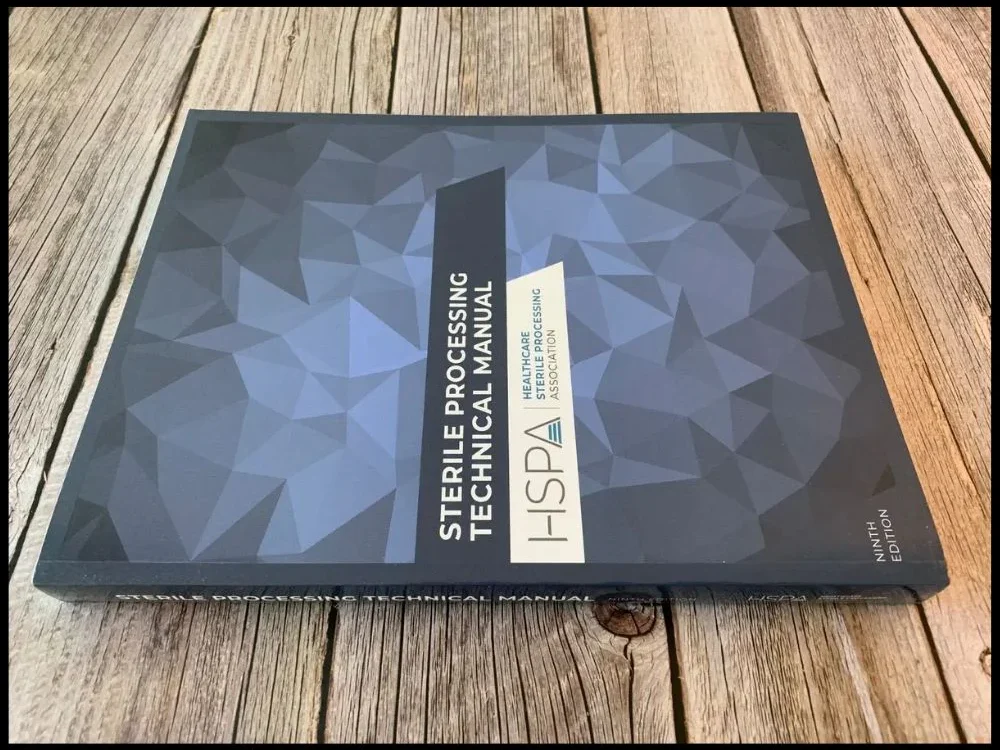
The best sterile processing technician study materials in 2026 are the resources that match the certification you actually plan to take and the standards used in current practice. A thick textbook by itself is not enough. Candidates need a current core manual, the certification exam content outline, hands-on exposure to decontamination and assembly workflows, terminology review, instrument recognition, practice questions, and a way to connect memorized facts with real department procedures. For candidates preparing for HSPA’s Certified Registered Central Service Technician exam, the most important update is that the current exam draws from HSPA’s ninth-edition Sterile Processing Technical Manual rather than the older eighth edition. HSPA states that beginning July 1, 2024, the eighth edition stopped being a current CRCST exam reference. Anyone building a 2026 study plan from old forum posts, used books, or inherited department materials should therefore check the edition before investing time.
Sterile Processing Technician Books and Start With the Certification You Plan to Earn
Sterile processing has more than one credentialing pathway, and study materials should be selected accordingly. HSPA’s CRCST is one widely recognized entry-level certification, while the Certification Board for Sterile Processing and Distribution offers the CSPDT credential. The broad knowledge areas overlap—decontamination, disinfection, sterilization, instrumentation, packaging, infection prevention, storage, quality, and regulations—but exam blueprints, terminology, policies, and application requirements are not identical. Before buying books, download the current candidate handbook and exam content outline from the certification body. The outline tells you what is actually tested and prevents a common mistake: spending weeks memorizing rare instrument names while neglecting high-weight topics such as cleaning, sterilization parameters, workflow, quality assurance, or infection prevention.
HSPA Sterile Processing Technical Manual, 9th Edition. For CRCST candidates, the HSPA: Sterile Processing Technical Manual, 9th Edition is the most direct core resource because HSPA identifies it as the current manual for the CRCST exam. The book covers medical terminology, anatomy, microbiology, infection prevention, regulations and standards, point-of-use treatment, cleaning, disinfection, instrumentation, packaging, sterilization, storage, tracking systems, and other daily sterile-processing responsibilities. The strength of the manual is not simply that it is “official.” Its chapter sequence mirrors the way candidates need to build knowledge: understand microorganisms and infection prevention, then learn how contaminated devices move through decontamination, inspection, preparation, sterilization, storage, and distribution. Candidates who treat the text as a reference rather than a book to memorize usually learn more effectively.
The HSPA Workbook Is Best Used With the Manual
HSPA sells a companion workbook and specifically describes it as a tool for reinforcing concepts from the ninth-edition text rather than as a stand-alone study resource. That distinction is useful. Workbooks help reveal gaps because answering a question requires retrieval, not recognition. If you only reread highlighted paragraphs, it is easy to mistake familiarity for mastery. A practical approach is to read one chapter, close the book, complete workbook or self-written questions from memory, then review every error. Keep a notebook of missed concepts rather than rewriting entire chapters. By exam week, that error log becomes a much more efficient review tool than rereading hundreds of pages.
HSPA CRCST Requirements Shape the Study Plan. The official HSPA: CRCST Certification page states that candidates need 400 hours of hands-on sterile-processing experience to obtain full CRCST status. Candidates can document the experience before testing or pass the exam provisionally and complete the required hours within the applicable provisional period. HSPA currently breaks the 400 hours across decontamination, preparation and packaging, sterilization and disinfection, storage and distribution, and quality-assurance processes. This is important educationally because the exam is not intended to be pure book knowledge. A technician who has physically loaded a washer, inspected instruments, assembled trays, read chemical indicators, managed sterilizer records, and handled storage has mental context for the textbook. If you are studying provisionally without experience, visit a department, seek volunteer or employment opportunities, and connect each chapter with how the process is actually performed under local policies.
Use Standards as Working Tools, Not Cover-to-Cover Textbooks
Sterile processing is governed by standards, manufacturer instructions for use, regulatory requirements, and facility policy. Candidates often hear names such as ANSI/AAMI ST79 or AORN Guidelines and assume they need to memorize every page. That is rarely the best way to prepare for an entry-level exam. Standards are dense reference documents designed for professional practice, not simplified exam-prep books. Use them to understand why procedures exist and to resolve specific questions about steam sterilization, quality control, storage, transport, or other topics. If your department has access, learn how to navigate the documents. That habit becomes more valuable after certification because standards change and sterile processing professionals need to locate current requirements rather than rely on memory from an old exam guide.
A Medical Terminology Resource Is Worth the Time. New technicians often underestimate how much vocabulary affects exam performance. Terms related to anatomy, microorganisms, cleaning chemistry, surgical procedures, instrumentation, sterilization, packaging, and quality systems appear throughout the material. When the language itself is unfamiliar, even a simple question can become difficult. Create a terminology deck as you study. Include the term, a plain-English definition, and one example from sterile processing. Avoid memorizing isolated definitions without context. For example, connect “bioburden” with what technicians are trying to remove during point-of-use treatment and cleaning, and connect “aseptic” with the conditions needed to prevent contamination after sterilization.
Instrument Identification Requires Visual Study
Surgical instruments are easier to learn from images and hands-on handling than from text descriptions. A candidate should become comfortable recognizing common clamps, scissors, retractors, forceps, needle holders, suction devices, laparoscopic instruments, and specialty devices while also understanding inspection points and functional testing. Use an instrument atlas, department tray lists, manufacturer catalogs, or approved training images. When studying an instrument, ask four questions: What is it called? What is its function? What features must be inspected? How should it be cleaned or handled? This prevents instrument study from becoming a picture-matching exercise.
Decontamination Should Receive Heavy Study Attention. Decontamination is foundational because cleaning failure can compromise everything that follows. Candidates should understand point-of-use treatment, safe transport, personal protective equipment, water quality, detergents, enzymatic products, manual cleaning, mechanical washers, ultrasonic cleaning, flushing of lumens, rinsing, drying, and how manufacturer instructions for use control the process. Focus on principles rather than memorizing one facility’s routine as if it applies everywhere. A local department may use a particular detergent concentration or washer cycle, while the exam may test the underlying rule that devices must be processed according to the device and chemical manufacturer’s instructions. When department practice and textbook language appear different, ask an educator to explain the governing standard.
Sterilization Study Should Connect Method, Device, and Monitoring
Candidates should know the major sterilization methods used in sterile processing and the reasons one method is selected over another. Steam is widely used for heat- and moisture-stable devices, while low-temperature systems serve devices that cannot tolerate conventional steam conditions. The key is to understand compatibility, packaging, cycle parameters, loading, drying, monitoring, and release criteria. Biological indicators, chemical indicators, physical monitors, and documentation are frequently confused because they all provide different information. Build a comparison table for what each monitor measures, where it is used, and what action is taken when a result is unacceptable. This is more useful than memorizing isolated color changes.
Practice Questions Are for Diagnosis, Not Prediction. A good question bank helps you identify weak domains and practice reading exam-style wording. It should not be treated as a prediction of the live exam. Avoid websites that claim to contain “real leaked CRCST questions,” guarantee a passing score, or encourage memorizing answer dumps. Certification exams change, and using unauthorized material undermines both preparation and professional integrity. When reviewing a practice question, explain why the correct answer is right and why each distractor is wrong. If you guessed correctly, count the question as a weakness. The goal is to build reasoning that transfers to a new scenario.
Online Courses Can Add Structure
Some learners study best with a scheduled course rather than a book alone. Online or classroom programs can provide lectures, quizzes, demonstrations, study calendars, and instructor access. However, HSPA is clear that an exam-preparation course is not the same as certification. Passing a course does not replace the certification exam or required experience. When comparing a sterile processing technician course, check whether it uses the current exam blueprint and references, how recently its lessons were updated, whether instructors have current sterile-processing experience, and whether the practice material teaches concepts rather than only answer memorization. Third-Party Books Can Be Useful Supplements. A well-written third-party sterile processing technician book or study guide can simplify difficult topics, provide extra practice questions, and offer a different explanation when the official text feels dense. It should supplement the current certification references, not replace them. Before buying any third-party book, check the publication date, edition references, author qualifications, certification target, and table of contents. A guide still built around the HSPA eighth edition may contain useful fundamentals, but it should not be your primary CRCST source in 2026.
Flashcards Work Best for Facts That Need Fast Recall
Flashcards are excellent for terminology, instrument names, indicator types, basic microorganisms, packaging vocabulary, abbreviations, and short rules. They are less effective for complex workflow decisions that depend on context. Use spaced repetition so difficult cards appear more often and mastered cards less often. Keep cards small. A flashcard with an entire paragraph on the back is usually a note, not a retrieval tool. One question and one concise answer makes self-testing faster and more honest.
Build a Study Plan Around Exam Domains
Study phaseMain focusBest materials
FoundationTerminology, microbiology, infection prevention, workflowCurrent core manual, notes, flashcards
TechnicalCleaning, instrumentation, packaging, sterilizationManual, instrument images, workplace observation
ApplicationQuality, standards, storage, troubleshootingWorkbook, practice questions, department policies
Final reviewWeak domains and exam timingError log, mixed practice tests, short summaries
Do not spend equal time on every chapter automatically. After the first pass, let practice results determine where study time goes. A candidate strong in anatomy but weak in decontamination should shift hours toward decontamination even if the study calendar originally allocated equal time. Every work shift can become exam preparation if you ask why a process is performed. When receiving contaminated instruments, connect the workflow to transport and PPE principles. During assembly, connect inspection to instrument function. At the sterilizer, connect loading and monitoring to the cycle and release criteria. In storage, think about package integrity, handling, environmental control, and event-related contamination. Write down unfamiliar situations and research them after the shift. This creates a study list based on real practice, which is often more memorable than random review questions.Do Not Memorize Numbers Without Their Context. Sterile processing contains many temperatures, times, concentrations, pressure values, shelf-life concepts, and quality-control intervals. Numbers are easy to confuse when memorized as an isolated list. Whenever possible, connect a number to a process, device, standard, or manufacturer instruction. Also be careful with old internet charts. Standards and manufacturer instructions change. If an online flashcard contradicts the current manual or IFU, the online flashcard should not win because it is easier to remember.
What to Buy on a Limited Budget
If money is tight, prioritize the current core manual for your target certification and access to the official content outline. Add a workbook or reputable practice-question source next. Use free or employer-provided instrument images, department education, and standards access where available. You do not need ten competing prep books. Used books can save money, but verify the edition carefully. For CRCST in 2026, the HSPA ninth edition is the important distinction. A cheaper eighth-edition manual may cost less but can create extra work because you will need to identify what changed. A Four-Week Final Review Approach. During the final month, move from chapter-by-chapter reading toward mixed retrieval. Week one can focus on decontamination and infection prevention, week two on instrumentation and preparation, week three on sterilization, quality, storage, and standards, and week four on mixed practice and weak areas. Continue short terminology and instrument review throughout. Take at least some timed practice so that you learn to move on from a difficult question and return later. HSPA currently gives CRCST examinees three hours to complete the exam, so preparation should include attention management as well as content knowledge.
Conclusion
The best sterile processing technician books and study materials in 2026 are current, certification-specific, and connected to hands-on practice. For CRCST candidates, HSPA’s ninth-edition Sterile Processing Technical Manual is the core reference, supported by the workbook, official exam outline, current standards, instrument resources, and well-designed practice questions. Third-party guides and courses can be valuable when they simplify difficult concepts, but they should not replace the current official material or the 400 hours of experience required for full CRCST certification. A strong study plan uses books to understand the process, practice questions to expose weak areas, and real sterile-processing work to turn facts into professional judgment.