
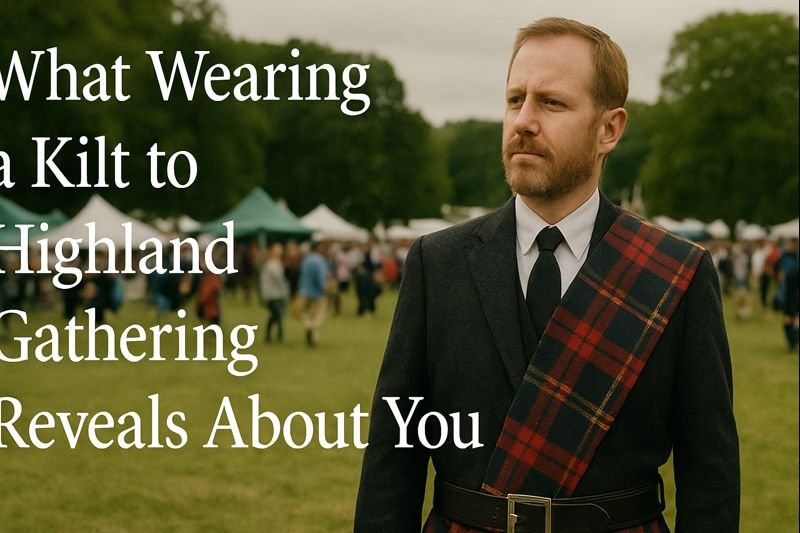
A Highland gathering is not merely an event. It is a convergence of memory, movement, sound, and identity. Pipes cut through open air, drums steady the rhythm of feet on grass, voices rise and fall in conversation, and history feels close enough to touch. When you choose to wear a kilt in this setting, you are not simply dressing for the occasion. You are making a statement—one that is read quietly, intuitively, and deeply by those around you.
What a kilt reveals at a Highland gathering is not loud or performative. It does not announce itself with explanation. Instead, it communicates through presence. Through posture. Through how comfortably you carry yourself among tradition. Others may notice the tartan, but what they truly perceive is the relationship you have with it. A kilt at a Highland gathering becomes a mirror, reflecting aspects of character, intention, and belonging that everyday clothing never could.
It Reveals How You Understand Tradition
At a Highland gathering, tradition is not abstract. It is lived. It is visible in the way people move, greet one another, and respect shared customs. Wearing a kilt in this environment shows how you approach tradition—not as something frozen in the past, but as something you are willing to step into.
Those who wear a kilt with ease reveal an understanding that tradition is not about perfection or rigid rules. It is about continuity. It is about showing up with respect rather than performance. The kilt does not demand historical expertise, but it does ask for sincerity. At a gathering, people quickly sense whether someone is wearing Highland dress to belong or simply to stand out.
Wearing a kilt in this setting suggests you understand that tradition is something you participate in, not something you observe from the edges. It shows that you are willing to carry a piece of history on your body, accepting both its weight and its meaning.
It Reveals Your Relationship With Identity
Identity behaves differently in a Highland gathering than it does elsewhere. Here, surnames matter. Patterns are recognized. Colours carry memory. When you wear a kilt, you place your identity into this shared space. You allow it to be seen, not scrutinized, but acknowledged.
This does not mean that everyone knows your story. It means that you are comfortable standing in relation to it. Wearing a kilt reveals whether you are at ease with who you are and where you come from, or at least with the journey of discovering it. Even those still learning about their heritage reveal openness by wearing Highland dress. Curiosity, after all, is a form of respect.
The kilt becomes a way of saying, without words, that identity matters to you. That you are not disconnected from your roots, even if those roots are complex or newly understood. At a gathering filled with shared symbols, this willingness to engage speaks clearly.
It Reveals Your Comfort With Visibility and Humility
Wearing a kilt makes you visible. There is no avoiding that. At a Highland gathering, this visibility is not about attracting attention, but about accepting presence. The way you carry that visibility reveals much about your character.
Those who wear a kilt comfortably reveal humility. They are not trying to dominate the space. They are not hiding either. They simply exist within it. They understand that the garment draws attention, but they do not chase it. Their confidence is quiet, grounded in belonging rather than display.
Others notice this immediately. Highland culture values dignity over spectacle. A person who wears a kilt with ease, without self-consciousness or exaggeration, demonstrates respect for the setting and for themselves. This balance between visibility and humility is one of the clearest qualities a kilt reveals at a gathering.
It Reveals How You Carry Responsibility
A kilt is not neutral clothing. It carries cultural weight. Wearing it in a space where that weight is understood reveals how you handle responsibility. You are, in a small but meaningful way, representing something larger than yourself.
At a Highland gathering, people notice whether someone treats the garment lightly or with care. This is not about strict rules. It is about attitude. Do you treat the kilt as a novelty, or as something worth honouring? Do you move with awareness, or with disregard?
Those who wear a kilt thoughtfully reveal that they understand responsibility as something lived, not spoken. They show that they are willing to be accountable to tradition, even in small ways. This quality is quietly respected within the gathering.
It Reveals Your Relationship With Community
Highland gatherings are communal by nature. They bring together clans, families, friends, and strangers connected by shared culture. Wearing a kilt in this space signals your willingness to be part of that community.
This does not require perfect knowledge or deep ancestry. It requires openness. A person who wears a kilt reveals that they are not standing apart. They are willing to participate, to listen, to engage. They understand that Highland culture is collective rather than individualistic.
Often, conversations begin around tartan. Questions are asked. Stories are shared. Wearing a kilt opens the door to these interactions. It reveals whether you are receptive to connection or closed to it. Those who engage warmly, who answer questions without defensiveness, who listen as much as they speak, reveal a strong sense of communal belonging.
It Reveals How You Honour the Past Without Living in It
A Highland gathering honours history, but it does not attempt to recreate it exactly. It exists in the present. Wearing a kilt in this context reveals how you balance respect for the past with life in the present.
Those who wear Highland dress comfortably among modern realities—phones, casual conversation, contemporary music mixed with tradition—show that they understand heritage as living rather than static. They do not treat the kilt as a relic. They treat it as something that belongs now.
This balance is important. It reveals maturity in how you approach culture. The kilt becomes part of your current life, not a costume from another era. At a gathering, this approach is quietly admired.
It Reveals Emotional Openness
Highland gatherings are emotional spaces, even when they are joyful. Music carries memory. Symbols evoke lineage. Stories surface unexpectedly. Wearing a kilt often heightens emotional awareness.
Those who choose to wear a kilt reveal a willingness to feel. They allow themselves to be affected by the environment rather than shielding themselves from it. This openness may show in small ways—a pause during a lament, a softened expression during a ceremony, a reflective moment amid celebration.
This emotional availability is not weakness. It is connection. Wearing a kilt at a gathering reveals that you are not afraid of feeling part of something larger, even when that feeling is complex.
It Reveals How You Move Through Tradition Physically
The kilt changes how a person moves. The weight, the pleats, the exposure to wind and weather all affect posture and rhythm. At a Highland gathering, this physical change becomes visible.
Those who wear a kilt naturally reveal patience. Their movements slow slightly. They stand with more intention. They become aware of their body in space. This physical awareness reflects internal respect. It shows that they are willing to adjust themselves to the garment rather than forcing the garment to adapt to them.
This willingness to adapt reveals flexibility, attentiveness, and presence—qualities that align closely with Highland values.
It Reveals Confidence Rooted in Belonging
There is a specific kind of confidence that appears at Highland gatherings. It is not assertive or competitive. It is steady. Wearing a kilt often amplifies this quality.
Those who wear a kilt confidently reveal that their sense of self does not rely on approval. They are comfortable being seen as they are, connected to something beyond individual expression. Their confidence comes from belonging, not dominance.
Others feel this instinctively. It creates trust. It creates ease. It allows genuine interaction. In this way, the kilt reveals inner stability rather than outward bravado.
It Reveals Respect for the Setting
A Highland gathering is a shared cultural space. Wearing a kilt shows respect for that space. It demonstrates that you have considered where you are and chosen to honour it through your presence.
This respect is communicated silently. It does not need explanation. Others recognize it immediately. They see that you have entered the gathering with intention rather than indifference.
This respect extends to how you behave, how you listen, and how you interact. The kilt becomes part of that behaviour. It reinforces awareness and restraint, reminding the wearer that they are part of something meaningful.
It Reveals What You Carry Forward
Ultimately, wearing a kilt to a Highland gathering reveals what you choose to carry forward. Tradition does not survive through preservation alone. It survives through people who are willing to embody it, even briefly.
When you wear a kilt in this space, you become part of the tradition’s continuation. You add your presence to a long line of others who stood in similar gatherings, hearing similar sounds, feeling similar emotions.
What you reveal is not perfection or expertise, but participation. You show that tradition matters enough to live in, not just remember.
Conclusion: The Kilt Speaks Quietly, but Clearly
At a Highland gathering, the kilt speaks without words. It reveals how you relate to identity, tradition, community, responsibility, and belonging. It shows whether you approach heritage with respect, curiosity, humility, and presence.
Others may notice the tartan first, but what they truly see is how you carry it. The kilt becomes a reflection of inner qualities rather than outward display.
In this setting, wearing a kilt is not about standing out. It is about standing with. And what that choice reveals is something no explanation could ever fully express.