
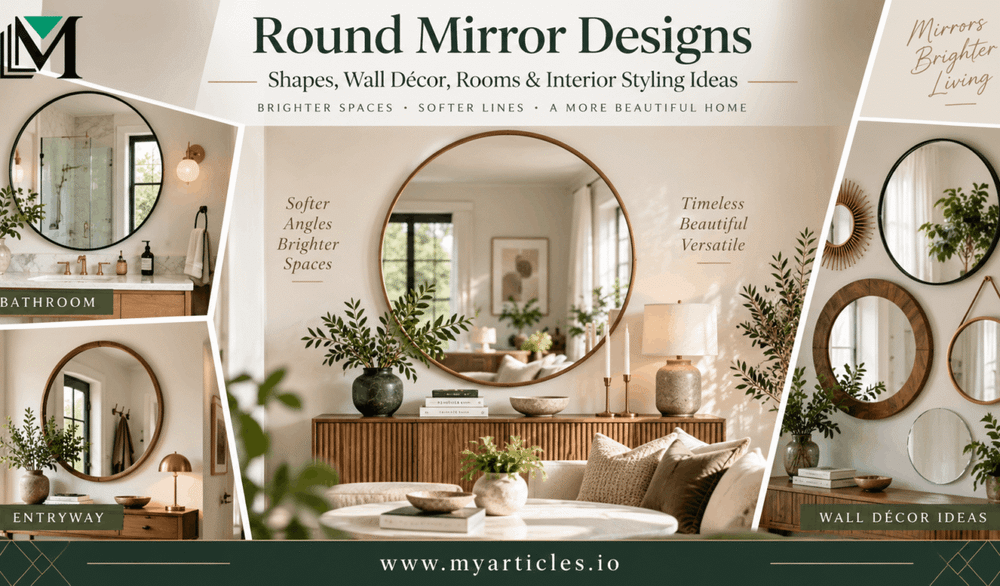
Round mirror designs work well in many interiors because the circular shape softens straight architectural lines while still providing a practical reflective surface. A well-chosen round mirror can make a bathroom feel lighter, give a hallway a stronger focal point, or add balance above a console, vanity, fireplace, or dresser. The best choice depends on scale, frame material, wall color, nearby furniture, and how much visual weight the room can handle.
Unlike rectangular mirrors, round mirrors do not introduce more hard corners into a space. That makes them especially useful in rooms dominated by cabinets, doors, tiles, shelves, or box-shaped furniture. MyArticles has a broader guide to the benefits of wall mirrors, while this article focuses specifically on how to choose and style circular designs.
Round Mirror Designs Start With the Right Size
The diameter of the mirror determines how strongly it reads in the room. A small round mirror can work as an accent, but it may look undersized above a wide vanity or console. A larger design can become the main visual feature of the wall, especially when the surrounding furniture is simple. As a practical rule, compare the mirror width with the furniture beneath it and leave enough breathing room so the mirror does not look squeezed into the available space.
In a narrow hallway or compact bathroom, a medium-size mirror often feels more balanced than an oversized statement piece. In a larger living room, entryway, or bedroom, a broad circular mirror can help fill an empty wall without requiring a complicated gallery arrangement. The most successful round mirror designs usually feel intentionally scaled to the wall rather than chosen only because a particular diameter was available.
9 Stylish Round Mirror Designs and Frame Ideas
1. Thin black frames suit modern, industrial, and minimalist interiors. The dark outline gives the circle definition without adding much visual weight, making it useful against white, beige, stone, or lightly textured walls.
2. Brass or gold-toned frames introduce warmth and can work particularly well with warm lighting, wood furniture, cream walls, and traditional or transitional décor. The metallic edge can also echo hardware used on lighting fixtures, taps, cabinet pulls, or furniture.
3. Frameless round mirrors create a cleaner look and keep attention on the reflective surface. They are useful in bathrooms and contemporary rooms where the surrounding finishes already provide enough texture and detail.
4. Wood-framed mirrors add natural texture. Light oak can suit Scandinavian or relaxed modern spaces, while darker wood can feel more traditional. A wood frame can also connect the mirror visually with flooring, shelves, or nearby furniture.
5. Leather or strap-hung mirrors add a decorative suspension detail above the circle. The strap becomes part of the composition, so it works best where there is enough vertical wall space for the hanging element to be visible.
6. Sunburst designs extend beyond the circular glass with radiating metal, wood, or decorative elements. These are more ornamental than minimalist mirrors and can serve as wall art as well as a functional mirror.
7. Shelf mirrors combine a round reflective surface with a small ledge for lightweight objects. They can be useful in entryways, bedrooms, or dressing areas, although the shelf should not be overloaded simply because it is available.
8. Pivot mirrors are practical in bathrooms because the angle can be adjusted. They often have side brackets and a more architectural appearance than a fixed wall mirror.
9. Oversized statement mirrors use scale rather than decoration to create impact. A large, simple circle above a console or dresser can feel more sophisticated than a heavily ornamented design if the rest of the room already contains strong colors or patterns.
Round Mirror Designs for Bathrooms
Bathrooms are one of the most natural places to use a circular mirror because the shape provides contrast against rectangular tiles, vanities, cabinets, and shower screens. A round bathroom mirror should still be large enough for practical grooming, and its center should align comfortably with the people who use the space. Before buying, measure both the vanity width and the available height between the countertop, taps, lighting, and ceiling.
A design such as this Round Mirror illustrates the clean circular format commonly used above bathroom vanities. When comparing products, look beyond the frame color. Check the diameter, edge treatment, mounting system, moisture suitability, and whether the hardware is appropriate for the wall construction.
Lighting also matters. If the mirror sits directly below a wall light, leave enough clearance so the two elements do not feel crowded. In a double-vanity bathroom, one wide mirror is not the only option; two matching round mirrors can create a balanced arrangement when the sinks are clearly separated.
Round Mirrors in Living Rooms Bedrooms and Hallways
In a living room, a round mirror can break up the repetition of straight furniture lines. It can work above a console, sideboard, fireplace, or low cabinet, particularly when the wall needs a single focal object rather than several small artworks. Placing the mirror where it reflects a bright part of the room can increase the sense of openness, but avoid positioning it only to reflect clutter or an awkward blank area.
Bedrooms often benefit from softer round mirror designs above a dresser or near a dressing area. A thin metal or wood frame can connect with bed frames, bedside tables, or lighting finishes without competing with textiles and artwork. If the mirror is mainly decorative, choose the position for visual balance; if it will be used for dressing, make sure the viewing height is practical.
Hallways and entryways are another strong location because a circular mirror adds a useful last-look surface without making the corridor feel more rigid. A medium or large mirror above a narrow console can create a complete composition with only a few additional objects, such as a lamp, tray, or small plant.
Using Multiple Round Mirrors as Wall Decor
A single mirror is usually the simplest option, but grouped round mirror designs can create a more decorative wall. Sets of three or five can work when the mirrors vary slightly in size or frame style while still sharing a common material or finish. The arrangement should feel intentional rather than scattered, so decide on the overall footprint before fixing anything to the wall.
Leave consistent visual spacing between grouped mirrors and consider how the composition relates to nearby furniture. A cluster that is too small can disappear on a large wall, while a group spread too widely can feel disconnected. Templates made from paper or painter’s tape can help you test the arrangement before drilling holes.
Placement Height and Reflection Matter
Even a beautiful mirror can look wrong if it is hung too high or too low. The ideal height depends on whether it is above furniture, used for grooming, or acting primarily as wall décor. When hanging above a console or dresser, the mirror should visually connect to the furniture instead of floating far above it. In bathrooms, prioritize a comfortable viewing height for the people using the vanity.
Think about what the mirror reflects from normal viewing positions. A window, light fixture, artwork, or attractive part of the room can strengthen the effect. A direct view of storage clutter, a blank ceiling corner, or a visually busy area may reduce the benefit. This is one reason placement should be tested before permanent installation.
Safety is also part of good placement. Large mirrors need mounting hardware appropriate for their weight and the wall type. Plasterboard, masonry, tile, and timber framing may require different anchors or fixing methods. When the mirror is heavy or installed above a high-traffic area, secure mounting matters more than achieving a perfectly minimal appearance.
How to Match a Round Mirror With the Rest of the Room
Frame finish is one of the easiest ways to connect a mirror to the surrounding interior. Black can echo window frames and modern lighting, brass can repeat warm metal hardware, and wood can tie into furniture or flooring. The match does not need to be exact; slightly varied finishes can look more natural than forcing every metal or timber tone to be identical.
Also consider contrast. A dark mirror on a dark wall may create a subtle, layered effect, while the same frame on a pale wall becomes much more graphic. Ornate round mirror designs tend to work best when other wall elements are restrained, while simple mirrors can sit comfortably beside patterned wallpaper, artwork, or textured surfaces.
Conclusion
Round mirror designs can work in bathrooms, bedrooms, living rooms, hallways, and entryways because the circular shape softens straight architectural lines and adapts to many interior styles. The key decisions are size, frame material, placement, reflection, and how strongly you want the mirror to act as a focal point.
A simple frameless circle may be the right choice for a modern bathroom, while a brass, wood, sunburst, shelf, or oversized design can bring more character to a decorative wall. Measure carefully, think about what the mirror will reflect, and choose a mounting method that suits the wall and the mirror’s weight. When those practical details are right, a round mirror can improve both the function and the visual balance of the room.