
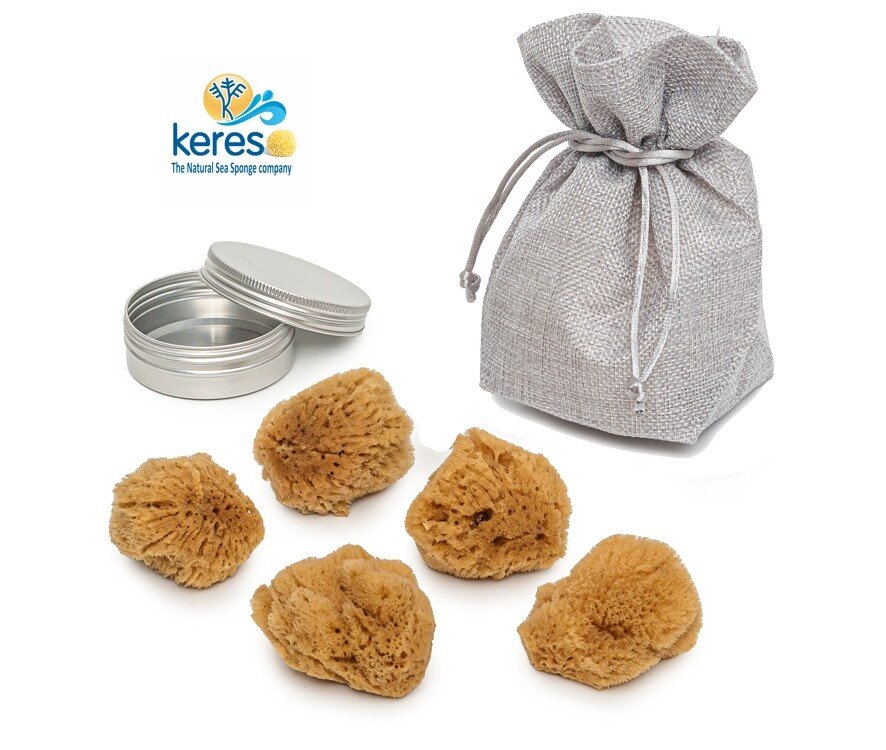
A natural sea sponge looks simple in the hand, but the object sold for bathing or cleaning began as part of a living marine animal. Sponges belong to the phylum Porifera, a very old animal lineage whose bodies are built around pores, canals, and chambers that move water continuously. That biological origin explains both the distinctive texture of a natural sea sponge and the care it needs once it becomes a reusable household product. The key distinction is easy to miss: the sponge on a reef and the sponge in a shower are not the same thing. A living sponge is an aquatic invertebrate that filters water for food and oxygen. A commercial bath sponge is the cleaned, processed supporting skeleton of selected species with a flexible network rich in spongin. By the time it reaches a bathroom, it is no longer alive, but its porous biological structure still determines how it absorbs water, dries, wears, and responds to cleaning. This guide brings those two sides together. It explains what sea sponges are in nature, how suitable species become bath sponges, what to look for when buying one, and how to clean, dry, store, and replace it without damaging the fibers. It also separates useful care advice from exaggerated claims that natural sponges are automatically sterile, antibacterial, or environmentally harmless.
Sea sponges in one minute: the essential facts
Sea sponges are animals, not plants. The NOAA — What Is a Sponge? overview currently describes about 8,550 living sponge species in the phylum Porifera and places them in four major classes: Demospongiae, Hexactinellida, Calcarea, and Homoscleromorpha. Most species live in marine environments, although some occur in freshwater and estuaries. Demosponges are by far the largest class and include the kinds of sponges from which traditional bath sponges are generally obtained. A sponge does not have a brain, heart, lungs, or digestive tract like familiar vertebrates. Instead, its body is organized around an aquiferous system: water enters through numerous small pores, flows through internal canals and chambers, and leaves through larger openings. As the Smithsonian — Sponge Feeding and Anatomy material explains, specialized cells and beating flagella help generate the current and capture suspended bacteria and organic particles. That constant movement of water is central to sponge feeding, respiration, waste removal, and ecological function. On reefs and other seafloor habitats, sponges are not just colorful scenery. By filtering water and processing dissolved and particulate material, they participate in nutrient cycling and can influence local water quality. Their bodies also add three-dimensional structure that creates microhabitats for other organisms. The familiar bath sponge therefore represents only one small human use of a much larger and ecologically important animal group.
Living sponge, bath sponge, and synthetic sponge are three different things
| Type | What it is | Typical characteristics | Main concern |
|---|---|---|---|
| Living sea sponge | An aquatic invertebrate animal | Filters water, grows attached to a substrate, has living cells and an internal canal system | Habitat protection and sustainable harvest |
| Natural bath sponge | The cleaned fibrous skeleton of selected sponge species | Irregular pores, compressible texture, high water absorption, natural variation | Hygiene, drying, fiber damage, sourcing |
| Synthetic sponge | A manufactured foam or polymer product | Uniform shape and pore structure, consistent texture, mass-produced | Material composition, durability, waste, hygiene |
This distinction also explains why not every sponge species can become a bath sponge. Many species have skeletons reinforced with microscopic mineral structures called spicules, made from silica or calcium carbonate. Commercial bath species are selected because their supporting structure can produce a soft, resilient fibrous skeleton after processing. The look and feel of natural products still vary because they are biological structures rather than identical pieces cut from factory foam.
How a sponge becomes a bath or cosmetic product
Commercial preparation removes the living tissue and cleans the remaining skeleton. The precise process varies by fishery, processor, species, and intended use, but it can include washing, squeezing, trimming, drying, grading, and repeated rinsing to remove tissue, sand, and debris. The final product expands and softens when wet because the network of fibers holds water throughout an irregular system of pores. Natural variation is therefore expected. Two sponges sold under the same commercial name may differ in color, pore size, density, shape, and softness. Those differences do not automatically indicate inferior quality. A useful product should feel flexible rather than brittle, have no sharp fragments, rinse cleanly, and suit the task for which it is being purchased.
For readers comparing common commercial shapes and grades, this visual example of What Are Sea Sponges shows how varied natural products can look after processing. Appearance, however, should never be the only buying criterion; texture, origin, preparation quality, and intended use matter more than a perfectly symmetrical shape.
Choosing the right natural sponge for the job
The best sponge for a bath is not necessarily the best sponge for facial cleansing, decorative painting, ceramics, or household work. Start by deciding how much softness, density, and surface texture you actually need. A large, springy sponge can be comfortable for body washing but clumsy around the face. A firmer or more open-textured sponge may be useful for craft work but unnecessarily abrasive on sensitive skin. For bathing and body cleansing. Choose a sponge that becomes soft and flexible after full saturation. Run your fingers over the wet surface and check for hard particles, stiff fragments, or edges that catch the skin. A dense structure tends to hold water and lather well, but an extremely thick sponge can take longer to dry, so the storage environment matters too.
For facial or delicate use. Fine-textured natural sponges are sometimes sold for the face, babies, and delicate skin, but “natural” is not a medical guarantee of gentleness. Anyone with active eczema, rosacea, inflamed acne, an open wound, a healing procedure site, or another condition that makes friction problematic should follow advice from a qualified clinician rather than assuming a sponge is suitable. Even on healthy skin, use light pressure; cleansing does not require aggressive mechanical exfoliation. For art, ceramics, and decorative finishing. Natural sponges are popular with painters and ceramic artists because their irregular pore pattern creates textures that are difficult to reproduce with a uniform synthetic foam. Keep craft sponges separate from personal-care products. Pigments, glazes, solvents, and cleaning chemicals used in art work make a sponge unsuitable for later skin contact.
A care routine that protects both the sponge and the user
The biggest practical problem with any reusable bathing sponge is moisture. After use, the sponge may contain water, soap, skin cells, oils, and other organic material. If it stays wet in a warm, poorly ventilated place, microorganisms have a better opportunity to multiply. Natural origin does not make a sponge self-sanitizing, so routine rinsing and drying are more important than dramatic “sterilization” tricks. After every use, rinse the sponge thoroughly under clean running water while gently compressing and releasing it. Continue until obvious soap residue is gone. Then press out excess water without forceful twisting and place or hang the sponge where air can circulate around it. Do not leave it sitting in a puddle, trapped in a closed soap dish, or sealed in plastic while damp.
Twisting and aggressive wringing can gradually break the internal fiber network. Heat can also shorten useful life. Boiling, microwaving, or routinely exposing a natural sponge to very hot conditions may change its texture and damage the organic structure. For periodic deeper cleaning, follow the instructions supplied for the particular product; concentrations and contact times vary between suppliers and materials. A practical manufacturer reference is How to Clean and Take Care of Sea Sponges. What about vinegar, hydrogen peroxide, or bleach?. Care guides sometimes recommend a diluted vinegar solution or a diluted hydrogen-peroxide treatment, but stronger is not automatically better. Acids and oxidizers can alter natural fibers, and product instructions may differ. Bleach can be especially harsh on organic material. If a seller provides a tested cleaning method for the specific sponge, use that method rather than improvising a concentrated chemical soak.
Travel and storage. A sponge should be fully dry before long-term storage. For travel, rinse it, press out as much water as practical, give it time to air-dry, and use a ventilated pouch rather than a sealed plastic bag if it still contains moisture. At home, an open rack outside the direct shower stream is usually better than a container that stays wet for hours.
Hygiene: the claims worth believing and the claims to ignore
Marketing language around natural sponges can become more confident than the evidence. Some sellers describe them as naturally antibacterial or self-cleaning. Certain marine sponges do produce biologically active compounds while alive, and sponge-associated microorganisms are an active area of research, but that does not mean a processed bath sponge cannot harbor microbes in a bathroom. A reusable wet product should still be cleaned, dried, and replaced when its condition declines. Do not share a personal bath sponge casually between household members. Sponges contact skin, collect cellular debris, and can touch tiny abrasions that are not visible. They should also be kept away from open cuts, active skin infections, fresh surgical wounds, and other areas where a nonsterile reusable object is inappropriate. There is no universal calendar date on which every natural sponge becomes unsafe. Replacement depends on use, care, drying conditions, and the physical quality of the product. What matters is whether you can still keep it clean and intact.
Replace the sponge when you notice:
a persistent unpleasant odor that returns after cleaning and drying;; visible mold or suspicious spotting;; a recurring slimy or tacky surface;; substantial tearing, crumbling, or fiber breakdown;; embedded debris that cannot be removed;; new skin irritation that appears to be associated with use.. By contrast, gradual color variation or a naturally uneven shape is not automatically a sign of contamination. Judge the product by cleanliness, odor, structural condition, and how it behaves when wet rather than expecting a natural material to remain visually identical over time.
Are natural sea sponges sustainable?
They can be renewable biological products, but sustainability depends on species, location, harvest pressure, method, regulation, disease, climate conditions, and how well the resource regenerates. “Natural” should not be treated as a synonym for “impact-free.” A sponge harvested from a poorly managed population can carry a different environmental cost from one produced under a regulated fishery or responsible aquaculture system. Current regulation in Florida illustrates why source matters. The Florida Fish and Wildlife Conservation Commission — Commercial Sponge Rules information shows that commercial sponge harvest is subject to species, license, gear, and minimum-size rules; it lists a five-inch minimum size across the top when wet for commercial sponges and notes additional rules on harvest methods and areas. These kinds of controls are intended to reduce damage and manage a biological resource rather than treating sponges as unlimited material.
In the Mediterranean, FAO/GFCM — Sustainable Aquaculture in the Mediterranean has also highlighted the Greek bathing sponge Spongia officinalis in work on restorative aquaculture. That does not mean every farmed or harvested sponge is automatically sustainable, but it shows why the future of the product is increasingly linked to traceable production, ecosystem management, and local fisheries knowledge rather than vague eco-friendly branding. When buying, ask where the sponge came from, whether the seller can identify the commercial type or species, and what harvest or cultivation practices are used. Longevity matters too: a durable product that is cared for well may need replacement less often than a cheap sponge that deteriorates quickly.
Natural sponge versus synthetic sponge: a practical choice, not a purity test
Natural and synthetic sponges solve similar problems in different ways. A natural sponge offers a highly irregular biological pore structure, a distinctive feel, and a material that is largely organic. Synthetic products offer predictable dimensions, engineered textures, broad availability, and sometimes lower upfront cost. Neither category is automatically cleaner; both can hold moisture and residue if used repeatedly without adequate rinsing and drying. The environmental comparison is also more complicated than “ocean sponge good, plastic sponge bad.” A full assessment includes harvesting or manufacturing, transport, packaging, lifespan, cleaning requirements, and disposal. Natural origin is a meaningful characteristic, but responsible sourcing and long service life are what turn that characteristic into a stronger environmental case.
A simple buying and care checklist
| Stage | What to check | Why it matters |
|---|---|---|
| Before buying | Origin, intended use, softness when wet, clean smell, no sharp debris | Reduces the chance of buying an unsuitable or poorly processed product |
| Before first use | Rinse thoroughly, saturate fully, inspect the surface | Removes loose debris and reveals the true wet texture |
| After each use | Rinse, gently compress, air-dry | Limits residue and prolonged dampness |
| Periodic care | Use the supplier-approved deeper-cleaning method | Avoids unnecessary fiber damage from harsh improvisation |
| Replacement | Watch for odor, mold, slime, breakdown, or irritation | Condition is more useful than an arbitrary replacement date |
If you remember only one care rule, make it this: a sea sponge should spend far more of its non-use time drying in moving air than sitting wet in a shower. Good drying improves the experience, reduces odor, and helps preserve the fiber network.
Conclusion
Sea sponges are remarkable because the everyday bath product preserves the architecture of a living animal whose entire biology revolves around moving water. In nature, sponges filter, process nutrients, and occupy important reef and seafloor habitats. In the home, selected species provide a soft, absorbent fibrous structure that can be reused for bathing, cosmetics, art, and cleaning. The most important ownership habits are straightforward: buy a product appropriate to the task, rinse it well, squeeze rather than wring, dry it with airflow, avoid unproven high-heat or harsh-chemical “sterilization,” and replace it when it can no longer be kept clean. For environmental claims, look beyond the word “natural” and pay attention to traceable origin and harvest or cultivation practices.