
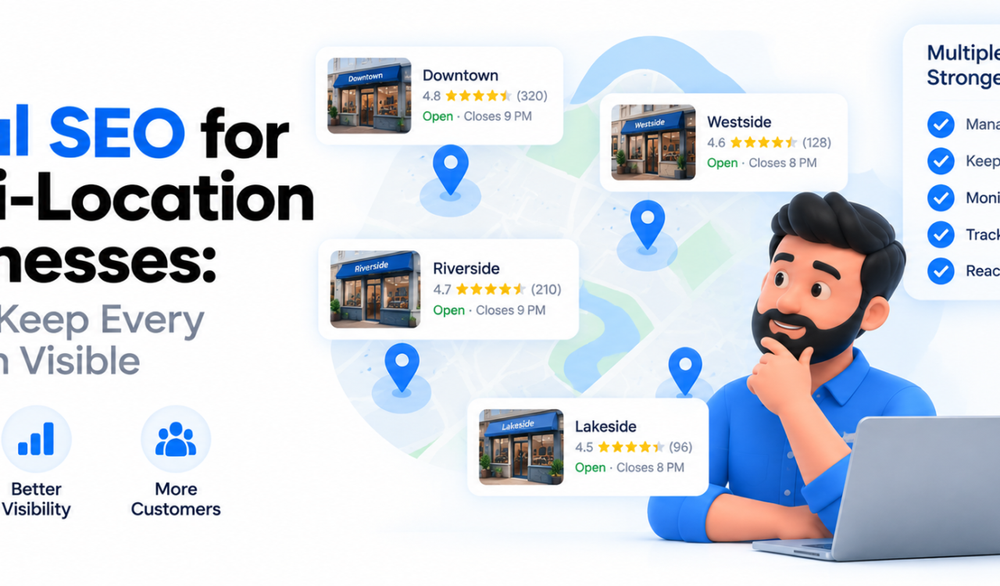
Managing multiple locations is not just about creating more profiles. It is about making sure customers can find accurate information about the right location.
As a business expands, its local search presence becomes more difficult to manage. Each location may have different hours, services, customer feedback, and local competitors. A profile that is accurate at one location may be outdated at another. Local SEO for multi-location businesses requires a consistent approach to managing location information while still making each branch relevant to its customers.
Why Multi-Location Businesses Need a Different Approach
A business with one location can often manage its Google Business Profile with a relatively simple routine. A business with several locations has to maintain that same quality across every branch.
Customers searching for a business near them want to know:
Which location is closest?
Is it open?
Does it offer the service they need?
Can they call or visit?
What do other customers say about that location?
Google’s guidance recommends maintaining accurate business information and consistent names and categories across eligible locations. At the same time, each location needs its own relevant details so customers can identify the right branch.
1. Treating Every Location as If It Were the Same
One of the most common mistakes is copying the same information across every location without checking whether it is accurate.
For example, a business may have different opening hours, phone numbers, services, or local contact details at each branch.
A consistent brand identity is useful, but customers also need location-specific information.
What to check:
Business name
Address
Phone number
Opening hours
Website or location page
Services offered
Photos and other relevant details
The goal is to maintain a consistent brand while ensuring that each location reflects its actual business information.
2. Creating Duplicate Profiles Instead of Managing Existing Locations
When a business expands, it may be tempting to create additional profiles for different services or variations of the same location.
However, Google’s guidelines state that there should generally be one Business Profile per business location, and duplicate profiles can create problems with how information appears on Google Maps and Search.
Before creating a new profile, businesses should check whether an existing profile already represents that location.
If a new location is genuinely eligible, it should be managed as its own business location rather than as a duplicate of another branch.
3. Using the Same Local Information for Every Branch
A multi-location business may have a central website and a shared brand name, but customers still need information about the specific location they are considering.
For example, a customer searching for a service in one city may want to know:
The exact address of the nearby branch
The phone number for that location
The services available there
The correct opening hours
How to contact that branch
Google recommends providing a phone number or website that represents the individual business location.
This is why businesses should avoid relying only on a generic contact page when a location-specific page would be more useful.
4. Ignoring Reviews at Individual Locations
A business may have a strong overall reputation, but customers often evaluate the specific location they plan to visit.
A review about one branch may mention a different experience from another branch. If those reviews are not monitored separately, important feedback can be missed.
For example, one location may receive praise for fast service while another receives repeated complaints about waiting times.
Managing reviews at the location level helps businesses understand what customers are experiencing at each branch.
It also makes it easier to identify recurring concerns that may need attention.
5. Focusing Only on the Main City or Headquarters
A business may have a strong presence in its main city but struggle to appear relevant in searches for other locations.
This can happen when the business relies too heavily on its headquarters information and does not provide enough useful information about its other branches.
Each eligible location should have accurate details that help customers understand where it is and what it offers.
For example, a business with locations in different cities should make it easy for customers to find the correct branch rather than forcing them to search through a generic website.
6. Not Tracking Performance by Location
A multi-location business should not rely only on one overall performance report.
Different branches may have different levels of visibility, customer engagement, and review activity.
Google provides Business Profile performance insights such as searches, calls, and other customer actions. These insights can help businesses understand how customers discover and interact with their profiles.
Tracking performance by location can help identify:
Which branches receive the most calls
Which locations receive more website visits
Which profiles need updated information
Which locations have growing review activity
Which branches may need additional attention
The goal is to understand what is happening at each location, not just the business as a whole.
7. Managing Locations Without a Consistent Process
As the number of locations grows, managing everything manually can become difficult.
A business may need to update information, monitor reviews, respond to customers, and review performance across several branches.
Google provides location groups and other management tools to help businesses organize multiple locations and manage access more efficiently.
A consistent process can help businesses avoid missed updates and make it easier for teams to work together.
For businesses that want to organize these activities more consistently, a Local SEO platform can help bring location management, review monitoring, and performance insights into one workflow.
How to Keep Every Location Visible
The best way to manage multiple locations is to create a repeatable process that works across the business.
Start with these steps:
Review each location’s information regularly.
Keep business names and categories consistent where appropriate.
Make sure each location has accurate contact details.
Monitor reviews separately for each branch.
Track performance by location.
Use a consistent process for updates and review management.
Review customer feedback to identify areas for improvement.
These steps can help businesses maintain a more reliable local search presence as they expand.
Key takeaway: Managing multiple locations is not just about keeping profiles active. It is about making sure every branch has accurate information, relevant customer feedback, and a consistent process that helps customers find and choose the right location.
Final Thoughts
Multi-location businesses face a different challenge from single-location businesses. The goal is not simply to create more profiles, but to maintain the quality and accuracy of each location’s information.
By keeping business details consistent, monitoring reviews, and tracking performance by branch, businesses can build a more reliable local search presence.
For businesses that want to organize these activities more efficiently, a Local SEO platform can help bring location management, review monitoring, and performance insights together.
The goal is simple: make every location easy to find, easy to understand, and easy for customers to choose.