
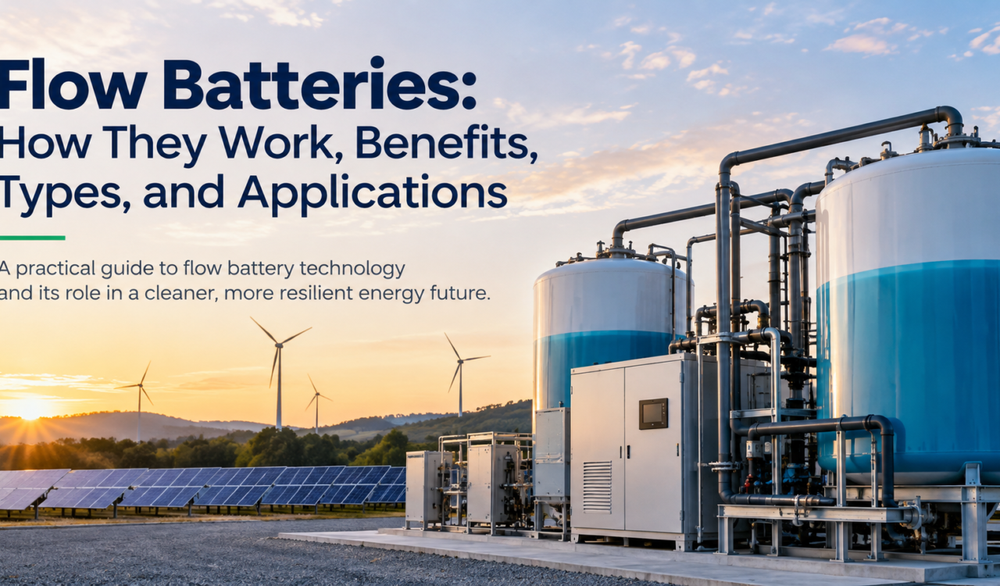
As renewable energy adoption grows, businesses and grid operators need storage systems that can shift electricity over longer periods and handle frequent charge-discharge cycles. Flow batteries offer one approach by storing energy in liquid electrolytes and separating energy capacity from power capacity.
Unlike conventional battery systems, flow batteries store their active materials in external electrolyte tanks and circulate the liquids through an electrochemical cell to charge or discharge the system. This design gives flow batteries particular advantages for applications that require long discharge durations and frequent cycling.
This article explains how flow batteries work, the main types of flow battery technology, their benefits and limitations, and where they are used. It also compares flow batteries with lithium-ion batteries to help identify which technology fits different energy storage applications.
What Is a Flow Battery?
A flow battery is a rechargeable energy storage system that stores energy in liquid electrolytes. Unlike conventional batteries, which keep the active materials inside the battery cells, flow batteries store the electrolytes in external tanks and circulate them through an electrochemical cell when the system charges or discharges.
During charging, the system uses electricity to change the chemical state of the electrolytes and store energy. During discharge, the electrolytes pass through the electrochemical cell and generate electricity.
A key feature of flow battery technology is that it separates power capacity from energy capacity. The electrochemical cell stacks determine the system’s power output, while the amount of electrolyte determines how much energy the system can store. Operators can therefore increase energy capacity by increasing the electrolyte volume and tank size.
This design makes flow batteries well suited to long-duration energy storage and applications that require frequent cycling. However, the right flow battery depends on the required storage duration, operating profile, space, efficiency, and project economics.
How Does a Flow Battery Work?
A flow battery stores energy in liquid electrolytes and uses an electrochemical cell to convert chemical energy into electricity. Pumps circulate the electrolytes from external tanks through the cell during charging and discharging.
During charging, the system uses electricity to change the chemical state of the electrolytes. The electrolytes then store that energy until the system needs to discharge.
During discharging, the electrolytes flow through the electrochemical cell and undergo a reverse reaction that generates electricity. The system sends the electricity through a power conversion system for use by a facility or the grid.
The system separates power capacity from energy capacity. The size and number of cell stacks determine the system’s power output, while the volume of electrolyte determines its energy capacity. This design allows operators to increase storage capacity by adding electrolyte and tank volume without proportionally increasing the cell-stack capacity.
A typical flow battery therefore includes four key elements:
Electrolyte tanks: Store the liquid electrolytes.
Pumps and circulation system: Move the electrolytes through the electrochemical cell.
Electrochemical cell or stack: Converts electrical and chemical energy during charging and discharging.
Control and power-conversion equipment: Manages system operation and connects the battery to the electrical system.
This architecture makes flow batteries particularly suitable for applications that require long-duration storage and frequent cycling, although the right technology depends on the project’s power, duration, efficiency, space, and economic requirements.
What Are the Main Types of Flow Batteries?
Flow batteries use different electrolyte chemistries, and each type offers different performance characteristics and suitable applications. The main types include vanadium redox flow batteries, zinc-bromine flow batteries, and iron-based flow batteries.
Vanadium Redox Flow Batteries
Vanadium redox flow batteries (VRFBs) use vanadium-based electrolytes on both sides of the electrochemical cell. The same element on both sides helps reduce cross-contamination between electrolytes and supports long cycle life.
VRFBs can independently scale power and energy capacity, making them well suited to long-duration applications, renewable energy integration, and frequent cycling.
Zinc-Bromine Flow Batteries
Zinc-bromine flow batteries use zinc and bromine-based electrolytes. They can provide relatively high energy density compared with some other flow battery chemistries and can support longer-duration energy storage.
These systems can suit applications that need stationary energy storage, renewable energy integration, and flexible discharge durations.
Iron-Based Flow Batteries
Iron-based flow batteries use iron-containing electrolytes to store and release energy. Developers have explored this chemistry as an alternative for stationary storage because iron offers wide availability and relatively low material cost.
Iron-based systems may suit long-duration and grid scale storage applications, although their commercial maturity and performance depend on the specific chemistry and system design.
The best flow battery chemistry depends on the project’s required duration, power and energy capacity, cycling profile, site conditions, efficiency, and overall economics.
What Are the Benefits of Flow Batteries?
Flow batteries offer several characteristics that make them suitable for stationary energy storage, particularly when a project requires long discharge durations or frequent cycling.
Long-duration storage: Flow batteries can store energy for extended periods by increasing electrolyte volume and tank capacity. This makes them suitable for applications that need several hours of discharge or longer.
Independent power and energy scaling: Operators can size the cell stacks for the required power output and the electrolyte tanks for the required energy capacity. This flexibility can help optimize system design for different storage durations.
High cycle capability: Flow batteries can support frequent charge and discharge cycles with relatively low capacity degradation when operators manage the system within its specified operating conditions.
Low fire risk for many chemistries: Many aqueous flow batteries use water-based electrolytes that do not present the same thermal-runaway risk associated with some lithium-ion battery chemistries. However, safety depends on the specific chemistry and system design.
Long service life: Flow battery systems can support long operating lives, particularly in applications that require regular cycling. Actual service life depends on the chemistry, operating conditions, and system maintenance.
Flexible renewable energy integration: Flow batteries can store surplus electricity from solar or wind generation and release it when renewable output falls or electricity demand increases.
These benefits make flow batteries a strong option for stationary energy storage, but they do not make the technology suitable for every project. Footprint, efficiency, capital cost, and application requirements still need careful evaluation.
What Are the Limitations of Flow Batteries?
Flow batteries offer strong advantages for long duration storage, but they also have limitations that businesses and grid operators should consider before selecting the technology.
Larger physical footprint: Flow batteries need electrolyte tanks, pumps, and supporting equipment in addition to the electrochemical cell stacks. This can require more installation space than a lithium-ion system with similar energy capacity.
Lower energy density: Flow batteries generally store less energy per unit of volume than lithium-ion batteries. Projects with limited space may therefore need to evaluate the site requirements carefully.
Higher system complexity: Pumps, pipes, sensors, tanks, and control equipment add mechanical and electrical components that require proper operation and maintenance.
Lower round-trip efficiency in some systems: Flow battery efficiency varies by chemistry and system design and can be lower than that of some lithium-ion systems. This can affect operating economics when the project frequently charges and discharges.
Higher upfront costs for some projects: The total installed cost depends on chemistry, system duration, equipment, installation, and project scale. Flow batteries can become more competitive as storage duration increases, but they do not automatically provide the lowest cost for every application.
These limitations do not rule out flow batteries. Instead, they show why storage duration, available space, cycling requirements, efficiency, and total project economics should guide technology selection.
Where Are Flow Batteries Used?
Flow batteries mainly serve stationary energy storage applications, including grid scale energy storage, where operators need long-duration storage, frequent cycling, or flexible energy capacity. Common applications include:
Renewable energy storage: Flow batteries can store excess electricity from solar and wind generation and release it when renewable output decreases or demand increases.
Grid-scale energy storage: Utilities can use flow batteries to shift energy, support grid reliability, and manage periods of high electricity demand.
Commercial and industrial facilities: Businesses can use flow batteries to manage energy consumption, reduce peak demand, and support on-site renewable generation.
Microgrids: Flow batteries can store energy from renewable sources and provide longer-duration support when the main grid is unavailable or when local generation cannot meet demand.
Remote and off-grid sites: Flow batteries can help store renewable electricity and reduce reliance on conventional backup generation where fuel delivery or grid access presents challenges.
Flow batteries make the most sense when a project values long-duration discharge, frequent cycling, and flexible energy capacity. For applications that need high energy density or very fast response in a compact footprint, other battery technologies may offer a better fit.
How Do Flow Batteries Compare With Lithium-Ion Batteries?
Flow batteries and lithium-ion batteries can both support renewable energy integration, peak demand management, and grid-scale storage, but their designs suit different operating requirements.
Factor | Flow Batteries | Lithium-Ion Batteries |
Energy storage | Electrolytes in external tanks | Active materials inside battery cells |
Power and energy scaling | Can scale independently | More closely linked |
Long-duration applications | Well suited | Suitable, depending on system design |
Energy density | Generally lower | Generally higher |
Cycle requirements | Well suited to frequent cycling | Strong cycle performance, depending on chemistry |
Footprint | Typically larger | Typically more compact |
Response time | Suitable for grid and stationary applications | Very fast response |
Common use | Long-duration stationary storage | Short- to medium-duration and high-power applications |
The choice depends on the application rather than one technology being universally better. Flow batteries can offer advantages when a project needs long duration energy storage, frequent cycling, and flexible energy capacity. Lithium-ion batteries can provide advantages when the project prioritizes compact installation, high energy density, and fast response.
For commercial, industrial, and grid projects, operators should compare duration, power requirements, available space, efficiency, cycling profile, safety requirements, and total cost of ownership before selecting a battery technology.
How Long Do Flow Batteries Last?
Flow batteries can support a long operating life because the electrolyte stores energy outside the electrochemical cell. This design can reduce the impact of repeated charge and discharge cycles on the energy-storage medium.
The actual service life depends on the flow battery chemistry, electrolyte condition, operating temperature, cycling profile, depth of discharge, and maintenance. Operators should therefore evaluate the manufacturer’s expected cycle life and degradation characteristics rather than assume a fixed lifespan for every flow battery system.
Flow batteries can also support frequent cycling without requiring the same type of routine capacity replacement associated with some conventional battery systems. In some chemistries, operators can maintain or restore electrolyte performance through appropriate maintenance or electrolyte management.
For a project evaluation, consider cycle life, calendar life, expected degradation, electrolyte management, warranty terms, and total lifetime operating costs together. These factors provide a more useful measure of flow battery longevity than a single years-of-service figure.
How Do You Choose the Right Flow Battery?
Selecting a flow battery starts with the application requirements, not the battery chemistry alone. A system that works well for grid-scale renewable storage may not suit a commercial facility with limited space or a different load profile.
Consider these factors before choosing a system:
Required storage duration: Determine how long the system must deliver electricity during each discharge cycle.
Power and energy requirements: Define the required power output and total energy capacity separately.
Cycling frequency: Estimate how often the system will charge and discharge because frequent cycling can influence technology selection and operating costs.
Available space: Account for electrolyte tanks, cell stacks, pumps, power-conversion equipment, and safety systems when assessing the site.
Battery chemistry: Compare available chemistries based on performance, operating requirements, safety, and application suitability.
Efficiency: Evaluate round-trip efficiency against the project’s expected operating pattern and electricity costs.
Lifecycle economics: Compare capital cost, operating and maintenance costs, expected service life, degradation, and replacement requirements.
Safety and environmental requirements: Review the electrolyte characteristics, containment, site conditions, and applicable safety requirements.
A good flow battery selection should match the system’s power, energy capacity, duration, cycling profile, site constraints, and lifetime economics to the application’s actual needs.
Further Read: Energy Storage Systems: Types, Applications, and How to Choose the Right Technology
What Is the Future of Flow Battery Technology?
Flow battery technology continues to develop as energy systems require more long-duration and flexible energy storage. Its ability to separate power capacity from energy capacity gives the technology a useful role in applications where operators need longer discharge periods and frequent cycling.
Future development will focus on improving energy density, efficiency, system costs, electrolyte performance, and overall system design. These improvements could help flow batteries compete across a wider range of stationary storage applications.
As solar and wind generation expand, flow batteries can also support renewable energy by storing excess electricity and delivering it when generation falls or demand increases. Their potential role will depend on project economics, technology maturity, site requirements, and the storage needs of each application.
Flow batteries are therefore likely to remain one option within a broader energy-storage market, alongside lithium-ion batteries and other long-duration storage technologies.
Conclusion
Flow batteries provide a flexible option for long-duration stationary energy storage, particularly for applications that require extended discharge periods, frequent cycling, and independent scaling of power and energy capacity.
Their main strengths include flexible system sizing, long cycle capability, and suitability for renewable energy integration. However, factors such as footprint, efficiency, system complexity, upfront cost, and project requirements can affect their suitability compared with other storage technologies.
Businesses, utilities, and project developers should therefore evaluate flow batteries based on the specific storage duration, power requirements, operating profile, site conditions, safety requirements, and lifetime economics rather than choosing a technology based on a single performance characteristic.
Sources
U.S. Department of Energy (DOE) – Flow Batteries
Use this for the technology fundamentals, how flow batteries work, and their role in energy storage.
U.S. Department of Energy – Flow BatteriesNational Renewable Energy Laboratory (NREL) – Energy Storage
Useful for supporting claims around stationary storage, renewable integration, system characteristics, and energy-storage applications.
NREL – Energy StorageInternational Renewable Energy Agency (IRENA) – Electricity Storage and Renewables
Good supporting source for flow batteries in renewable-energy and long-duration storage applications.
IRENA – Electricity Storage and Renewables