
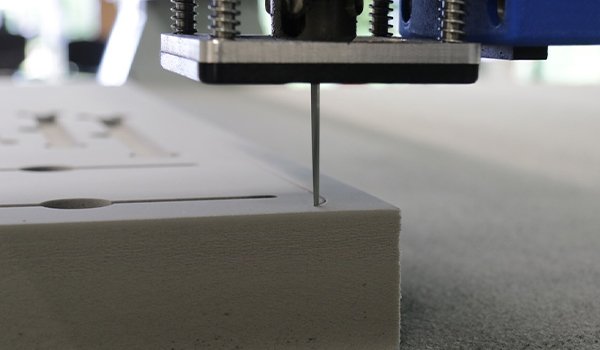
There is no single best machine for cutting every type of soft or flexible foam because “foam” covers materials with very different chemistry and mechanical behavior. Flexible polyurethane upholstery foam compresses and rebounds under a blade, polyethylene and EVA can be denser and more elastic, nitrile/PVC foams behave differently again, and rigid EPS or XPS can be cut by thermal methods that may be unsuitable for flexible polyurethane. The correct process therefore starts with identifying the exact material, thickness, density, geometry, production volume, and required edge finish. For many industrial flexible-foam applications, oscillating-knife CNC equipment offers an excellent balance of repeatability, complex contour capability, and mechanical cutting without deliberately melting the material. Band knives remain highly efficient for straight cuts through blocks and slabs, die cutting is economical for large quantities of flat repeated parts, and manual or electric knives are sensible for one-off cushions and prototypes. Thermal methods such as hot wire should be treated as material-specific processes, not as a universal foam solution.
Why Flexible Foam Is Harder to Cut Than It Looks
Soft foam moves away from the cutting force. A blade can compress the material before it cuts, which causes the finished dimension to change after the foam rebounds. Long blades can deflect, tight curves can tear, porous foam can be difficult to hold with vacuum, and very soft material can distort under rulers or clamps. This is why a workshop that cuts wood accurately does not automatically have the right setup for foam. The finish requirement also matters. Upholstery may tolerate a slightly textured edge hidden inside fabric, while a presentation packaging insert may need a visually clean contour, and a gasket may require repeatable dimensions and controlled compression. Define what “clean cut” means before selecting equipment. Identify the Foam Chemistry Before Choosing Heat or Blades. Flexible polyurethane, EVA, polyethylene, polypropylene, nitrile rubber foam, latex, EPS, and XPS do not respond the same way to heat. The current UK Health and Safety Executive guidance on cellular plastics warns that hot-wire processing of flexible polyurethane can create fire risk and can produce toxic fumes and flammable vapours if temperature becomes excessive. That is consistent with the existing OSHA: Fire Hazard of Polyurethane and Other Organic Foam guidance, which treats organic foams as combustible materials requiring controlled handling. Never decide “hot wire or laser” from the word foam alone. Review the supplier’s Safety Data Sheet, ask whether thermal cutting is approved for that grade, and verify ventilation and fire-control requirements before heating it. Manual Knives Are Best for One-Off Work. A sharp utility knife, long foam knife, serrated specialty blade, or electric carving knife can be surprisingly effective for upholstery and repair work. The equipment cost is low, setup is immediate, and a skilled person can produce clean cushions and simple contours without programming. An electric carving knife is particularly useful because reciprocating blades reduce the force required to push through soft polyurethane. The limitations are repeatability and labor. Thick foam can cause the blade to wander, curves vary from one operator to another, and measuring becomes difficult if the material is compressed. Manual tools make sense for prototypes and low volume, not for a factory that needs hundreds of identical components.
Band Knives Excel at Straight Cutting and Block Conversion
Foam band knives use a continuous narrow blade and are common in upholstery, mattress, and packaging production. They can cut thick blocks quickly and create straight, square edges with relatively little compression when the machine is set correctly. Vertical machines are useful for trimming blocks and blanks, while horizontal splitters are designed to slice large buns into sheets of consistent thickness. Band knives are less suited to complex internal cutouts or constantly changing digital shapes. They also require serious guarding, operator training, housekeeping, and blade maintenance. Foam is soft; the moving blade is not. Oscillating-Knife CNC Is the Most Versatile Digital Option. An oscillating knife moves rapidly up and down while the CNC system guides the blade along programmed geometry. Because the tool cuts mechanically rather than by melting, it works well with many flexible foams and can create repeated curves, pockets, packaging shapes, automotive components, gaskets, and upholstery profiles. CAD files can be changed quickly, which makes the process attractive for short runs and mass customization. Accuracy still depends on the material. Extremely soft foam can move or compress, and long blades can deflect through deep sections. Machine calibration, feed rate, blade length, oscillation settings, material support, and hold-down all influence the finished part. A first-article cut should be measured after the foam has relaxed rather than while it is still compressed on the table. Vacuum Hold-Down Is Helpful but Not Magic. Many digital cutters use vacuum tables to keep sheets flat. Dense closed-cell materials can seal against the bed well, while porous open-cell upholstery foam leaks air and may receive much less holding force. Shops compensate with masking film, carrier sheets, zoned vacuum, mechanical stops, low-pressure clamps, or nesting strategies that leave enough material connected until cutting is nearly complete. The goal is to hold the foam without crushing it. A clamp that distorts the material can create an accurate machine path but an inaccurate finished dimension once the pressure is removed.
Tangential Knives Improve Direction Control
A tangential knife rotates actively so the cutting edge follows the direction of travel. This can improve corners and reduce dragging in dense flexible sheets. Some systems combine tangential steering with oscillation, giving the machine better control through thicker EVA, rubber foam, gasket materials, or layered products. Tool choice should be based on the smallest required radius, material thickness, density, and acceptable edge. A narrow blade can turn tightly but may be less stable through a deep block; a stronger long blade may hold depth better but cannot create the same small internal corner. Die Cutting Is Hard to Beat for High-Volume Flat Parts. Steel-rule dies can cut repeated foam shapes extremely quickly. Once the die is made, cycle time is short and the per-part cost can be low, which makes the process common for pads, packaging components, seals, and gaskets. The tradeoff is tooling cost and inflexibility. A design change can require a new die, and deep three-dimensional shapes are not the natural strength of the process. For a stable product made in tens of thousands of units, die cutting may be more economical than a CNC knife. For frequently changing designs or short production runs, digital cutting usually provides greater flexibility. Abrasive-Wire Cutting Is Different From Hot Wire. Abrasive-wire systems cut mechanically with a moving abrasive wire rather than melting the foam. They can be useful for large blocks, profiles, insulation shapes, and selected composite cores. Because the mechanism is mechanical, the main process concerns are dust, wire wear, tension, speed, and edge texture rather than thermal decomposition. This distinction matters because the words “wire cutter” can mislead buyers into assuming every wire process uses heat. When comparing machines, ask whether the wire is abrasive, smooth and fast-moving, or electrically heated.
Hot Wire Belongs Mainly to Approved Thermoplastic Foams
Hot-wire systems are widely used for EPS and XPS because the heated wire melts a narrow path through the thermoplastic material. That can create clean architectural profiles, packaging shapes, and insulation components without blade force. It does not mean hot wire is appropriate for upholstery polyurethane. Current HSE guidance specifically treats hot-wire cutting of flexible PU as a controlled fire and fume risk and recommends trained setup, ventilation, fire protection, and prevention of overheating. The existing NIOSH: Isocyanates and Thermal Decomposition material is also relevant to heated polyurethane processes. The safest rule is to use thermal cutting only when the material manufacturer and equipment process support it. Laser Cutting Requires the Same Material-Specific Caution. Laser cutters are programmable and fast, but they heat the polymer intensely at the cut line. Depending on the foam, this can cause melting, charring, flame, smoke, shrinkage, and hazardous decomposition products. Some chlorine-containing or otherwise unsuitable materials should never be placed in a laser cutter. Unknown foam should be treated as unsuitable until its composition and laser compatibility are confirmed. A laser can be excellent for approved thin foams where a sealed edge is acceptable, but it should never be selected simply because the machine is already available in the workshop. CNC Routing Is Better for Rigid or Dense Foam. Rotary cutters work very well on rigid tooling board and many dense foams because the material resists the tool. Very soft foam tends to lift, wrap, tear, or distort as the rotating cutter pulls at it. Routing can still be successful with dense semi-rigid foam when suitable tooling, feed rates, and fixturing are used, but it is rarely the first choice for soft upholstery material. The decision should be made from trial parts. If the foam moves, tears, or leaves fuzzy edges at reasonable settings, a knife-based process is likely to be more appropriate.
Waterjet Works for Some Dense Foams and Elastomers
Waterjet cuts without a heat-affected zone, which is attractive for some gasket and rubber-foam applications. The process can produce complex shapes without a physical blade, but open-cell foam may absorb water and deform, and high-pressure cutting can require specialized support. For absorbent upholstery foam, introducing water may create more problems than it solves. Waterjet is therefore a niche choice rather than a universal flexible-foam method. It is most useful when the material tolerates water and the part needs a cold, programmable cut. Choose the Method From the Application
ApplicationOften suitable method
One-off upholstery cushionElectric carving knife or long foam knife
Large straight blocks and slabsVertical or horizontal band knife
Complex flexible-foam profilesOscillating or tangential CNC knife
High-volume flat pads or gasketsSteel-rule die cutting
Approved EPS/XPS profilesHot wire with ventilation and fire controls
Rigid tooling foamCNC routing
Selected dense gasket materialsKnife, die, or waterjet depending on specification
Material Density and Firmness Change the Result. Density and firmness are related but not identical. Two foams can have similar density yet very different compression behavior. Very soft open-cell foam may collapse under a guide, while dense closed-cell foam can resist the blade and require slower feed or a stronger tool. Thickness also matters: a long blade passing through 150 millimeters of foam can wander even if the same tool is extremely accurate on a 20-millimeter sheet. Test the actual production material rather than a sample that merely “looks similar.” Different formulations, skin surfaces, laminations, adhesives, or fire-retardant additives can change cutting behavior and safety requirements. Measure Parts After the Foam Relaxes. Because flexible foam compresses, inspection methods should be defined. If the operator presses a ruler into the surface, the apparent dimension can change. Let the part recover after cutting, measure without excessive compression, and agree on tolerance and measurement condition with the customer before production. For cushions and seals, dimensional accuracy may be less important than compression behavior and fit. For packaging nests, pocket geometry and product retention may matter more than an isolated millimeter measurement.
Nesting Can Save More Money Than Cutting Speed
Digital cutting software can arrange parts closely on a sheet or block to reduce scrap. A machine that cuts 10% slower but improves material utilization can be cheaper overall when foam is expensive. Nesting also lets the shop group several orders on one sheet and change designs without new tooling. Evaluate total part cost, including material yield, programming, labor, blades, maintenance, dust or fume control, and scrap disposal. Machine speed alone is a poor purchasing metric. Housekeeping and Fire Control Are Production Requirements. Mechanical cutting can create dust and offcuts that accumulate inside guards and around sharpening equipment. HSE guidance warns that sparks from blade-sharpening equipment can ignite foam dust and recommends regular cleaning and appropriate extraction. Thermal cutting adds further risk because overheated foam can generate flammable vapours and toxic fumes. Professional shops should provide suitable extraction, fire extinguishers, guarding, training, and maintenance. Aerosol lubricants and other flammable products should be stored and used according to their safety instructions. Outsourcing Can Be Cheaper Than Owning Specialized Equipment. A company that needs occasional complex foam shapes may be better served by a specialist rather than buying a CNC cutter, vacuum system, extraction equipment, and software. The original article referenced https://www.wecutfoam.com; any supplier should be evaluated on its experience with the exact foam chemistry, thickness capability, tolerance, edge finish, sample quality, lead time, and production controls. Provide the supplier with more than a drawing. Include foam type, density, thickness, quantity, intended use, acceptable edge, tolerance, and whether the material will be laminated or compressed in service. Better specifications produce better quotes and fewer surprises.
Run a Trial Before Committing to Production
- Identify the exact foam and obtain its safety data.
- Define thickness, density, geometry, tolerance, and edge requirements.
- Select two or three plausible cutting methods.
- Produce representative sample parts, including difficult curves and deep cuts.
- Measure parts after recovery.
- Inspect edge quality and material damage.
- Record speed, scrap, dust, fumes, and operator effort.
- Calculate total part cost rather than only machine time.
Conclusion
The best method for cutting soft and flexible foam depends on the material and the production goal. Manual and electric knives are practical for one-off upholstery work, band knives are excellent for fast straight cutting, die cutting is efficient for stable high-volume flat parts, and oscillating-knife CNC systems are usually the most versatile option for complex repeatable flexible-foam profiles. Hot wire and laser should never be treated as universal solutions because heating some foams—especially polyurethane—can create hazardous fumes and fire risk. Identify the foam chemistry first, test the real material, control movement and safety, and choose the process that produces the required part consistently at the lowest total cost.