
In a busy kitchen, sharp knives aren’t a luxury—they’re how you keep prep moving, maintain consistent cuts, and reduce fatigue across a long service. The challenge is that the best results usually require time, technique, and the right tools. Choosing the right knife sharpeners setup means balancing speed, consistency, staff skill levels, and the kinds of knives your team actually uses.
If you’re building a reliable sharpening workflow (and not just “fixing dull knives when someone complains”), it helps to start with a system that can scale. Many kitchens standardize around one approach and then add a few accessories for quick touch-ups. You can explore professional-grade guided options at Hapstone USA and use the framework below to match a sharpening method to your kitchen’s pace and reality.
What makes sharpening hard in a busy kitchen
Most kitchens don’t struggle because they lack sharpening gear—they struggle because sharpening competes with prep, service, cleaning, and staffing constraints. The “right” system is the one your team will actually use correctly and consistently.
Common pain points include:
Time pressure: No one wants to spend 20–40 minutes restoring an edge during a rush.
Multiple users: Different grip, cutting style, and habits cause edges to degrade unevenly.
Mixed knife quality: House knives, personal knives, and specialty blades may have different steels and bevel angles.
Inconsistent technique: A great whetstone setup fails if only one person knows how to use it.
Safety and sanitation: Sharpening creates metal swarf; the process must be controlled and clean.
Define your kitchen profile before buying anything
Before comparing knife sharpeners, answer four practical questions. This determines the right category immediately:
How many knives do you maintain weekly
A small café may maintain 6–12 knives. A high-volume hotel or commissary may manage 30–100+.Who will do the sharpening
One trained person (chef, prep lead), or many staff members rotating?What level of sharpness do you need
Basic prep sharpness (efficient and safe) or high performance (fine slicing, plating work)?Are you maintaining or repairing
Maintenance means regular touch-ups. Repair means chips, bent tips, abused edges, or frequent angle resets.
Your answers determine whether you need a fast maintenance tool, a precise sharpening system, or a hybrid.
The main sharpening options and how they fit kitchen reality
1) Honing rods as a daily habit not a sharpening solution
Honing rods (steel, ceramic) don’t truly sharpen by removing much metal. They realign a rolled edge and keep a working knife feeling sharper for longer.
Best use in busy kitchens
Pre-service and mid-prep touch-ups
Maintaining a stable “working edge” between real sharpening sessions
Limitations
If the knife is actually dull, honing won’t bring it back.
Used aggressively, rods can damage delicate edges or create uneven micro-bevels.
Verdict
Honing is essential—but only as part of a system that includes true sharpening.
2) Pull-through sharpeners for speed but with trade-offs
Manual pull-through devices are popular because they’re quick and require minimal skill. But many remove steel aggressively and can leave a rough edge, especially on thinner or harder knives.
Best use
Low-stakes house knives where convenience matters more than edge refinement
Emergency “get it cutting again” moments (ideally not during service)
Limitations
Can shorten knife life by removing too much material
Inconsistent angles, especially on varied blade shapes
Not ideal for premium Japanese knives or thin grinds
Verdict
Good for a basic house-knife program, not ideal if you care about performance or longevity.
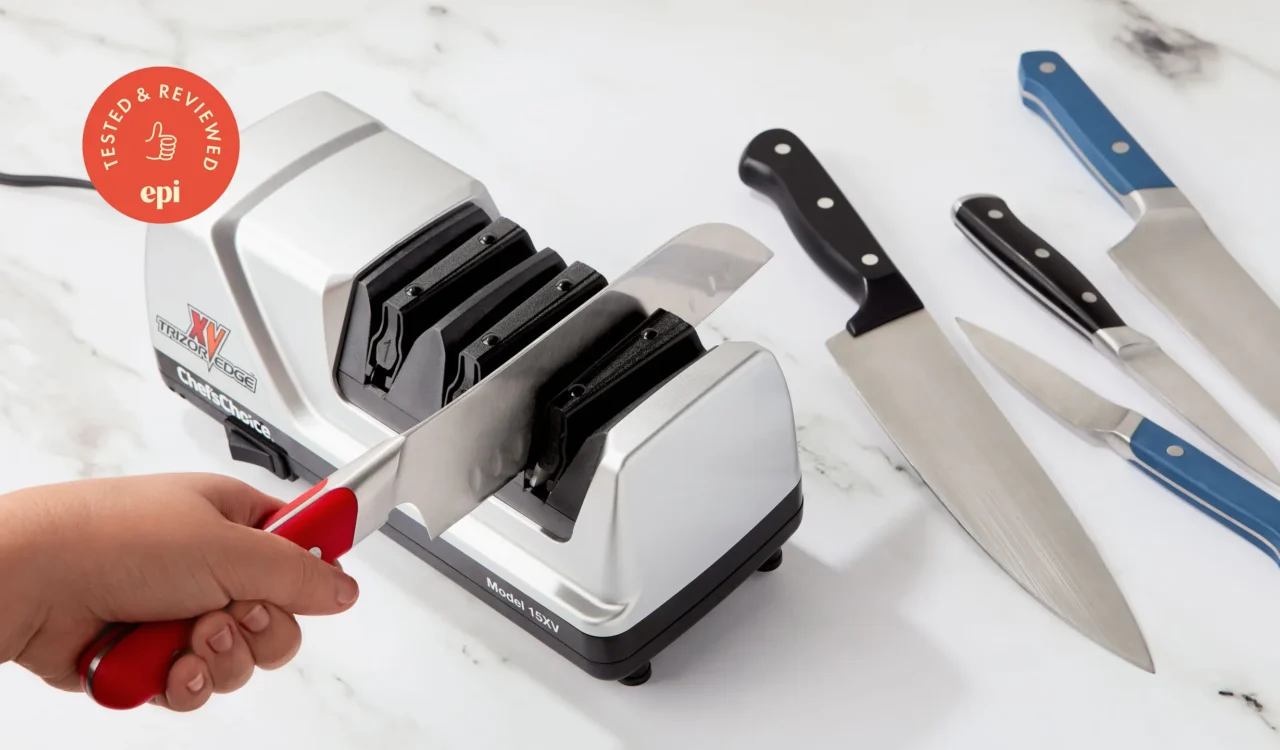
3) Electric countertop sharpeners fast and consistent but not universal
Electric sharpeners can be a strong choice for busy kitchens because they’re repeatable and fast. The key is picking one that matches your knives and using it correctly.
Best use
High throughput environments with standardized knife types
Teams needing consistent results without deep training
Limitations
Some models are too aggressive or set fixed angles that don’t match your knives
Not great for specialized single-bevel knives or very hard, thin edges
Requires attention to cleaning and safe setup area
Verdict
A practical “kitchen standardization” solution when paired with good habits and a plan.
4) Whetstones highest potential but training dependent
Whetstones can deliver excellent edges and are inexpensive long-term. In a busy kitchen, though, the outcome depends on whether you can train staff and protect the process from shortcuts.
Best use
Kitchens where one or two people “own” sharpening
Teams that value edge quality and knife longevity
Limitations
Steeper learning curve
Requires flattening and maintenance
Hard to standardize across many staff members
Verdict
Excellent if you can commit to training and accountability.
5) Guided sharpening systems the repeatability sweet spot
Guided systems stabilize the knife and control the sharpening angle with a clamped or supported setup. For many professional environments, this is the sweet spot between whetstone quality and operational consistency.
Best use
One trained sharpener (chef/prep lead) maintaining knives weekly
Kitchens with harder steels or premium knives that deserve careful treatment
Standardizing angles across a fleet of knives
Limitations
Slower than electric for quick fixes
Requires a dedicated station and some setup time
Still needs training, but less than freehand stones
Verdict
One of the best “professional consistency” paths when you want quality and repeatability.
6) Outsourcing to a sharpening service scalable but variable
A professional service can keep knives sharp with minimal internal labor. Many busy kitchens love this approach—until inconsistent results, delays, or damaged knives become an issue.
Best use
High-volume operations that prefer predictable scheduling
Kitchens without staff capacity for sharpening
Limitations
Quality varies by provider
Turnaround time can disrupt workflow
You still need a touch-up option in-house
Verdict
Great when you find a reliable provider; still pair with a basic in-house maintenance plan.
The best approach for most busy kitchens a hybrid system
Most kitchens do best with a simple, repeatable hybrid:
Daily maintenance: honing rod (or ceramic rod) + occasional strop
Weekly sharpening: one accountable person uses a controlled method (guided system or stones)
Monthly or quarterly reset: deeper sharpening or service visit depending on wear and abuse
This spreads the workload and prevents knives from reaching “disaster dull,” which is when sharpening becomes time-consuming.
How to choose the right system a decision framework
Step 1 Pick your sharpening owner model
Centralized model: One person responsible for all sharpening
Best for guided systems or whetstones.Distributed model: Many staff members sharpen as needed
Best for electric sharpeners or standardized pull-through (with clear rules).
If you can centralize responsibility, you usually get better edges and longer knife life.
Step 2 Match the system to your knife mix and steel types
Busy kitchens often have:
Softer stainless house knives (easy to sharpen, roll sooner)
Harder personal knives (hold edges longer, may chip if abused)
Specialty blades (slicers, boning, offset serrated, etc.)
If your knife mix includes harder steels or premium knives, choose knife sharpeners that allow controlled angles and gentle progression (guided systems or stones). If nearly everything is basic stainless and treated roughly, speed and repeatability may matter more (electric).
Step 3 Prioritize angle consistency over “mirror polish”
In kitchens, a slightly toothy edge often performs better on food textures than an ultra-polished edge. Choose a system that reliably hits the same angle and produces a clean apex.
Angle consistency matters because:
It improves edge life
It reduces frequent heavy sharpening
It makes touch-ups faster and predictable
Step 4 Consider workflow and station design
Your sharpening plan should include:
A fixed location (not on a crowded prep counter)
A cleaning routine for metal residue
Safe storage for stones, rods, and accessories
Clear “who/when” rules so sharpening doesn’t happen during peak chaos
Even the best knife sharpeners fail if the workflow is inconvenient or messy.
Step 5 Evaluate total cost not just purchase price
Look beyond the price tag:
How much steel does the method remove over time
How many minutes per week it takes
How often knives need replacement
Training time and consistency risk
Often, a slightly more controlled system pays for itself by extending knife life and cutting prep friction.
Recommended setups by kitchen type
High-volume line kitchen with mixed staff experience
Electric sharpener for standardized maintenance
Ceramic honing rods at stations with quick training
A monthly deeper sharpening routine (in-house or service)
Goal: keep everything safely sharp with minimal skill requirement.
Chef-driven kitchen with premium knives
Guided system or whetstones owned by one trained person
Light stropping for finishing
Clear rules: no pull-through devices on personal knives
Goal: protect knife quality and deliver consistent high performance.
Catering commissary or prep-heavy operation
Centralized sharpening owner
Guided system for repeatability and documentation
Coarse-to-medium progression for efficiency, fine finish only when needed
Goal: maintain many knives with predictable results and minimal downtime.
Practical implementation tips so the system actually works
Create a simple schedule: “Touch-up daily, sharpen weekly, reset monthly.” Put it on a clipboard.
Standardize angles by knife category: chef knife, petty/utility, heavier prep knives.
Track problem knives: if one house knife dulls constantly, it may be damaged, too soft, or used incorrectly.
Train the team on what not to do: glass boards, scraping edges sideways, tossing knives in sinks.
Keep a “sharpness test” consistent: paper slice, tomato skin test, or a simple visual inspection of reflection along the edge.
Bottom line
For busy kitchens, choosing knife sharpeners is less about chasing the “best edge” and more about building a system that produces reliable sharpness with minimal disruption. If many people need to sharpen, prioritize speed and repeatability. If one person can own sharpening, prioritize control and consistency with a guided system or stones. Either way, the winning move is a hybrid: quick daily maintenance plus scheduled real sharpening—so dull knives never pile up and service never suffers.